|
GEC PABX
No. 4 (PB4200)
Private
Telephone System
The PABX No. 4 allows for:-
-
Automatic
connection between extensions using dial or pushbutton telephones.
- Attractive
cordless floor-mounting switchboard.
- Dialled
access to public exchange for all or selected extensions by dialling '9'.
- Public
exchange trunk routes may be barred to PABX extensions in STD areas.
- Access
to public exchange via switchboard for all extensions by dialling '0'.
- Incoming
calls from public exchange signalled on switchboard.
- Trunk-offering
available.
- Call-back
and automatic-transfer facilities on public exchange calls and inter-switchboard
calls.
- Night-service
working when operator is not on duty.
- Virtually
unlimited expansion, as required, by the addition of further equipment.
- Executive
right-of-way for selected extensions.
FULL
INTERCOMMUNICATION
Any
extension user is connected to any other extension by dialling the appropriate
number. The exchange can have a 3 digit, mixed 3 and 4 digit or a 4 digit
numbering scheme depending on the total number of extensions fitted.
OUTGOING
CALLS
Direct
access to the public exchange is obtained by dialling '9'. If the public
exchange is automatic, the caller then dials the required number; if the
exchange is manual, the call is completed by the public exchange operator.
Selected extensions may be barred from this facility, if desired, by a simple
alteration to the strapping in the automatic exchange equipment. Similarly, calls can be dialled to other private exchanges over inter-switchboard
lines by dialling either one or two routing digits prior to dialling the
requisite extension number on the distant exchange.
Alternatively,
calls to the public exchange or inter-switchboard calls can be made via the
switchboard by dialling '0'. The operator answers the call and asks for
the required number. The caller can then restore his handset while the
operator sets up the required connection using a keysender. As soon as the
wanted party answers, the operator keysends the local extension number requiring
the call. Until the extension answers, appropriate supervisory signals are
provided for the benefit of the operator who may re-enter the circuit if
necessary. When the extension does answer, communication is established
directly between the exchange line subscriber and the extension independent of
the switchboard. if all '0' level lines are engaged, busy tone is heard by the
caller.
An
extension speaking on an external call can recall the operator by pressing the
pushbutton on the telephone and dialling '0'.
CALL
WAITING INDICATION
Three
switchboard lamps are provided to indicate that calls are waiting for the
operator. These are labelled calls waiting, busy, and congestion. A
typical method of operation is for the calls waiting lamp to light if two or
more calls are waiting, the busy lamp to light if six or more calls are waiting
and the congestion lamp to light if twelve or more calls are waiting. The
number of calls waiting at each stage before the respective lamps light can be
varied to suit the requirements of individual customer demands.
INCOMING
CALLS
An
incoming call from the public exchange is signalled at the switchboard and is
answered by the operator, who extends the caller to the wanted extension by
keying the appropriate number. When the extension answers, the switchboard
connect circuit is automatically released without any further action by the
operator. The extension can later recall the operator by pressing the
pushbutton on the telephone and dialling '0'.
CALL-BACK
AND AUTOMATIC TRANSFER
An
extension engaged on a call over an exchange or inter-switchboard line may hold
the call (by pressing a pushbutton on the telephone), while he calls another
extension. At the end of his conversation with the second extension, he
can resume his original conversation by pressing the pushbutton again.
Alternatively, he may transfer the call to the other extension merely by
replacing his handset.
If
an extension calls a second extension using the recall facility and receives no
reply, or the wanted extension is engaged, he can recall the operator by
pressing the pushbutton twice in succession and dialling '0'.
An
extension that has received a call by the transfer facility can further transfer
it to another extension. The number of times a call can be transferred is
unlimited.
CONTINUOUS
RING CALL GUARD
If
an extension calls another extension for the purpose of transferring an external
call and receives no reply, or, conversely, the wanted extension is engaged at
that time, any attempt made to evade the responsibility of further dealings with
the call by replacing the extension instrument handset results in the telephone
instrument receiving continuous ringing current. Ringing continues
unabated until communication has been re-established with the original calling
party.
The
provision of this safeguard ensures that virtually no calls can be 'lost'
through negligence or design and that call-back and automatic transfer can only
be effected after the desired party has answered his or her telephone.
RELEASE
At
the end of all extension-to-extension calls the switch train is released by the
first party to replace the handset, except when the caller is an executive.
On executive and operator calls, release is provided. If an extension line
becomes looped, either through a fault or because a handset replaced correctly,
a line throw-off facility becomes effective and releases the switch train for
use by other callers.
NIGHT
SERVICE
Night
service is provided by arranging that incoming calls to the switchboard (either
exchange or inter-switchboard) ring bells at selected locations. The call
can be answered at any extension by dialling '8'. The call can then be
automatically transferred to the wanted extension as described under call-back
and automatic transfer. This is the standard arrangement provided for
night-service working. Alternative arrangements can be supplied; these are
described below.
RINGING
AND TONES
Ringing
current and service tones, e.g., dial, ringing, busy, and number unobtainable,
are generated by a battery driven ring and tone machine. Two machines are
provided and in the event of failure of one, a standby is brought into service
automatically.
ALARMS
Any
faults arising that adversely affect the operation of the exchange give rise to
audible and visible alarms on the automatic equipment and/or at the switchboard.
An alarm signal is caused by any of the following conditions.
Blown
fuse.
Selector
failing to restore to normal.
Ringing
supply failure.
Failure
of mains supply to the charging equipment.
Permanent
loop on an extension line.
EXECUTIVE
RIGHT-OF-WAY
By
means of this facility, the calls of certain executives are given priority, so
that they can get through to a wanted extension even when that extension is
already engaged. When the executive hears busy tone, he dials a further
digit '1'. This causes intrusion tone to be connected to the conversing
extensions indicating that an executive is waiting. When the conversing
parties replace their handsets the required extension is automatically rung and
connected to the waiting executive.
Additional
Features
The
PABX4 allows several additional features to be provided either at the time of
installation, or at a later date.
AUTO/MANUAL
EXTENSIONS (PRIORITY ANSWERING)
An
extension can be connected directly to the operator's switchboard for priority
assistance. When the handset is lifted a call signal is given at the
switchboard. The operator answers, establishes the connection, then rings
back the caller. These extensions can be called direct from automatic
extensions and can dial their own calls without the assistance of the operator
by pressing the enquiry pushbutton before lifting the handset.
GROUP
HUNTING FINAL SELECTORS
Special
final selectors can be fitted to serve certain numerical groups allowing the
selector to hunt over from two to ten lines in the group in the event of the
first line being engaged. A caller can thus be connected to a free line in
the group without the inconvenience of having to dial other numbers.
CONFERENCE
LINES
These
enable a conference to take place by telephone while the participants remain at
their desks.
STAFF
LOCATION
Members
of staff absent from their offices can be called by a system of lamps or bells.
A special locating number is dialled from any telephone followed by digits in a
personal code.
ALTERNATIVE
NIGHT SERVICE ARRANGEMENTS
Two other forms of night service can be provided as alternatives to that
described earlier:-
- Selected extensions can be connected to individual exchange lines to answer
incoming calls. Should the extension be engaged on an internal call, an
audible signal is given to indicate that an exchange call is waiting.
- All incoming exchange fine and inter-switchboard line traffic can be routed to
selected extensions and extended to the wanted extension by the call-back and
automatic transfer.
ROUTE
RESTRICTION
In
STD areas facilities can be provided to bar certain public exchange codes to
selected extensions, and to give local metering of main exchange calls at the
PABX. If required, local meters can also be fitted at those individual
extensions accorded appropriate access facilities.
PUSHBUTTON
TELEPHONES
Any
of the dial telephones can be replaced with pushbutton (keyphone) instruments.
One
of the main features of the GEC PABX4 is versatility. Exchanges of
virtually any size and providing a wide range of facilities can be built up from
standard racks to suit almost any application. If you would like to know
more about GEC's PABX4 system, or details of a system designed to your
particular requirements, please advise how many public-exchange,
inter-switchboard, extension lines, and the range of facilities you require.

Equipment
The
PABX will work to public automatic or CB manual exchanges. If the public
exchange is of the magneto or CBS type, an auxiliary circuit is supplied to
effect the necessary signalling.
The
automatic switching apparatus is mounted on single-sided open racks thus
providing easy access to the equipment for maintenance. The racks are 2286
mm (7 ft 6 in) high and 1370 mm (4 ft 6 in) wide, except for the combined
MA/ringer rack which is 838 mm (2 ft 9 in) wide. A main distribution frame
is provided to facilitate connections between the extensions, exchange lines,
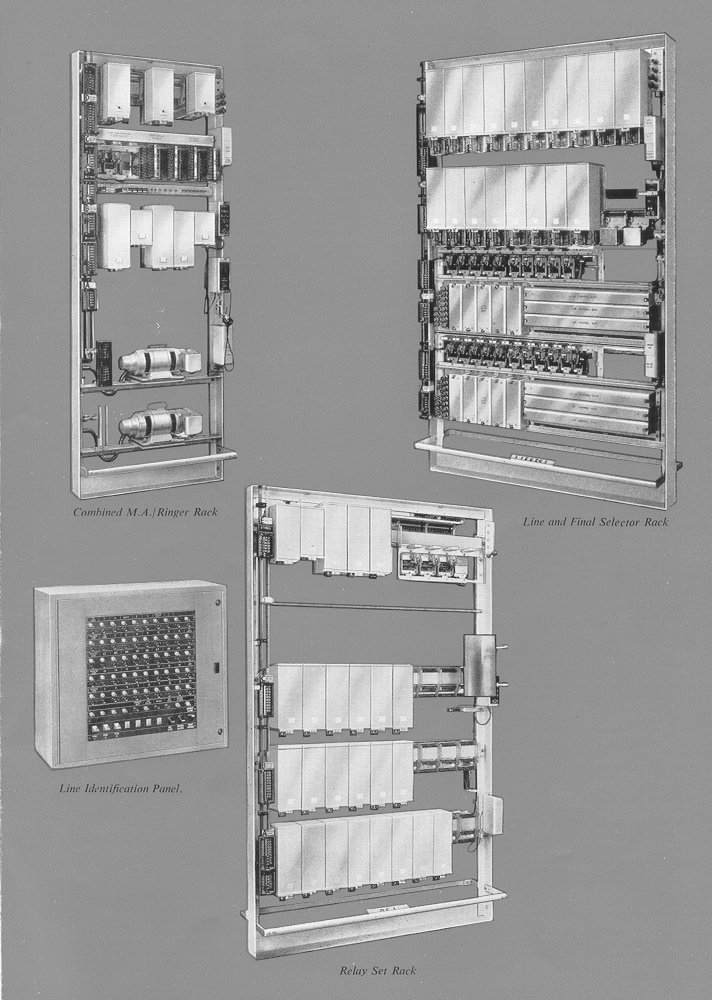
and inter-switchboard lines, and the exchange. The system comprises five
different racks: line and final selector rack; group selector rack; relay set
rack; operator's connect rack; and MA/ringer rack.
Easily
removable metal covers protect the relays against dust and damage. All
apparatus is the same as that used in many large public exchanges throughout the
world, and includes the GEC SE50 two-motion selector. Throughout, the
exchange and apparatus are designed to give ease of maintenance.
The
line and final selector rack accommodates the equipment for one hundred line
circuits, linefinders and allotters for these hundred extensions, and twenty
final selectors.
The
group selector rack accommodates sixty group selectors and the relayset rack
twenty relaysets for exchange or inter-switchboard lines together with the relay
sets for call-back and automatic-transfer service.
The
operator's connect rack carries the relays and other apparatus associated with
the operator's position as well as the keysender equipment.
The
ringing machines, associated control relay sets, alarms and '0' level relay sets
and other miscellaneous apparatus are situated on the combined MA/ringer rack.
The
switchboard is floor mounting and has been designed to ensure straightforward
and speedy operation. All connections are established by key operation and
keysending. Calling and supervisory lamps are associated with each key.
The system can be easily extended to incorporate more operators by adding
further positions as the overall capacity increases. Positions need not be
"en suite" as there is no multiple between them. Access to cable
terminations is from the front or rear thus enabling switchboards to be located
against a wall if required. Each position is 1016 mm (3 ft 4 in) high, 660
mm (2 ft 2 in) deep, and 1054 mm (3 ft 5 in) wide.
The
switchboard fascia panel is hinged so that it can be easily swung forward to
allow access to the wiring at the back of the keys and lamps. The desk front
allows plenty of space for writing and compartments are provided below for
telephone directories or other references. A lightweight headset is
provided for each operator; the position is inoperative until the plug on the
operator's headset has been correctly inserted. Thus, any person
interfering with the keys when an operator is not present would not affect calls
being set up on adjacent positions if the safeguard is correctly used.

Console shown close-up
The
number of external routes on a standard switchboard is 30 divided between
extension, public exchange, and inter-switchboard lines.
The
Line identification panel is normally situated alongside the switchboard, and
may be either table or wall mounted. It ensures the operator is made aware
of any alarm indications from the automatic equipment and also serves to
identify, and remove from service, any exchange line or inter-switchboard line
that is considered unserviceable for any reason.
The exchange operates on a 50v DC power supply. This is in the form of a lead-acid battery floating across the terminals
of a constant-potential rectifier unit operating from the AC mains supply.
When the mains supply is DC, a motor-generator or
rotary transformer converts the mains supply to the required voltage. With this arrangement, a charge/discharge system must be used.
This ensures that the battery connected to the mains is isolated from the
exchange.
Recommended telephones include the GEC746, GEC741,
GEC740, and LST4D rotary-dial instruments, and also the GEC 'keyphone' series of
pushbutton telephones.
All telephones are fitted with a pushbutton to provide
call-back and automatic-transfer facilities.
Line wires can be any insulated twin conductor,
suitably protected if exposed to risk of damp or mechanical damage, may be used
to connect the telephones to the exchange provided the line-loop resistance does
not exceed 600 ohms. This can be
extended to 1000 ohms by the addition of auxiliary equipment. A third wire must be connected from each telephone to a nearby earth
(ground) point. If there is no
convenient earth point, the third wire must be run to the exchange
DISTRIBUTION AND PROTECTION
The simplest method of connecting the extension
instruments to the PABX is to use separate line wires for each telephone. A saving in line wire and space, with a gain in neatness, may often be
achieved by running a multi-core cable from the main distribution frame to a
distribution box so situated that only short lengths of wire are required to
connect each telephone instrument to the distribution box.
The exchange equipment must be protected against high
voltages and heavy currents, which may be accidentally introduced into external
fines, e.g. due to lightning. All
lines to the public exchange and all external inter-switchboard lines and
external extension lines must be connected to protection apparatus before being
connected to the private exchange equipment. The protection equipment is mounted on the main distribution frame.
All the exchange lines and external lines terminate on one side of the
frame; cables from the private exchange terminate on the other side. The two sides can be cross connected as desired by flexible connections.
Changes in the allocation of extension numbers, and line
testing facilities, are simplified by the use of a distribution frame.
On receipt of a dimensioned sketch of the premises,
with indication of the location of each telephone, the most economical
distribution scheme is planned, and quotations for materials submitted.
1972
GEC
GEC
Telecommunications article
PABX 4 Satellite
G.E.C.
CORDLESS PRIVATE AUTOMATIC BRANCH
EXCHANGE
The G.E.C. cordless P.A.B.X. is suitable for any size of installation and can
employ either a 3-digit, mixed 3 and 4-digit or 4-digit extension numbering
scheme. One extension calls another by dialling the appropriate number. An
extension obtains direct access to the public exchange by dialling ' 9'. This
direct access is given to selected extensions and withheld, if desired, from
others. All extensions can gain access to the public exchange, via the P.A.B.X.
operator, by dialling '0'. In areas provided with subscriber trunk dialling
facilities, selected extensions who have direct access to the local public
exchange can be barred from dialling their own trunk calls. Direct access is
provided to inter-switchboard lines (tie lines) by dialling the appropriate
routing digits.
An incoming call from the public exchange is signalled on the manual console,
and extended to the wanted party by the operator. Incoming calls over the
inter-switchboard lines can be either routed to the console operator or direct
to the automatic equipment, as required. When more than one exchange is
connected to the cordless P.A.B.X. over inter-switchboard lines, the P.A.B.X.
can be used as a tandem exchange to allow connexion between extensions on all
the other exchanges. When a call, either outgoing or incoming, is established by
the operator, the console circuits are only engaged during the setting up of the
call and then released for use by other calls. Facilities are provided to enable
the conversing parties to recall the operator when required.
The P.A.B.X. will work to public automatic or C.B. manual exchanges. If the
public exchange is of the magneto or C.B.S. type, an auxiliary circuit is
supplied to effect the necessary signalling.
PRINCIPAL FEATURES
- Automatic connexion between extensions. Attractive cordless
floor-mounting manual console.
- Dialled access to public exchange by all or selected extensions.
- Public exchange trunk routes may be barred to P.A.B.X. extensions in
S.T.D. areas.
- Access to public exchange via manual console by all extensions.
- Incoming calls from public exchange signalled on manual console.
- Trunk-offering facility available at manual console.
- Call-back and automatic transfer facilities on public exchange calls and
inter-switchboard calls.
- Night-service working when operator is not on duty.
- Easily extended, as required, by the addition of further equipment.
- Executive right-of-way for selected extensions.
STANDARD FEATURES
FULL INTERCOMMUNICATION
Any extension user is connected to any other extension by dialling the
appropriate number. The exchange can have a 3-digit, mixed 3 and 4-digit or a
4-digit numbering scheme depending on the total number of extensions fitted.
OUTGOING CALLS
Direct access to the public exchange is obtained by dialling a single digit,
usually `9'. If the public exchange is automatic, the caller then dials the
number of the required subscriber ; if the exchange is manual, the call is
completed by the public exchange operator. Selected extensions may be barred
from this facility, if desired, by a simple alteration to the strapping in the
automatic exchange equipment. Similarly, calls can be dialled to other private
exchanges over inter-switchboard lines by dialling either one or two routing
digits to gain access to these lines prior to dialling the requisite extension
number on the distant exchange.
Alternatively, calls to the public exchange or inter-switchboard calls can be
made via the manual console, direct access to which is obtained by dialling a
single digit, usually `0'. The operator answers the call and asks for the
required number. The caller can then restore his handset while the operator sets
up the required connexion using the position keysender. As soon as the wanted
party answers, the console operator keysends the local extension number
requiring the call. Until the extension answers, appropriate supervisory signals
are provided at the console for the benefit of the operator who may re-enter the
circuit if necessary. When the extension does answer, communication is
established directly between the exchange line subscriber and the extension
independent of the console. All extensions may obtain calls to the public
exchange via the operator. If all `0' level lines are engaged, busy tone is
heard by the caller.
An extension speaking on an external call can recall the operator by pressing
the pushbutton on the telephone and dialling '0'.
CALL WAITING INDICATION
Three lamps are provided on the console to indicate that calls are waiting
for the operator. These are labelled "Calls Waiting", "Busy" and "Congestion". A
typical method of operation is for the "calls waiting" lamp to light if two or
more calls are waiting, the "busy" lamp to light if six or more calls are
waiting and the "congestion" lamp to light if twelve or more calls are waiting.
The number of calls waiting at each stage before the respective lamps light can
be varied to suit the requirements of individual customer demands.
INCOMING CALLS
An incoming call from the public exchange is signalled on the manual console and
is answered by the operator, who extends the caller to the wanted extension by
keying the appropriate number. When the extension answers, the console connect
circuit is automatically released without any further action by the operator.
The extension can later recall the operator by pressing the pushbutton on the
telephone and dialling '0'.
Should the wanted extension be engaged, if the connexion is left through, the
telephone will be automatically rung as soon as the handset is replaced. This is
known as the "Ring-When-Free" facility. Alternatively, the operator may use the
trunk-offering facility to inform the extension that a call is waiting. When the
operator breaks into an established connexion in this way, operator intrusion
tone is given to tell the conversing extensions that a third party is on the
line.
Incoming calls from inter-switchboard lines can be arranged either for direct
connexion to the automatic equipment or for answering by the operator. Tandem
connexions over the inter-switchboard lines can be arranged.
CALL-BACK AND AUTOMATIC TRANSFER
An extension engaged on a call over an exchange or inter-switchboard line
may hold the call (by depressing a pushbutton on the telephone), while he calls
another extension. At the end of his conversation with the second extension, he
can resume his original conversation by depressing the pushbutton again.
Alternatively, if he wishes, he may transfer the call to the other extension
merely by replacing his handset.
If an extension calls a second extension using the recall facility and
receives no reply, or the wanted extension is engaged, he can recall the
operator by depressing the pushbutton twice in succession and dialling '0'.
An extension that has received a call by the transfer facility can further
transfer it to another extension. The number of times a call can be transferred
is unlimited.
CONTINUOUS RING CALL GUARD
If an extension calls another extension for the purpose of transferring an
external call and receives no reply, or, conversely, the wanted extension is
engaged at that time, any attempt made to evade the responsibility of further
dealings with the call by replacing the extension instrument handset results in
the telephone instrument receiving continuous ringing current. Ringing continues
unabated until communication has been re-established with the original calling
party.
The provision of this safeguard ensures that virtually no calls can be "lost"
through negligence or design and that call-back and automatic transfer can only
be effected after the desired party has answered his or her telephone.
RELEASE
At the end of all extension-to-extension calls the switch train is released
by the first party to replace the handset, except when the caller is an
executive. On executive and operator calls, calling party release is provided.
If an extension line becomes permanently looped, either through a fault or
because a handset has not been replaced correctly, a line throw-off facility
becomes effective and releases the switch train for use by other callers.
NIGHT SERVICE
Night service is provided by arranging that incoming calls to the console
(either exchange or inter-switchboard) ring bells at selected locations. The
call can be answered at any extension by dialling '8'. The call can then be
automatically transferred to the wanted extension as described under "Call-back
and Automatic Transfer". This is the standard arrangement provided for
night-service working. Alternative arrangements can be supplied; these are
described under "Additional Facilities".
RINGING AND TONES
Ringing current and service tones, i.e. dial, ringing, busy, N.U. and
warning tones are generated by a battery driven ring and tone machine. Two
machines are provided and in the event of failure of one, a standby is brought
into service automatically.
ALARMS
Any faults arising that adversely affect the operation of the exchange give
rise to audible and visible alarms on the automatic equipment and/or at the
console. An alarm signal is caused by any of the following conditions:-
- Blown fuse.
- Selector failing to restore to normal. Ringing supply failure.
- Failure of mains supply to the charging equipment.
- Permanent loop on an extension line.
EXECUTIVE RIGHT-OF-WAY
By means of this facility, the calls of certain executives are given
priority, so that they can get through to a wanted extension even when that
extension is already engaged. When the executive hears busy tone he dials a
further digit '1'. This causes intrusion tone to be connected to the conversing
extensions indicating that an executive is waiting. When the conversing parties
replace their handsets the required extension is automatically rung and
connected to the waiting executive.
EQUIPMENT
AUTOMATIC RACKS
The automatic switching apparatus is mounted on single-sided open racks thus
providing easy access to the equipment for maintenance. The racks are 7' 6" high
(225 cms) and 4' 6" wide, (137 cms) except the combined M.A./ringer rack, which
is 7' 6" high and 2' 9" wide (84 cms). The cordless console has an attractive
appearance, stands on the floor, and has been specially designed to ensure
straightforward and speedy operation. The size of each position is 3' 4" (102
cms) x 2' 2" (66 cms) x 3' 5" (106 cms). A main distribution frame is provided
to facilitate connexions between the extensions, exchange lines, and
inter-switchboard lines, and the exchange. The system comprises five different
racks:-
- Line and Final Selector Rack.
- Group Selector Rack.
- Relay Set Rack.
- Operators Connect Rack.
- Combined M.A./Ringer Rack.
Easily removable metal covers protect the relays against dust and damage. All
apparatus is the same as that standardised for large public exchanges in many
parts of the world, and includes the G.E.C. SE50 two-motion selector.
Throughout, the exchange and apparatus are designed to give ease of maintenance.
The Line and Final Selector Rack accommodates the equipment for one hundred
line circuits, linefinders and allotters for these hundred extensions and twenty
final selectors.
The Group Selector Rack accommodates sixty group selectors and the Relay Set
Rack twenty relay sets for exchange or inter-switchboard lines together with the
relay sets for call-back and automatic transfer service.
The Operator's Connect Rack carries the relays and other apparatus associated
with the operator's position as well as the keysender equipment.
The ringing machines, associated control relay sets, alarms and '0' level
relay sets and other miscellaneous apparatus are situated on the Combined
M.A./Ringer Rack.
MANUAL CONSOLE
The console-type switchboard is floor mounting. All connexions are
established by key operation and keysending. Calling and supervisory lamps are
associated with each key. The system can be easily extended to incorporate more
operators by adding further positions as the overall capacity increases.
Positions need not be en suite as there is no multiple between them. Access to
cable terminations is from the front or rear thus enabling consoles to be
located against a wall if required.
The console facia panel is hinged so that it can be easily swung forward to
allow access to the wiring at the back of the keys and lamps. The desk front
allows plenty of space for writing and compartments are provided below for
telephone directories or other references. A lightweight headset is provided for
each operator. The position is inoperative until the plug on the operator's
headset has been correctly inserted. Thus, any person interfering with the keys
when an operator is not present would not affect calls being set up on adjacent
positions if the safeguard is correctly used.
The number of external routes on a standard console is thirty. These are
divided between the P.A.B.X., public exchange and inter-switchboard lines.
LINE IDENTIFICATION PANEL
This panel is normally situated adjacent to the manual console, and may be
either table or wall mounted. It ensures the operator is made aware of any alarm
indications from the automatic equipment and also serves to identify and remove
from service any exchange line or inter-switchboard line that is considered
unserviceable for any reason.
POWER SUPPLY
The exchange operates on a 50-volt D.C. power supply. This is in the form of
a lead-acid battery floating across the terminals of a constant potential
rectifier unit operating from the A.C. mains supply.
When the mains supply is D.C. a motor-generator or rotary transformer
converts the mains supply to the required voltage. With this arrangement, a
charge/ discharge system must be used. This ensures that the battery connected
to the main is isolated from the exchange.
TELEPHONE INSTRUMENT
Any automatic telephone having a dial pulse speed of between 7 and 14 pulses
per second, with a ratio of 2 to 1 break to make is suitable for use with this
exchange. Recommended telephones are the "G.E.C. 706" telephone and the "G.E.C.
711" telephone described in G.E.C. leaflet Nos. STLI6 and STL18. All telephones
are fitted with a pushbutton to provide call-back and automatic transfer
facilities.
LINE WIRES
Any insulated twin conductor, suitably protected if exposed to risk of damp
or mechanical damage, may be used to connect the telephones to the exchange
provided the line loop resistance does not exceed 600 ohms. This can be extended
to 1,000 ohms by the addition of auxiliary equipment. A third wire must be
connected from each telephone to a nearby earth (ground) point. If there is no
convenient earth point, the third wire must be run to the exchange.
The following table gives examples of maximum lengths for various line-wire
conductors:-
| Size of Copper Conductors |
Maximum Permissible Length of
Cable Pair |
| Line Loop Resistance 600 Ohms |
Line Loop Resistance 1000 Ohms |
| lb/mile |
AWG (B & S) |
SWG |
mm Diam. |
Yards |
Metres |
Yards |
Metres |
| 4 |
26 |
27 |
0.4 |
2374 |
2160 |
3960 |
3600 |
| 6.5 |
24 |
25 |
0.408 |
3760 |
3440 |
6280 |
5720 |
| 10 |
22 |
23 |
0.64 |
5790 |
5230 |
9650 |
8740 |
DISTRIBUTION AND PROTECTION
The simplest method of connecting the extension instruments to the P.A.B.X.
is to use separate line wires for each telephone. A saving in line wire and
space, with a gain in neatness, may often be achieved by running a multi-core
cable from the main distribution frame to a distribution box so situated that
only short lengths of wire are required to connect each telephone instrument to
the distribution box.
The exchange equipment must be protected against high voltages and heavy
currents, which may accidentally be introduced into external lines, e.g. due to
lightning. All lines to the public exchange and all external inter-switchboard
lines and external extension lines must be connected to protection apparatus
before being connected to the private exchange equipment. The protection
equipment is mounted on the Main Distribution Frame. All the exchange lines and
external lines terminate on one side of the frame. Cables from the private
automatic exchange terminate on the other side. The two sides can be
cross-connected as desired by flexible connexions. Changes in the allocation of
extension numbers, and line testing facilities, are simplified by the use of a
distribution frame.
On receipt of a dimensioned sketch of the premises, with indication of the
location of each telephone, the most economical distribution scheme is planned,
and quotations for materials submitted.
Taken from the G.E.C. Catalogue Leaflet PXL 010A
Click here for pictures of the ACD
equipment
GEC Telecommunications
article
ADDITIONAL PICTURES
Taken in 1963
These pictures were taken in the GEC factory
at Coventry

PABX No. 4 (PB4200) console
This one was made for Hogg Robinson and Capel Curf Travel Agents, London

The console as it left the factory

Console with rear panel removed

Console with keyboard in lowered position

PABX 4 Attendants Console
|
 GEC PABX No. 4