A.E. Co. Type 30/30
| ||||||||
|
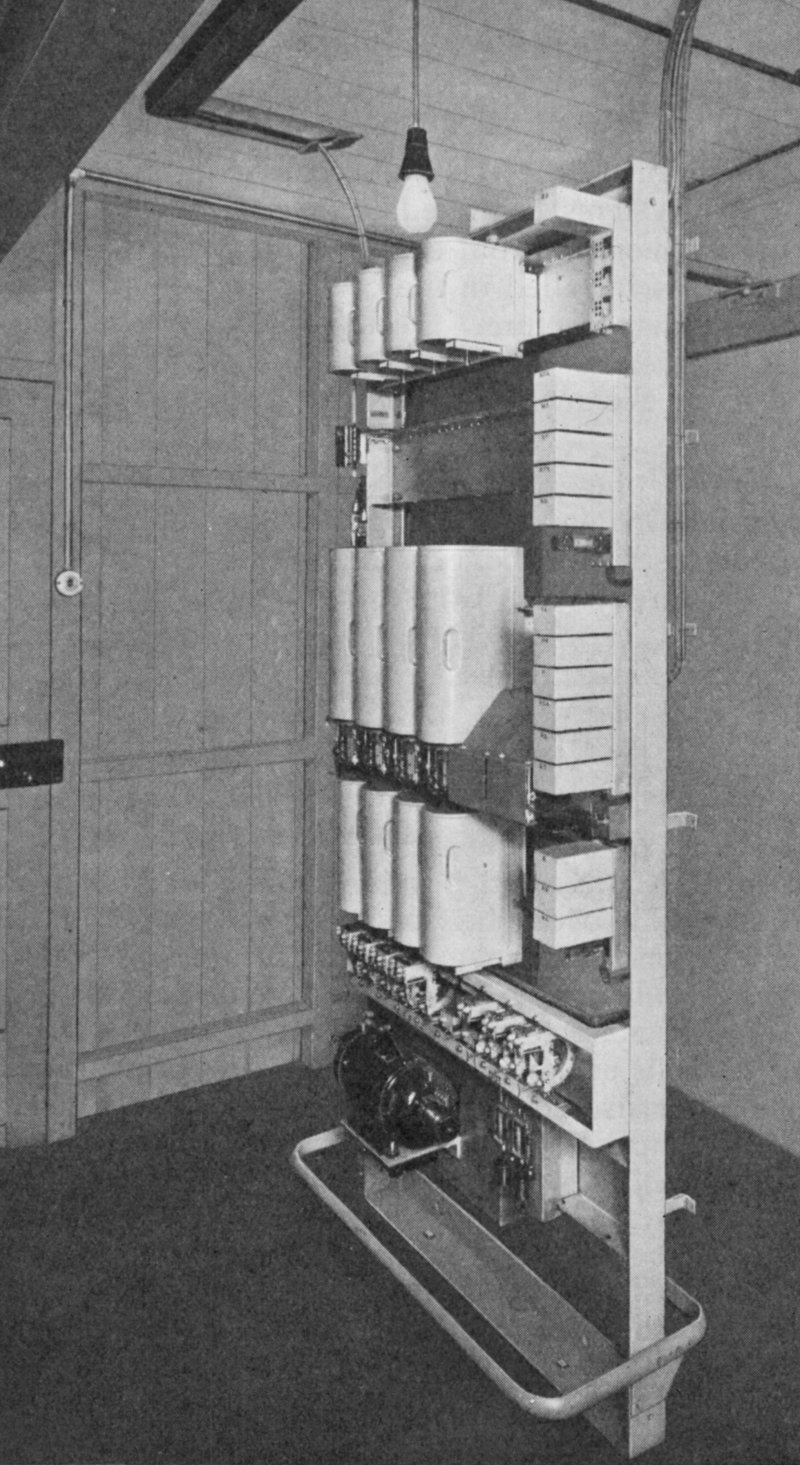
SYSTEM APPROVED BY THE POST OFFICE ADMINISTRATIONThe A.E. Co's 3 0 line P.A.B.X.This is known as the 30/30 line P.A.B.X. and provides all the requirements and facilities set out above. It is designed to cater for a maximum of 30 extensions and 10 exchange lines and 6 connecting circuits. By altering a few straps on the shelf jacks the system can be adapted to work into any type of manual/ or automatic public exchange system. The system functions on a line finder basis, a free line-finder being pre-selected by a distributor switch.Racks and equipment Two shelves at the top of the rack contain the exchange line equipment, and the next shelf below these contains the Final selectors. (The system functions on a 2-digit basis and group selectors are not required).The fourth shelf counting downwards contains the extension line equipment. The line finder uniselectors which are of the well known A.E. Co. uniselector type, two distributor uniselectors and the "forced release" uniselector, which also provides P.G. delayed alarm conditions, are all contained on the fifth shelf, counting downwards.The bottom shelf contains the ringing and tone equipment. The manual board provides circuits similar to the P.O. 10 + 50 type and contains in addition to the usual plugs and cords, etc., the alarm lamps mentioned earlier in this paper. For "trunk offering" a special plug is provided which, when inserted into an extension jack, will not break down an existing connection.
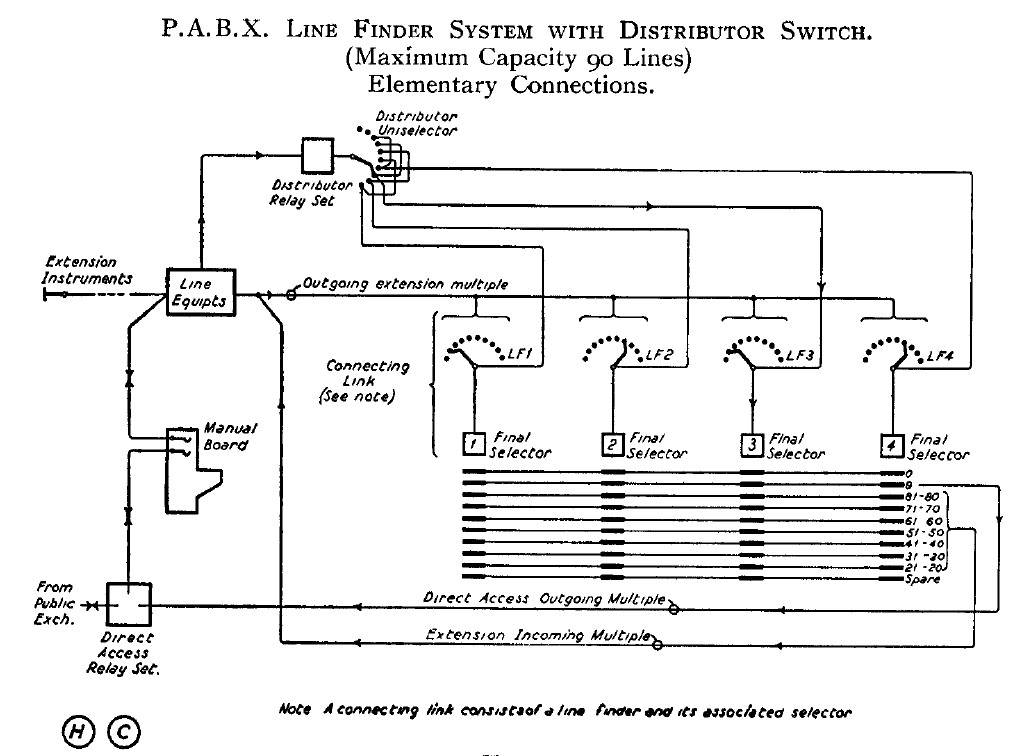
Schematic diagram Power The ringing and tone equipment comprises a jack-in unit and is so arranged that the transformers are interchangeable, one type only being used for all tones. The usual dynamotor supplies the tones and ringing currents.Equipment The exchange line groups are in units of one circuit per base. Extension units contain five circuits per base. The equipment operates on the line finder principle, provision being made by means of a distributor uniselector for only one free pre-selected line finder to hunt for a calling line. The whole of the equipment is in unit form, so many units of each type being taken out of stock and jacked in, or otherwise mounted on the rack provided, to form a complete P.A.B.X. of the desired size. The distributor switch is always standing on a free line finder circuit and thus a final selector associated with a particular line finder, will always be available to callers. If all line finders happen to be engaged, the distributor steps on to the 25th contact and remains there until a line finder becomes disengaged, when it will step on and open it in readiness for the next call. An emergency distributor switch is provided and can be brought into operation by a change- over key. When a calling extension is switched through to a final selector, dialling tone is connected, and the appropriate extension line jack at the manual board is "busied." The final selectors are provided with a vertical marking bank which comes into operation on calls to levels 8, 9 or 0, i.e., when tie lines, direct access or manual board facilities respectively are provided. For extension to extension calls the final selector receives two digits which operate the vertical and rotary magnets respectively in the usual manner; when "0" is dialled, however, the vertical marking bank causes a circuit to be closed for the manual board calling lamp. This operation also effects the release of all the automatic equipment taken into use by the caller, thus making it available to other callers. The extension receives ringing tone until the operator answers. Direct access and tie line working. On calls to levels 8 or 9 the vertical marking bank functions in a similar manner, but provides a circuit condition which converts the final selector into a repeater. The extension caller can then continue to dial digits (after receipt of dialling tone) into the public exchange automatic equipment or, if level 8 is dialled, into another P.B.X. installation. Restricted service Numbering scheme Taken from a paper by the IPOEE dated 1932 (No. 142)
Equipment rack
|
||||||||
Last revised: June 18, 2022FM | ||||||||