Australian Post Office
| ||||||||||||||||||||||
|
Telephone, Automatic and CB, Table
Large quantities of these (black) telephones were imported to cope with the ever increasing demand for these telephones in Australia. A sliding drawer in the base provided for note paper which allowed frequently called numbers to be recorded. Because of sticking drawers and subsequent breakages, later orders placed by the APO PMG with the U.K. manufacturers requested that the drawers not be fitted, and hence dummy plates were substituted in their place. Limited purchases of red, green and ivory telephones were made by the PMG Department prior to World War 2, but no purchases of the red and green phones were made after the war, as the fading problem encountered with earlier coloured telephones remained unsolved. After some experience with the phone, the APO was able to suggest a number of redesigns and modifications. The bell gongs were provided in different thicknesses of steel to give a slightly different and more pleasing tone (parts 2 and 2A). A small Alnico generator used by the APO was reworked to make it easier to turn, and fitted into the front of the case to make a magneto phone, the 333/4. The 164 handset was replaced by the updated 184 model, with the BPO Transmitter, Inset No. 13. The note drawer was done away with because of problems with it sticking and breaking and a blank plate substituted. Initially a wall model was not provided for by British Ericsson, but this was added to the range as the phone proved its worth. Except for the dial and cords, the entire phone could be produced in Australia. This was a good move as World War 2 had started and supplies of imported phones would become erratic. At this point the phone was produced in black only. Some green and red phones had been imported before the start of the War, but these purchases were suspended and not resumed, as experience showed that the coloured models still suffered from fading. Some of the initial production was fitted with black-finished dials, but the chromed "StayBrite" dial was soon substituted. The 332 "Tropical" is a GEC telephone. It was brought in in small numbers around 1939, probably for evaluation. GEC made many standard design phones for the British and Australian Post Offices, but also produced their own customised models where they thought they could improve on the original. A UK Tropicalised telephone can be indentified as it has mesh over the sound holes in the base plate and a ventilator on top of the case or two round vents in the side. It is marked "PMG 38" underneath. Telephones No's 332CBTH and 332ATH were the original models. The 333MTH was rare in Australia, but following the modifications suggested by the APO and development of the smaller internal generator, it was produced as the 334MTH. This telephone was supplied as Automatic (332AT) or C.B. (332CBT). A, key operated, dial lock could also be fitted to these telephones. This was fitted in the top of the case, in front of the handset and operated a switch which short circuited the dial springs 4 and 5. The types 300CBT, 300AT, 300CBW and 300AW, were developed by the Australian Post Office. Click here for more information. British Ericsson supplied 332AT which was their model
N1002K
- their diagram N55546. Australian Drawing C1350 Schedule C. Click here for Telephone 332AT and CBT Circuit Diagram Click here for the BPO Type 332 Superseded by the Type 300. Taken from Bob's Old Phones
Additional information on the 332
Model 332AP made by Ericsson - model No. N1002K25
Model 332AT with dial control lock
Model 332AT with dial control lock
Model 332AT with dial control lock
Model 332 in Jade green
GEC model shown below
British Ericsson Model
|
||||||||||||||||||||||
Last revised March 24, 2026 FM2 |
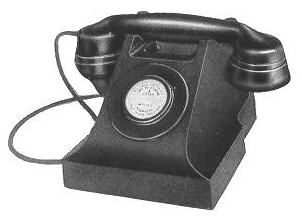 This telephone, introduced into Australia in 1939, were manufactured in
the U.K. by the Telephone Manufacturing Company, GEC and Ericsson Telephones
Ltd (ETL). It was largely developed by Ericsson Telephones Ltd in Britain
and called the
This telephone, introduced into Australia in 1939, were manufactured in
the U.K. by the Telephone Manufacturing Company, GEC and Ericsson Telephones
Ltd (ETL). It was largely developed by Ericsson Telephones Ltd in Britain
and called the 


