PO ENGINEERING INSTRUCTIONS
MISCELLANEOUS
TIME
B 1321
Issue 5, Oct 1970
CLASS A (PULSE) CLOCKS
 This is one of the standard half minute pulse clocks at present used by the
Post Office. The movements are described in B 1311 (Clock 98A shown to the right). This is one of the standard half minute pulse clocks at present used by the
Post Office. The movements are described in B 1311 (Clock 98A shown to the right).
CLOCKS No's 94A, 96A, 98A and 100A
As Clocks Nos. 74A to 80A, but with 24 hour dials, i.e. as the standard dial, but with the addition of the numerals 13 to 24 in red. These clocks are for use only where operations are based on 24 hours timings.
Drawing No. P/T 10062.
| No. |
Overall diameter |
Diameter of dial |
Depth (back to front) |
| 94A |
9in. |
7.75in. |
3in. |
| 96A |
12in. |
10.5in. |
3in. |
| 98A |
18in. |
16.25in. |
3.25in. |
| 100A |
24in. |
21.75in. |
3.5in. |
PO ENGINEERING INSTRUCTIONS
MISCELLANEOUS
TIME
B 1361
Issue 4, Oct 1970
CLASS B (SYNCHRONOUS) CLOCKS

One of the standard synchronous clocks at present used by the PO. The movements are described in B 1351.
Synchronous clocks are suitable for use only in areas where the mains supply is reliable. The basis for provision is given in B3001. The types used in the
PO are all non self-starting for use on a supply of 200-250 volts ac, single phase, 50 Hz, with a frequency which is time controlled. They should not be installed where
time keeping is of vital importance.
Clock No's 94B and 96B
As Clocks Nos. 74B and 78B, but with 24 hour dials i.e. similar to the standard dial, but with the addition of the numerals 13 to 14 in red. These clocks are for use only where operations are based on 24 hour
timings.
Clocks No. 96B are self starting.
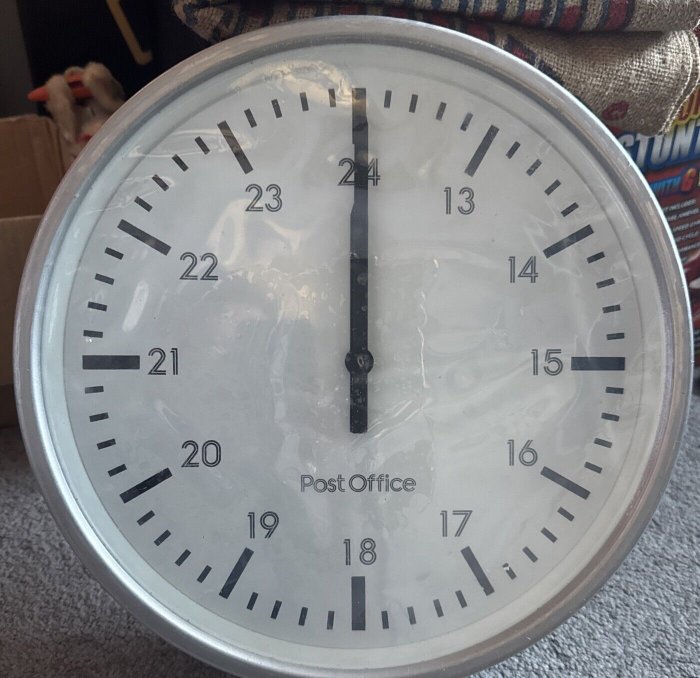
Clock No. 96A (Made by DCA in 1971)
This is a new clock and still in a cellophane wrapping
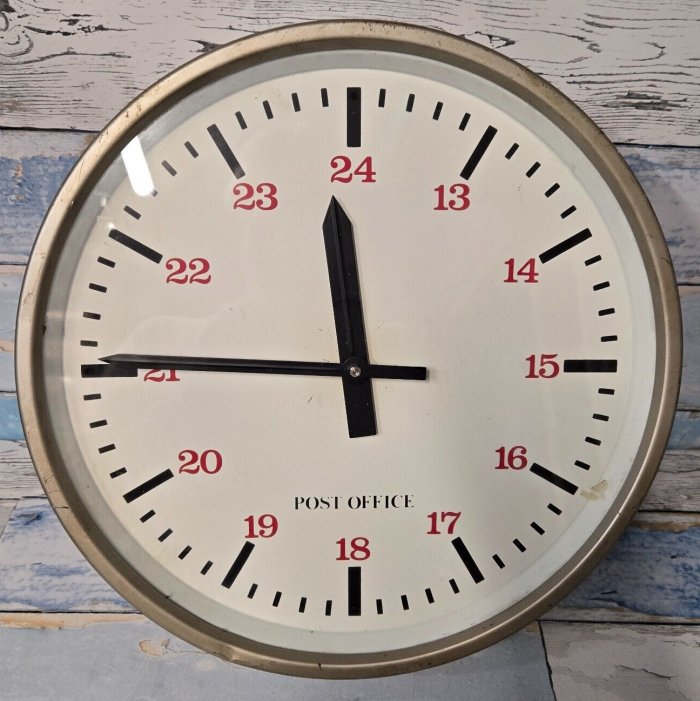
Clock No. 96A (Made by DCA in 1973)
|