DATEL SERVICES GROW UP - 1968 | ||||||||
|
An article from the Post Office Telecommunications Journal Volume 20, No. 3, Autumn 1968 The Datel Services grow up The Datel services operating over the existing telecommunications system effectively and economically meet the present data transmission requirements. Together with the new services which are planned, they will continue to do so for some time to come. However, in face of the growth of data traffic switched connection because of inherent difficulties there is an increasingly convincing case for a number of specialised networks using common transmission paths but separate switching points. The history of public data transmission services has been one of adapting circuits designed to carry telephone or telex calls to accommodate data traffic. So, Datel 100 was restricted initially to transmission at 50 bits (binary digits) a second, matching the 50 bands specification which was agreed as a reasonable international standard for interconnecting manually-operated teleprinters. Now, however, speeds up to 100 bits a second can be achieved on point-to-point connections although still using existing telegraph signalling techniques. Similarly, Datel 600, the first public data transmission service over public telephone lines has been geared to a maximum guaranteed transmission rate of 600 bits a second over any public such as inband signalling systems and limitation on the transmission of frequencies in the upper part of the commercial speech band. This has not detracted, however, from the fact that over the great majority of connections (about 90 per cent), the restrictions are not present to the same degree, and so a transmission rate of 1,200 bits a second is possible. All along, the basic problem of providing data services has been that of setting up a new facility. The Post Office has to suggest to the computer industry what it can do and industry then designs its equipment to use Post Office services. This means that the Post Office must be ahead of the requirement and commercially reasonably sure that there is an adequate market for it. The Post Office has had plenty of advice: almost every technical and professional body associated with the computer world has told it how such a project should be undertaken. Their welcome suggestions generally contain, however, two basic weaknesses. First, they are biased in one way or another depending on the source. Rather more surprising is the second failing: that they rarely take account of capital cost and economic viability during the early build-up period. For the next few years, data services arc likely to remain based on the existing telecommunications system. Plans must, however, be formulated now for the longer term. To this end the Post Office is collecting the best possible information from all sources on the likely future trends and forward thinking, both nationally and internationally, in the use of computers and automatic data processing. To take up
again the historical development of services, Datel 100 and Datel 600 were
quickly followed by the first special quality private point-to-point links
for customers requiring transmission rates greater than 1,200 bits a second.
These are supplied by Datel 2,000 under which the Post Office provides the
circuits, engineered to work with customer equipment at speeds of up to
about At the right time, more public network services designed to meet customers' special needs, were launched. For instance, demand for intermittent remote computer interrogation has been met by Datel 200, soon to be extended into the international field. Then, unattended answering facilities were opened up to create greater flexibility. This will be followed fairly soon by the next move in computer-originated calling over the public switched telephone network.
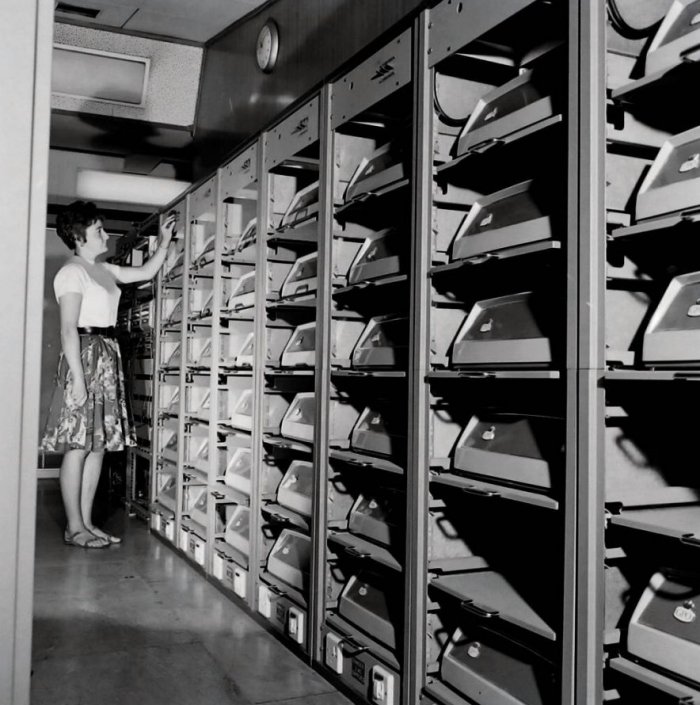
At De La Rue Bull's time-sharing service centre in London, a bank of GPO modems No. 2, each linked over the public network to a modem in a customer's office. The combination enables the user to communicate with a computer.
The next step in
extending transmission services will be the introduction of the Datel 2400
service to supersede Datel 2000. This will see the Post Office breaking away
from mere provision of circuits for a service of this rating and advanced
modems giving a guaranteed transmission rate of 2,400 bits a second will be
used. This must needs be over special quality leased circuits although
But Datel 2400 will offer an important support service. While based on
relatively high-speed facilities, it will provide for the user to switch to
the public telephone network for standby alternative transmission rates of
600/1200 bits a second. On the far side of the gap, work is going on to permit more effective customer use of wideband channels, whether over existing routes or on other, specially-created sub-networks. The tendency to date has been for users to transmit unique traffic on wideband. Some national newspapers, for example, have speeded up provincial production by passing facsimile pages on such routes. As part of the plan to expand the Datel services, contracts have been placed for the manufacture of a further 16,000 modems - the modulating and demodulating devices which convert computer language into a form in which it can be passed over telephone circuits. Half the new modems will be for use with Datel 600 and the rest with Datel 200. Most of them will be for computer bureau clients who interrogate a distant computer from their own offices by Teleprinter and for banks which are now setting up extensive data networks over Post Office circuits for computerising their accounting systems. The most exciting venture in this field has been the Daily Express front-page transmission via Early Bird and other centres to Puerto Rico (see the Winter, 1967 issue of the Journal). This began with a wideband link to the Post Office satellite earth station at Goonhilly Downs. Data, speech and telegraph can just as easily be used as the unique load. Plans are also being made to set up a switched network of wideband circuits covering a frequency range 60.6 to 107.7 kilocycles for casual or relatively short duration connections. The Post Office also plans to introduce in 1969 two new modems for use with the switched network which will be designed to operate at 48,000 bits-a second. The present Post Office systems were designed for speech and Teleprinter working. There are also television circuits. The tremendous growth of data traffic that is forecast and the special nature of data messages indicate a case for a separate dedicated network. This network will almost certainly be a system offering multi-speed facilities - rather than a straightforward unispeed network - with rapid set-up time and an appropriate tariff structure. Consideration must also be given to improved facilities for telegraph type messages offering faster transmission times than are possible over the existing telex service. Facsimile could also grow to proportions justifying consideration of a separate system. Whatever traffic has to be handled, it is vital for the basic and early planning of systems to provide for extension into a complete national network with full international compatibility. Current effort is geared to determining what facilities will be required; from this will spring the necessary technological development. Co-operation is particularly active with computer equipment manufacturers who have special access to Post Office lines for testing their equipment. The same close links with customers are encouraged, specially through the Post Office Customer Advisory Services which, apart from feeding information and guidance to the user, enable official sources to keep in direct touch with developments elsewhere. Superimposed on all, there are the important meetings of the various international committees. Having established a profile of customer requirement for a dedicated data network, technical planning will be necessary to devise the service. Costs can then be assessed and tentative tariffs worked out which can be put to customers to determine demand. The capital cost of creating a new network must be justifiable in terms of additional or improved facilities and customer use must be sufficient for a reasonable return to be secured: that is only sound business. It is debatable how far we are from the time a separate network will be required. The Post Office is examining every appropriate, enlightened source. The intelligence gained will enable it to continue to play a responsible part in creating the most efficient and most economical communications service on an international basis. To keep pace with rapidly-expanding demands for data transmission services, the Post Office recently commissioned an independent market survey to find out the likely needs of business users for facilities to transmit digital and analogue data over the next five, ten and 15 years. The survey will run in parallel with the Post Office's own research and development programme. A team of specialist consultants will interview every kind of organisation likely to use data transmission-business and industrial firms, medical and research establishments, universities, public utilities, Government departments and so on-and also visit computer and allied equipment manufacturers and professional institutions and trade associated linked with science and industry.
The new Group Delay Measuring Set To assist in the rapid setting-up and maintenance of the growing number of data circuits of various types and speeds, the Post Office is about to introduce a new Group Delay Measuring Set for field use. These sets will measure the differences in transmission time which would be suffered by the various frequency components of a pulse type signal. Ideally, of course, there should be no time difference so that the components of the signal bear the same relationships to each other at the receiving end of a circuit as they do at the sending end. When necessary, group delay equallisers can be inserted in a circuit to correct for time differences. The new set, which is being manufactured by Bardic Systems Ltd., of Southampton, will be portable and mains-operated, weigh about 40lb and cover the frequency range 200 Hz to 600 kHz. This range includes the audio band basic group band (for 48 kHz channels) and basic supergroup band (for 240 kHz channels). Accuracy of measurement is expected to be plus or minus five microseconds at audio frequencies and plus or minus one microsecond above 20 kHz. Each set includes sending and receiving equipment so that one is sufficient for loop measurements. When two arc used for A to B measurements no return circuit is necessary.
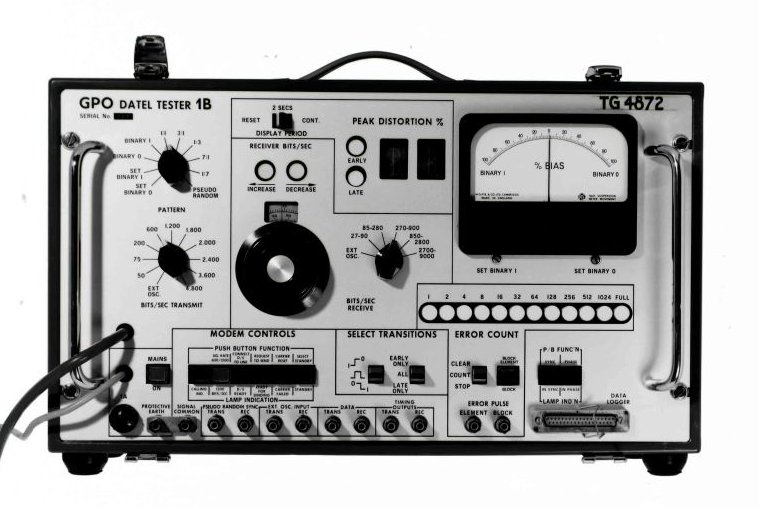
A NEW TEST SET This is the new portable data transmission test set-called the Datel Tester No. 1, which is used to test modems and to check data transmission equipment and computer data links. Designed to specifications laid down by
the Post Office and manufactured by Trend Electronics Ltd, it comprises a
transmitter and receiver of de signals in which the former The new
test set is only 19 inches long, nine inches wide and I It inches high and
weighs only 38 lb.
|
||||||||
Last revised: August 23, 2025FM2 | ||||||||