|
Repairing dials
Many
dials become sluggish after a while, usually through
dust and/or over-lubrication in the past. If you are
lucky they will respond to a very small drop of light oil on the insides of the
governor cup and on the governor worm drive (DO NOT use
WD40). If this fails
then you will have
to do a full disassembly job (tedious!), followed by
washing in white spirit. Afterwards lubricate the
re-assembled item with a minute amount of watch oil. You may
find that electronics component shops sell a micro-spout oiler
containing oil and Teflon particles for a very
moderate price.
If
the problem is dial spring, this advice from
Steve Hilz will help:-
Rewinding the spring - “You can rewind dial springs by carefully
pushing the mainspring into the holder and working it into the
centre as you go. You have to watch out that you don't let the
spring release, but it will go back OK with some patience.
Wear safety goggles and gloves so you don't cut yourself.
Broken spring - If you
have a broken spring near the end, you can anneal it
in a flame and let it cool gradually. Then, make the
bend that you want to be permanent. Then, reheat the
portion of spring that you annealed, until it is red,
then quench it in cold water to restore the
temper. (To be honest it is probably best to obtain a
replacement spring).
Usual dial failures are:-
-
Noise - Lubricate governor cup - a drop of light oil on the end
of a small screwdriver.
-
Slowness - Check for dirt and fluff on the gearing. Remove
and just dab a minute drop of oil on the governor spindle.
-
Slowness - Lubricate governor cup and dial central spindle.
If that doesn't work then note that the central spindle can become packed with oil residue - complete strip
down to cure this. On reassembly use a very, very small amount of
light oil
on the central
spindle.
-
Dial will not move - This is usually the clutch mechanism. Remove and
check to see if it will rotate. See below for a couple of
fixes.
-
Dial not returning - Firstly check for fluff and dirt.
Then check the spindle to see if seized. To do this remove
the governor and clutch. If the central spindle still will
not rotate or rotating very slowly then the dial is seized or
the return spring is broken -
complete strip down.
-
Dial not returning but spindle rotates - probably a broken dial spring
- complete strip down and replace the spring.
Tips:-
-
Dial speed check - dial the digit 0 to the finger stop and on it's return say
"one - one thousand and one" at normal speech speed.
-
Broken dial spring - generally all GPO dial springs from the
Dials No's
10 to 30 will work in any dial.
-
Do not dowse in oil. A drop on the tip of a very small
screwdriver is more than enough. Oil tends to go sticky
with age and gunge up!
Sized clutch mechanism
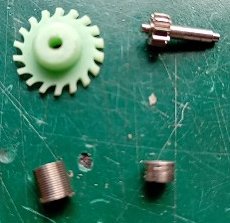 These are ways that people have
used to fixed a seized clutch
mechanism. The words are theirs. The picture to the
right shows a stripped down clutch. These are ways that people have
used to fixed a seized clutch
mechanism. The words are theirs. The picture to the
right shows a stripped down clutch.
- The clutch consists of 4 parts, The
main plastic cog, shaft, spring and a keeper on the end.
This keeper is simply a push fit on the shaft and inside the
spring and can be pulled off (a real tight push fit!!!) See
the picture. A pair of fine wire cutters between the top of
the spring and the keeper will move it.
If the keeper
will not move then it is strongly recommend that the bearing
ends should not be tapped under any circumstances when
attempting to separate the keeper from the shaft. The
shaft is not made of hardened steel and tapping it will more
than likely damage the end, possibly making it unusable. If
a puller is not available, an alterative method of accessing
most of the clutch for cleaning is as follows: If the
keeper can not be removed, it is possible to release the
spring by gently prising the end of the spring over the
retaining lip of the keeper and then carefully unwinding it
until it comes free. Do not stretch or bend the
spring, and make a careful note of the direction of winding
to ensure it can be replaced correctly. The spring can
then be cleaned with white spirit or switch cleaner, as can
the keeper and much of the interior of the housing.
Dry off the parts, re-lubricate with dial oil or clock oil
and reassemble.
- When the dial is wound up the spring is made smaller.
When released the spring grips the inside of the plastic
cog and transfers the power to the cog and to the
governor from the dial spring. Check the shaft as
it may have spots of rust and this won't allow the
spring to become smaller will therefore drag on the
plastic cog.
A tip, if this is suspected, is to check to see if the
governor moves when the dial is wound up, it shouldn't!
Well not much...!
Clean up the shaft, very lightly oil and reassemble.
- All is not lost with a rusted or seized clutch.
Simply put the small cog into a battery drill and place some
light oil on the spring. Hold the larger cog in a
piece of cloth and put the drill into reverse and starting
with a short burst of the drill. Once it's free, oil
it again and give it a good spin.
Dial 10 - 11 adjustment Document
Dial 12 - 30 adjustment Document
|