PRIVATE AUTOMATIC BRANCH EXCHANGES
Strowger
20+100 PABX
The 20+100 PABX is a single-unit equipment, having capacity for 20 automatic or
C.B.
exchange lines (including tie lines to private exchanges if required), 100 extension lines
in two separate groups of 50, and 10 connecting circuits.
When the unit accommodates more than 50 extensions, the line-finders for each group of
extension lines are connected via group switching relays to their respective connectors,
exchange-line and assistance circuits. These switching relays and the second group finders
are not provided when 50 or fewer extensions are to be catered for; therefore the cost of
the 20+100 PABX when equipped to 50 lines is kept to the minimum.
The exchange lines may comprise a single group of up to 20; alternatively, circuits 1
to 10. may be used for 2 groups of tie lines or constitute a separate exchange line group.
A modern desk-type cordless switchboard is supplied for dealing with incoming exchange
calls and assistance calls.
Numbering and Facilities Numbering
Extensions are numbered 200 to 299. Single-digit dialling codes 6, 7, 8, 9 and 0 are used,
as appropriate, for exchange-line and tie-line groups, and for assistance and
night-service answering.
Facilities
Extension to Extension Calls are dialled direct. Outgoing Exchange Calls are made by
dialling an access digit, then the exchange subscriber's number (or instructing the
distant operator if the exchange is manual). Alternatively, calls may be set up by the
PABX operator. Connecting circuits are not retained during exchange-line calls.
Incoming
Exchange Calls are received at the switchboard. Digit keys are used for extending the
call. Ring-when-free facilities are provided. Barred Access. Automatic access by
extensions to exchange facilities can be partially or completely barred. Enquiry Calls. An
exchange call can be held by the PABX operator or an extension, while making an internal
enquiry call. The internal conversation is secret from the exchange subscriber.
 Front view of the 20+100 PABX unit, with
dust-proofing removed from the lower sections and rear view of the unit, showing
dust-proofing in position enclosing the distribution, exchange-line finders and common
equipment. The dustproof panels are removed from the lower sections, exposing
exchange-line relaysets and extension line relay and finder shelves. Front view of the 20+100 PABX unit, with
dust-proofing removed from the lower sections and rear view of the unit, showing
dust-proofing in position enclosing the distribution, exchange-line finders and common
equipment. The dustproof panels are removed from the lower sections, exposing
exchange-line relaysets and extension line relay and finder shelves.
Call Transfer
Exchange calls can be repeatedly transferred without operator assistance, by extensions
with exchange facilities, to other extensions permitted to receive such calls.
Trunk Offering
The PABX operator can enter established connections; warning tone is given.
Right-of-way
Preference on internal calls can be given to executives. Assistance. Extensions dial a
single digit to call the PABX operator.
Manual Extensions
Immediate calling of the PABX operator by lifting the handset can be arranged for up to
four of the extensions.
Night Service
Incoming exchange calls are signalled by d.c. bells. Any extension not fully barred can
answer by dialling 8. Alternatively, from one to four extensions may be selected to answer
calls.
Tie Lines
If standard exchange line circuits are used, outgoing and incoming calls are obtained as
described in 'Outgoing Exchange Calls' and 'Incoming Exchange Calls'. If special tie-line
circuits are used, calls can be dialled out and dialled in, no extensions being barred.
0ptional Service Features
Message waiting; message registration: conference; trunk barring; extension busy lamps;
direct-access key calling and staff location.
PABX Unit
This is a double-sided unit, enclosed at the front and rear by transparent, semi-rigid,
non-flammable plastic panels, edged with strips of 'magnetic' rubber to hold them
firmly by attraction against light metal supports; nylon studs in the panels ensure
correct positioning. The supporting T-section cross-members are easily removable to allow
access to the entire unit if necessary, but for general maintenance, panels are removed
one at a time. A panel can be lifted in one hand and temporarily parked over another panel
simply by placing the two in contact. Enclosure of the unit is completed by sheet metal
sides, base and roof.
The exterior finish is opaline green enamel; the interior ironwork, apparatus covers
and p.v.c. insulated cables are cream. The equipment has a tropical finish. Connecting
wires are p.v.c. insulated.
Components are of standard BPO type and proven reliability. They include N30000 (BPO
3000) and N45000 (BPO 600) relays, heavy duty line-finder uniselectors (BPO No. 2) and
100-outlet 2-motion selectors N46600 (BPO 4000). (BPO 2000 type 2-motion selectors can be
supplied if ordered specially.)
A cross-connecting field is included in the unit, and the line and exchange sides of
circuits can be isolated for testing. Ringing and tone frequencies are generated by
transistor-type oscillators, powered from the 50v exchange supply. These static devices
require little maintenance and do not cause interference with radio signals. The switching
equipment provided for PABXs of up to 50 lines and over 50 lines respectively is as
follows:
| |
Up to 50 Extensions |
Over 50 Extensions |
| Connectors |
7 |
10 max. |
| Line finders |
1 per connector |
2 per connector |
| Assistance finders |
1 |
2 |
| Exchange finders |
1 per exchange line |
2 per exchange line |
| Call-back selectors |
1 |
2 |
| Group switching circuit |
- |
1 |
The following common items are supplied for each exchange: (a) assistance and
night-extension circuit; (b) ringing, tones, alarms, and pulse circuit; (c) marker
circuit; (d) unit common services.
Cordless Switchboard
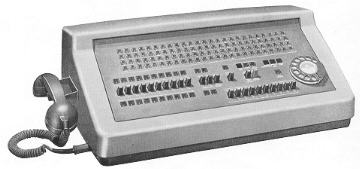 The N24119A1T cordless switchboard with
'extension busy' lamps is shown right. The design of the small two-tone grey
switchboard accords with contemporary taste and facilitate maintenance. The metal front
panel and internal rear equipment frame are both hinged on the metal base so that they can
be opened, book fashion, when the ABS copolymer plastic drop-on cover is removed. The N24119A1T cordless switchboard with
'extension busy' lamps is shown right. The design of the small two-tone grey
switchboard accords with contemporary taste and facilitate maintenance. The metal front
panel and internal rear equipment frame are both hinged on the metal base so that they can
be opened, book fashion, when the ABS copolymer plastic drop-on cover is removed.
Keys
have wedge handles with tips of contrasting colour, to enable operated keys to be easily
discerned. A hundred lamps, arranged in four rows, are 'extension busy' lamps fitted only
when specified. The upper row of double-throw keys and associated lamps are for
exchange-line, tie-line, manual extension, assistance and miscellaneous circuits; the
lower row for key-sending, intrusion, etc. Supervisory lamps are at the left of the dial,
and alarm keys and lamps at top right.
Lamps can be removed without using an extractor.
The dial has standard numbering, a 2:1 break/make pulse ratio and a plastic
finger plate. A
grey plug-in handset, with rocking armature receiver and grey braided extensible cord is
provided. A smaller alternative attendant's switchboard is available, with similar
facilities, but excluding the extension busy' lamps.
Power Equipment
The working voltage is 45 to 55v (50V nominal). If a reliable a.c. mains supply is
available, a battery eliminator (N22405B) may be used. It is designed for inputs of 100 to
125 or 200 to 250v, 40 to 100Hz, has a 10A output and mounts on a wall. Alternatively, a
45Ah battery, with 5A charger and control unit, can be supplied.
Telephones
Plesseyphones (catalogue sheet 7159) or Etelphones (catalogue sheet 7145) are recommended
for extension telephones. However, any telephone suitable for 2 wire and earth or 3 wire
working may be used, provided it is equipped with a non-locking press button and
incorporates a dial with a 2:1 break/make ratio and pulsing speed of 10 p/s.
When ordering, please quote PABX 20+100 N24398A1 T
|
