|
Loudspeaking and "S - 10"
(non-dialling) Telephones
The convenience which busy executives find in a private automatic
telephone system becomes even more marked if loudspeaking telephones are
installed. Whilst the handset type of telephone has many advantages
over earlier types, it still necessitates the use of at least one hand
whilst telephoning, introducing difficulty in the arranging of papers and
writing of notes, and imposing very definite limitations on movement about
the office, as a result of which access to files, etc. can be obtained only
by interrupting conversation. By employing the G.E.C. LOUDSPEAKING
AUTOMATIC TELEPHONE all these difficulties are overcome since:-
- Both hands are left free whilst conversation is in progress.
- Complete freedom of movement about the office is given.
- Loudspeaker or handset may be used at will, the lifting of the
latter automatically cutting off the loudspeaker and causing received
speech to be heard only in the handset receiver.
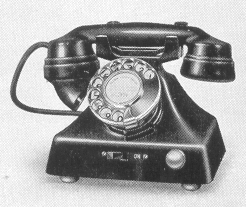 The
complete loudspeaking set consists of a telephone incorporating a microphone
behind the dial, a loudspeaker and an amplifier (see picture to the right).
The microphone is unobtrusively incorporated and is sensitive to a degree
that permits it to pick up speech delivered in normal tones from almost any
direction. A call is taken on the handset by lifting the handset or on
the loudspeaker merely by throwing the key seen in the front of the
telephone. This switches on the amplifier, a pilot lamp adjacent to
the key indicating that the latter must be restored at the end of
conversation. The
complete loudspeaking set consists of a telephone incorporating a microphone
behind the dial, a loudspeaker and an amplifier (see picture to the right).
The microphone is unobtrusively incorporated and is sensitive to a degree
that permits it to pick up speech delivered in normal tones from almost any
direction. A call is taken on the handset by lifting the handset or on
the loudspeaker merely by throwing the key seen in the front of the
telephone. This switches on the amplifier, a pilot lamp adjacent to
the key indicating that the latter must be restored at the end of
conversation.
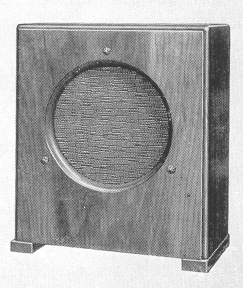 The
loudspeaker is of the permanent-magnet, moving-coil type and is fitted in a
cabinet of hardwood measuring 8 in. by 4.5 in. by 9.5 in. high. If
required, the loudspeaker can be supplied for mounting behind a panel. The
loudspeaker is of the permanent-magnet, moving-coil type and is fitted in a
cabinet of hardwood measuring 8 in. by 4.5 in. by 9.5 in. high. If
required, the loudspeaker can be supplied for mounting behind a panel.
The amplifier unit (not illustrated) employs an amplifying valve for speech
in each direction and is contained in a wood case measuring approximately 16
in. by 9 in. by 11 in. high. Power supplies are obtained from
batteries or A.C. mains as desired, the case providing suitable
accommodation.
The loudspeaker and telephone can also be incorporated in a single unit.
The busy executive who wishes to be relieved of the necessity of dialling
will appreciate the time and laboursaving features offered by the G.E.C.
"LOUDSPEAKING S-10" INSTRUMENT.
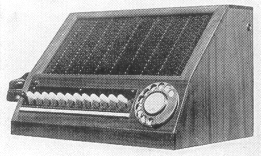 This
set (pictured to the right) incorporates all the facilities of the
loud-speaking instrument described on the previous page, but in addition to
enabling the user to communicate with every department in the usual way, it
permits him to call, simply by pressing a button those instruments with
which he has to be in frequent communication. Dialling is not
necessary. This
set (pictured to the right) incorporates all the facilities of the
loud-speaking instrument described on the previous page, but in addition to
enabling the user to communicate with every department in the usual way, it
permits him to call, simply by pressing a button those instruments with
which he has to be in frequent communication. Dialling is not
necessary.
One of the buttons is generally fitted as priority line to allow the
executive to "get through" even on a line already engaged.
The G.E.C. "S-10" Set (pictured below) incorporates pushbutton calling
but is without loudspeaking feature. It should particularly be noted
that a multiple cable is not necessary to give this service, but merely an
additional twin wire to the Impulse Sender cabinet (not illustrated).
Other telephones on the system are in no way altered.
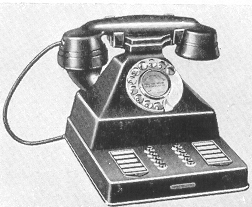 Any
number of departments can be fitted with this facility and every executive
can have those numbers associated with the push buttons on his "S-10" Set
which relate to his particular section of the organisation. Therefore
the numbers represented by the push buttons on the "S-10" Set of the Works
Manager can differ from those of the Managing Director or Chief Accountant.
The numbers can be altered even after the "S-10" has been installed.
The system therefore is flexible and suited to meet changes which may take
place within the organisation after installation of the telephone system. Any
number of departments can be fitted with this facility and every executive
can have those numbers associated with the push buttons on his "S-10" Set
which relate to his particular section of the organisation. Therefore
the numbers represented by the push buttons on the "S-10" Set of the Works
Manager can differ from those of the Managing Director or Chief Accountant.
The numbers can be altered even after the "S-10" has been installed.
The system therefore is flexible and suited to meet changes which may take
place within the organisation after installation of the telephone system.
Taken from the GEC Private Automatic Telephone
Exchanges No. 18/2 (undated) |
 GEC S-10