|
These are
extracts of minutes from the
British Telephone Technical Development Committee, Subscribers Apparatus Development Sub-Committee meetings, which were held every 3
months. These were run by the GPO and held on their premises. The
GPO contractors also attended these meetings. The minutes started around
1942 and finished in December 1967 due to the re-organisation of the Post
Office.
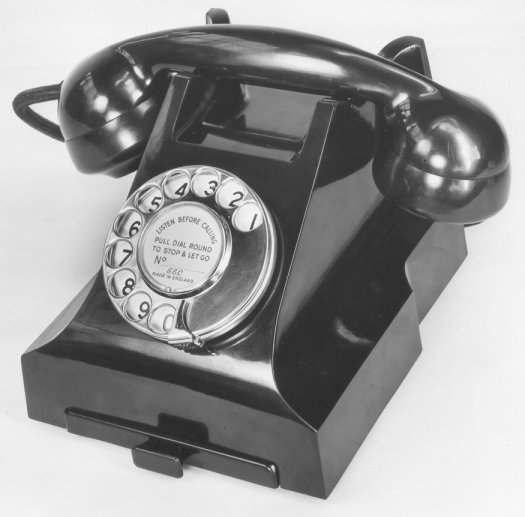
The Telephone No. 700 initially sprung from the introduction of a new handset, rocking
armature receiver and improved telephone circuitry. These minutes start
with the projected introduction of the improved circuitry, which is superseded
by the actual telephone set.
The 700 set did not actually get into introduction in the UK, as it was
superseded by the Telephone No. 706.
BTTDC
SUBSCRIBERS APPARATUS SUB-COMMITTEE
11th April 1951
SCP 117 (Inf.) - Telephone Set Circuit
The Chairman thanked S.T.C. for the SCP and stated that the P.O. would welcome diagrams so that the proposal could be fully appreciated. Mr. Smith
(S.T.C.) said he would arrange for these to be provided.
10th October 1951
The Chairman remarked that S.T.C. had been requested to supply copies of the diagram of the telephone set circuit referred to in
SCP 117, This they had done and the diagram was now issued as Appendix 1 to the
SCP. Issue of the document was noted.
16th July 1952
Mr. Williams (R Branch) said that the results of tests had been written up
and the draft report was being typed. The results would then be discussed with S.T.C. He
commented that the tests concerned were laboratory tests only.
15th July 1953
The Chairman said that a copy of Research Report No. 13466 had been sent to S.T.C.
14th January 1954
Mr. Williams reported that two samples had been received at Dollis Hill and
tests were commencing.
Mr. Williams, replying to Mr. Lewis, said that the P.O. had made comments on the automatic control of line sensitivity, with which they were not quite satisfied
and he thought that the points made were also
appreciated by S.T.C.
14th April 1954
Mr. Williams said tests on the two samples were proceeding.
The Chairman, referring to the new telephone instrument, said a P.O. Committee had been sitting under the Chairmanship of the
E-in-C, to consider a design target. A complete investigation of local line conditions, signalling, etc, had been made and the
final meeting was held about 6 weeks ago.
Sir Gordon Radley had decided that introduction of a new telephone-instrument
should go ahead immediately, based on Transmitter Inset No. 13, the Rocking Armature Receiver,
and a new Induction Coil and Balance Circuit. It was hoped with this arrangement to secure a gain in sending of at least 3
db and 4 db if possible, with substantially the same receiving allowance as at present
(in comparison with Tele, No. 232). It would be suitable for 1000 ohm lines of
6.5 lb. cable.
If the present handset were used an adaptor would be necessary for the rocking armature
receiver, if, on the contrary, a new handle were introduced it might be hollow (i.e. without
moulded in conductors or inserts), but an adaptor for the transmitter would be necessary.
The external shape of the instrument body would be unchanged, but improved methods of manufacture were not
excluded.
The new telephone should be no dearer than the present instrument and Sir Gordon
had expressed the hope that it would be in production in twelve months.
The Chairman added that circuitry had not been finally settled. The
E-in-C's decision was an interim measure to get matters moving rather than wait for, say, a further five years for a superior instrument,
Referring to SCP 131, Mr. Dewar (G.E.C.) said the instrument had been designed for New
Zealand, and in reply to Mr. Williams, said he would try to provide two sets complete for test purposes.
Mr Lewis said S.B. also had an improved telephone, incorporating an improved
Transmitter-Inset of the No. 13 type, A SCP would be submitted and samples made available for test.
14th July 1954
Mr. Combridge (S Branch) said that the P.O. had written further letters on the
24th May and 6th July, and in the former had asked for the Manufacturers'
considered opinion upon the possible savings by the introduction of a hollow handle.
Mr. Lewis (S.B.) said there were several points which had to be considered e.g. whether the lighter handle
would be sufficient to operate the springsets; it might mean that the whole telephone had to
be redesigned. Mr. Helman (S Branch) thought there was sufficient margin of safety in the present
mechanism.
The Chairman said the entire project for a new telephone circuit depended on cost. The E-in-C had ruled that the new telephone must be no dearer than the present instrument, and it was felt that as the new capacitor would certainly
add to the cost, the only possible compensation could come from cheapening the handset.
Mr. Helman added that as things appeared, unless savings could be made on the handset, there
would be no new telephone: for that reason
S Branch were anxious to know the Manufacturers' opinions.
In reply to Mr. Dewar, the Chairman said that the P.O. had no preference so far as the design of the handset was concerned, provided that the financial conditions
were met. Mr. Combridge added that if a hollow handle with inserts was cheaper than one without inserts, the P.O. would have no objection to the retention of inserts.
After further discussion, Mr. Warren said he appreciated the urgency and
would refer the question of costs to T.A.C.
In reply to a question, the Chairman said that the cost of a complete hand-set, including a
4-way cord was required, and he would like to have the answer within one month.
13th October 1954
In reply to the Chairman, Mr. Warren (T.A.C) said lie had asked the
Manufacturers' Commercial Side for cost information, but had not yet had a reply from
them, they were, however, meeting the following day. They were apparently experiencing difficulty in obtaining reliable cost information.
12th January 1955
Mr. Combridge reported that a statement on costs had been received from the
Manufacturers.
Mr. Warren said the Manufacturers proposed that a SCP be issued stating the reasons for the new design of
handset and offered to submit a draft. The Chairman welcomed the suggestion.
13th July 1955
Mr. Warren said the Manufacturers had received Research Report No. 13970 and thanked the Department for
it.
The Chairman said that just after SCP 133 had been issued a circular letter G.E.C. had been received,
which had prompted the issue of SCP 131.
After discussion, it was agreed that it was intended that SCP 134 be considered as a draft
SCP and the manufactures undertook to comment on it.
Mr. Warren said the Manufacturers Commercial Committee were to meet on 21st July to look
further with the question of the abolition of the tray. He had stated the P.O. views as fully as possible to them in writing.
Mr. Lewis commented that it appeared to be the Department's intention to
retain the Telephone No. 332 type case, in which provision was made for the tray and he questioned the desirability of
dispensing with the tray. Mr. Helman replied that the case had to be retained as standard until such
time as authority was given for the standard to be changed. Further approaches to the I.T.D. would have to await the outcome of the Manufacturers' discussions, but for the field trial,
the existing case would have to be accepted as standard, if only for a short
time.
Mr. Dewer said that in April last year a degree of urgency had been inferred, and
asked if this still applied. Mr Helman replied, that the P.O. considered that the date had been
met.
12th October 1955
Referring to the last minute, the chairman amplified Mr. Helman's
comments by stating that the P.O. considered that the date had been met so far as the present stage of
development was concerned, but it was still regarded as a matter of urgency that the work should be
pressed to completion for bulk production.
Referring to the draft of SCP 134, Mr. Warren said the P.O. comments on the Manufacturer's suggestions had been
received and the Manufacturers had no further comments to add.
It was agreed that the SCP be issued subject to clause 4. (b)i being amended
to read 'Transmitter Inset No. 13, Mark I'.
The SCP was allocated, to G.E.C. whose L.O. would be nominated in due course
SCP 134 (Draft) New Telephone Instrument (Type 700) for 1000 ohm lines
had been issued.
11th January 1956
Telephone Set Circuit - It was agreed to discharge this item from the
agenda, any future discussion would be taken under SCP 134.
All minutes from this point onwards refer to SCP 134
11th January 1956
Replying to Mr. Combridge, Mr. Dewer said moulding was proceeding but he thought
it unlikely that the February delivery date would be met. He would make
inquiries. Mr. Williams asked if all major questions e.g. capacitors - were now
settled and was informed by Mr. Smith (S.T.C.) that the manufacturers were not
aware of any outstanding problems.
The individual components had been the subject of SCP's for many years, an
active SCP could not be issued until exact requirements were known. The Manufacturers were probably aware
that from time to time difficulty arose in connexion with export interests of which the P.O. usually
took note. This had been the case in this instance and had delayed the issue of the
SCP.
11th April 1956
Mr. Warren (T.A.C.) thanked Mr. Williams (R Branch) for the copies of P/R. 13971. Mr. Dewar
(G.E.C.) commented that delay in obtaining a capacitor was holding up completion of the 100 telephones for field trial. Mr. Atherton offered to arrange to let G.E.C. have a supply from P.O. deliveries.
The Chairman said some of the first models of the new telephone instrument
had been seen by the Engineer-in-Chief, who had commented on the mis-match between the sweeping curve of the handset and the
angular appearance of the present base. The feeling was that steps should be taken to produce a base more aesthetically in
harmony with the handset. If any manufacturer had a more attractive base, it would be welcomed; failing this the P.O. might be forced to approach
the Council of Industrial Design. He suggested that manufacturers should submit informative
SCP's and models as soon as possible, in any case within the next six months.
Mr. Combridge (S Branch) added that it was desirable that certain shortcomings with the present design be overcome. Mr. Helman
(S Branch) said that at this stage the P.O. was mainly interested in the artistic lines of the base provided that it was a practical engineering proposition.
11th July 1956
The Chairman said 100 telephones had been received and asked what future delivery prospects were. Mr. Jones said
G.E.C. were held up, awaiting condensers. They were prepared to produce the remaining 900 telephones in one go, and hoped to get started in about 2 weeks. If the job got carried into the 2 weeks holiday shutdown period there would be a further 2 weeks delay.
10th October 1956
Mr. Combridge said 1000 Telephones had now been received. The Chairman added that the P.O. was taking all steps to get the field trial
started. Mr Dewar said G.E.C. were making every effort to have a further 1000 telephones available by the
the end of November, but were being hindered by difficulty in the supply of capacitors. Mr. Smith
(S.T.C.) said G.E.C. received supplies of capacitors from another part of
S.T.C.; the latter promised supply of a further 400 capacitors next week to be followed by
400 per week. The Chairman commented that if and when it were decided to introduce this telephone in really large quantities, he
hoped that capacitors would be available in suitable quantity.
10th April 1957
Mr. Williams said the field trials in the Canterbury and Portsmouth Telephone Managers' Offices has been
designed to obtain Staff opinions. There was a majority opinion (about 80%) that
the telephone was too loud, on local calls and 50% considered it too loud on external
calls. The complaints had been primarily of loudness rather than sidetone.
Assessments had shown that on internal calls, loudness was about 7 db up on the
Tele 332 to Tele. 332 call and on external calls, about 3 db up.
The Chairman said it h ad been agreed in principle that something would have to be done: there were
several possible solutions but no decision as to which would be adopted had been
taken. This had considerable repercussions on P.B.X's as a result of which,
development of SCP 140 would have to he held up while a solution was found. The
answer might be to segregate switching and transmission supplies at P.B.X's. He did
not want the position to arise that when a decision on the new telephone were given
by the administration, development would be held up by this technical problem.
Any suggestions the manufacturers could offer would be welcomed.
Brief discussion of various possibilities ensued, non-linear resistors, padded terminal blocks
and modification to exchange ballast resistors were some of the points mentioned.
10th July 1957
The minutes referred to SCP 153 - 700 Type Telephone.
9th October 1957
Mr. Troke said that there were no further developments to report the G.E.C. had
submitted the drawings for the Handset No,1 and these were still under scrutiny. Mr. Bryan
(S.E.S.) asked whether the field trial was still proceeding and Mr. Combridge confirmed that it
was, with particular reference to the performance of the rocking armature receiver.
8th January 1958
Mr. Combridge said work on the drawings for Handset No. 1 was being coordinated with that on the
SCP 153 handset.
6th October 1958
Mr. Williams reported that the Canterbury field trial of the regulators
had been entirely favourable and the users were pleased. The life tests at Dollis Hill had been running for the
equivalent of 20-30., years normal life without a single failure,
7th January 1959
Mr. Williams said that the accelerated life tests on the automatic regulator had now reached an equivalent of 20 years with no faults.
13th April 1960
It was agreed to discharge this SCP.
Click here for the Telephone No. 700.
|