|
BRITISH INSULATED & HELSBY CABLES
Few collectors will have heard of this British company, but
they were involved in telephones and cable manufacture from the earliest days,
and they played a big part in the development of the Australian cable industry.
In 1884 J and G Crosland Taylor founded the Telegraph Manufacturing Company in
Helsby in England. They made batteries, insulated wire and telegraph equipment.
Within four years their lack of business experience was showing, and an inept
manager was driving them into trouble. A new manager and a diversification into
golf balls (made from gutta-percha, as used in their insulated wire) got the
company out of trouble, but they found it hard to attract skilled staff to the
quiet town of Helsby. In 1892 they moved much of the plant to a factory in
Liverpool. Further diversification followed. They produced a range of products
including bike tyres, and gained a large contract with the National Telephone
Company for telephone wire and 26-pair cable. This established them in the cable
market.
In 1902 they amalgamated with the British Insulated Wire Company of Prescot, in
Lancashire, England. British Insulated started in 1890 and had built up a good market for
insulated telephone, telegraph and electrical wiring. In 1899 they provided a
submarine cable to run under Sydney Harbour. The amalgamation was a good move
for both companies. British Insulated had the British and colonial patents for
the new paper-insulated dry core cables and a large factory in Prescot to make
it. TMC had a good range of telephone technology, which was a fast growing area,
and many contracts for telephone cable. The new company became British Insulated
and Helsby Cables Ltd (BI&HC).
In 1903 BI&HC built a new factory in Edge Lane, an outer
suburb of Liverpool. The factory was badly needed, as the existing factories
could not keep up with the demand. Business was growing rapidly and telephone
exchange equipment was being exported to, among other cities, Fremantle in
Western Australia. The two phones listed in the Australian Post Office 1914
manual were possibly from this installation. They also exported large amounts of
wire and insulators to the developing Australian railways. They seem to be
well-known in Western Australia particularly.
BI&HC was now building CB telephone exchanges as well as
phones. Their CB switchboards were quite successful, and they equipped some
large British cities with trunk exchanges for the British Post Office. The
design followed Western Electric practice but was based on a version invented by
J S Stone in the United States that had proved popular with the independent
telephone companies (thus avoiding the Western Electric patents).
Although information on BI&HC phones is scarce and ambiguous, some trends are
emerging as collectors forward information. Rather than build their own phones
completely, they seem to have bought in Western Electric phones and parts
initially. A typical early phone will be standard Western Electric, but will
carry at least one branded BI&HC part as well as BI&HC circuit diagrams inside the
case and bell box. They started producing their own designs before the First
World War, following the move to Edge Lane. The production dates of the WE
phones are well known, so this gives us approximate dates for the BI&HC models.
Poole (1912) lists three examples of their CB phones. Some of
these appear to use unbranded Ericsson transmitters fitted to an unusual 'radial
arm' whose purpose was 'to accommodate to the different heights of the
persons using it'. This could have been a useful feature in the days when
the transmitters were less sensitive, but other companies managed to do without
it. The desk set has an extendable handset shaft 'so as to accommodate the
face length of any individual'. These phones are pictured on the next page.
Jim Bateman's book 'History of the Telephone in New South Wales' shows
another and probably earlier design. It is a three box wall phone similar to a
Western Electric pattern but fitted with an Ericsson receiver and a Manchester
Shot transmitter in place of the usual Blake transmitter.
The Australian Post Office (APO) listed two BI&HC phones in a
1914 technician's manual. One was a magneto wall phone with dual receivers. These phones date from
about 1886 to the early 1890s when the Solid Back transmitter was introduced.
The other, from the circuit diagram shown in the manual, was a CB candlestick
style (see next page). The circuit diagram shows provision for a second
receiver. The phone appears to be a rebadged Ericsson model. Previous
BI&HC candlestick phones were WE-based, but there is no evidence of any WE candlesticks
being fitted with a second receiver. In spite of this, the only candlestick
known in Australia (so far) is a WE model, so maybe the APO manual has the
incorrect circuit diagram from the later Ericsson model. By 1914 the APO had
replaced many phones inherited from the old state telephone administrations, so
the BI&HC phones must have been reliable for the APO to retain them. In spite of
this, they appear to be almost unknown to collectors. The APO also listed BI&HC
switchboards.
By 1914 BI&HC was building CB wallphones to the now standard BPO pattern and
these were listed in the APO's 1914 handbook as the Telephone No. 17. Although BI&HC's
catalogue picture shows an Ericsson transmitter, it would more likely have been
fitted with a Solid Back transmitter by this time, as per British Post Office
practice. A similar magneto model was also made. Other companies made the same
phone and only the numbers stamped into the back woodwork would identify it as a
BI&HC.
BI&HC also made a telephone called the 'Pantophone'. This was a Phonopore-type telephone for
use on railway telegraph lines. Note that they used an Ericsson transmitter for
the "ring" signal. Like most other companies they also produced a small range of
intercom phones.
At the White City Exposition in 1908 one of the new American automatic telephone
exchanges was demonstrated, probably by Strowger's company Automatic Electric.
It was a refined operation, rather than the clumsy early versions. The phones
used the familiar ten-digit dial instead of the early 'Knuckleduster'
eleven-hole dial. The exchanges ran reliably on a two-wire subscriber circuit,
which provided automatic ringing and busy tone.
The new manager of BI&HC, Mr. Dane
Sinclair, could see that this was the way of the future. He had actually
patented an automatic switchboard in Britain in 1883 and he was well-placed to
judge the efficiency of the Strowger design. He had been Engineer-in-Chief of
the National Telephone Company, giving him experience of the competing
Gilliland, Betulander and Lorimer systems and he knew their deficiencies. It was
he who got BI&HC to acquire the patent rights for the Strowger system for the UK
and the British Empire. Eventually Dane Sinclair became the MD of BI&HC.
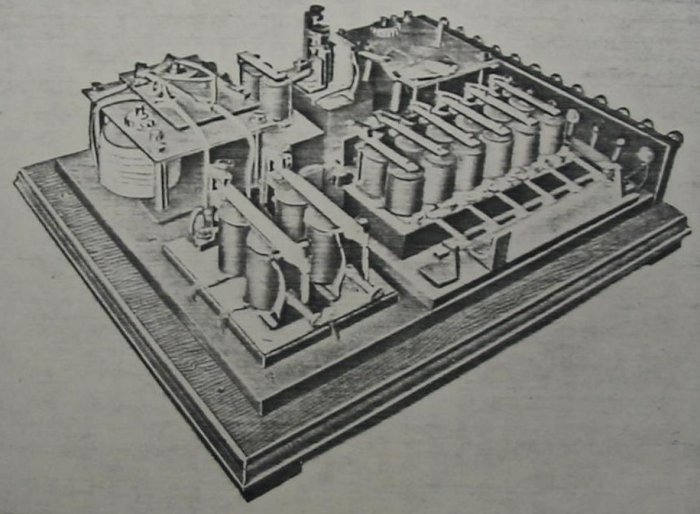
Dane Sinclair's Automatic Switching Device (1883)
The Board agreed, and set up a new company to build the equipment
called the
Automatic Telephone Manufacturing Company. They acquired the rights in 1911.
Although they were supposed to be a separate company to BI&HC, the Post Office
allocated them the manufacturer code of 'H' (for Helsby). The old company,
BI&HC, now concentrated on cables. The first British-built Automatic Telephone
Manufacturing exchange was assembled from imported parts and installed at Epsom,
and the company took over the Edge Lane factory from its parent. They began
making their own equipment in 1912. This gave ATM a head start on other
potential manufacturers like Ericsson and Western Electric. ATM began producing
modified and reengineered versions of the Strowger equipment and was soon
building a strongly British product. This was exported to Britain's colonial
markets as well. It also marked the end of BI&HC as CB telephone manufacturers.
The British Post Office had decided on a small range of standardized phones to
their own designs and the BI&HC phones were dropped. BI&HC briefly produced a CB
wall phone for the BPO, but it soon became evident that there was no point in
them producing anything but automatic phones.
The original company became British Insulated Cables in 1925
to reflect their new emphasis, which after merging with Callenders of Erith in
1945 became British Insulated Callenders Cables Cables Ltd (BICC).
During World War 1 the Australian Government found that they had no local
manufacturer of electrical wire, a vital military supply. They arranged a joint
manufacturing deal between BI&HC and local investors. The new Australian company
was called Metal Manufactures Limited. Their factory was at Port Kembla, South
of Sydney, where they produced copper rod for drawing into wire. By 1923 they
were producing 3000 tonnes of copper rod per year, and they were diversifying
into copper tube as well. They absorbed another local company, Austral Bronze
Co. Ltd., who produced rolled brass and copper sheet.
During World War 2 the strategic value of these companies was realised by the
Government, but it turned out that Australia still did not have a local
manufacturer of insulated cables. A new consortium of Metal Manufactures,
Olympic Tyres, and, once again, British Insulated was formed. It was called
Cablemakers Australia Pty Ltd. Following another amalgamation in 1945 with
Callenders, British
Insulated became British Insulated & Callenders Cables Ltd and was for a time the
world's biggest cable manufacturer.
BI&HC eventually became part of the Marconi group of British companies and it is
interesting to note that Marconi appropriated the company's previous history as
its own. On its website under the heading 'Marconi Celebrates a Century of
Switching Innovation in Liverpool', (4th December 2003), they modestly claimed
'Known as British Insulated and Helsby Cables', Marconi began manufacturing
manual telephone exchanges in Liverpool in December 1903.' To the victor goes
the right to rewrite history, but Marconi fell in its turn too!
The original TMC factory in Helsby was finally closed in 2002.
|
 HISTORY OF THE