Taken from BT Maintenance News (Number 16 - Spring 1980)
Key
System
4+12
A proprietary
SBS
Edinburgh Telephone Area is about to
market trial a proprietary small
business system (SBS)-known as Key
System 4+12. Twenty are to be
installed. The Key System 4+12 has
many similarities to the PO developed
'Herald' call connect system to be
introduced in London during 1980.
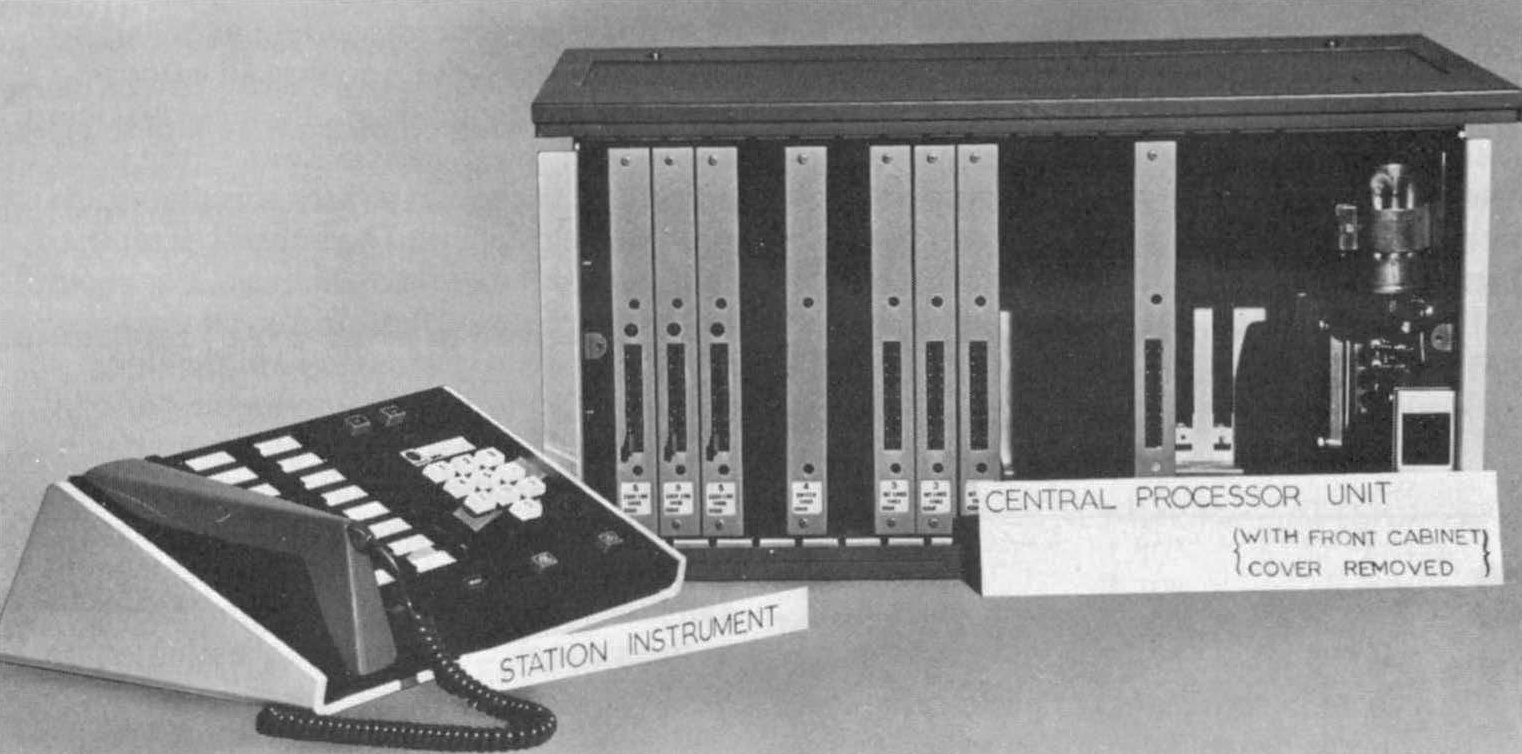
System outline
The versatile, electronic Key System 4+12
offers both intercom and direct public or
private exchange access. Designed to be
installed in offices, it
is small and silent in
operation and includes advanced features
normally associated with more elaborate
systems, such as hold, transfer and
conference facilities. It provides for a
maximum of 4 exchange lines and 12
extensions. A 4-wire cable connects the
extension instruments to a central switching
cabinet, two wires being
used for speech and two
for signalling. The photograph
shows the central switching cabinet
or
Processor Unit
and a station instrument.
The units are fully factory wired. Standard
plug-in printed wiring boards (PWB) are
inserted to meet the specific requirement
exchange
lines and extensions-of each
installation. There are four different types of
PWB, a fully equipped unit having a total of
thirteen.
Digital control
The switching element for the speech circuits
uses a single stage of reed relays. The folded
matrix arrangement only needs a single
crosspoint to be operated per call, the
number of cross points provided giving a
non-blocking system so that all extension
stations
can be used simultaneously. Using
a time-sharing digital technique, the
signalling system caters for simultaneous
bothway signalling.
The control equipment
looks at each extension in a cyclic scan and
during each interrogation period the
extension instrument is sent
eight clock
pulses. In periods between the first and fifth
clock pulses, the station instrument has
access to the central equipment during
which
1t sends five data pulses. These five data
pulses provide a possible 32 codes which
satisfies the maximum signalling
requirement
of the system. Clock pulses six to eight are
used for signalling from the central
equipment to the extension instrument.
Maintenance
A handbook has been prepared to help
maintenance staff in localising faults.
Maintenance of the Processor Unit is based
on
defective card identification and
replacement procedures, that is, associating
the loss of certain facilities on the system
with the
functions of specific cards. Fault
location down to a specific card is achieved
using logical deduction with the aid of
faulting/flow charts and tables contained in
the handbook. A faulty card, once
identified, is changed with a serviceable
replacement. The defective card is then
returned to the maintenance AEE who
arranges for its repair.
Two complete sets of spare cards and
power supplies are held in two purpose
built
suitcases designed to protect the cards
during transportation
between customers'
premises and the designated holding/storage
area. When a faultsman is called to repair the
Processor Unit he collects a suitcase.
returning it to the holding point once the
repair has been completed. This method
ensures that a faultsman has all the
necessary equipment
to deal with most faults
and any spares deficiency can be easily
monitored.
Training
Familiarisation training has been given to
21 faultsmen at STB/HO's
Engineering
Training Centre in Edinburgh. This one-day
course gave them a working knowledge of
the facilities available and the operating
principles of the system. Special emphasis
was placed on faulting techniques using the
flow charts. tables and diagrams contained
1n
the maintenance handbook.
Forerunner
The Key System 4 +12
will be one of the first
modern electronic switching systems
available
in the
customer apparatus market.
It is likely to rival
present systems such as
key and lamp units. small PBXs and house
exchange systems. Experience gained by
Edinburgh and STB/HO staff will be useful
when the Herald call connect system comes
on stream in Scotland.
|