AA Call Boxes - A Guide | |||||||
|
These characteristic black and yellow buildings were once "the lighthouses of the road." (1) In times past, motoring enthusiasts relied upon them for directions, breakdown help, and support throughout their travels. Individually numbered, each AA call box had its own sentry and well-documented location. At first, these buildings were intended as shelters for road patrols. Over time, they came to be used by AA members. A stranded motorist had nothing more to do than call and give the number of the kiosk, and help was on the way. The easily recognized logo meant that a traveller could find a light, maps, fire extinguisher, and many other items whenever they were needed. As technology progressed, telephones and other communication devices were added. Ironically, however, it was the further development of technology that eventually caused the AA sentry box to become obsolete. Shortly after the turn of the 20th century, the number of AA call boxes had shrunk from over 1,000 to a mere 21. By 2010, there were even fewer. Not even one of them had been in use for years. Many were in dire need of repair or relocation. AA Call Boxes Offered Assistance for Early Motorists
In the early 1900s, AA sentry boxes were an innovative way to make motoring about the countryside safer for everyone. Up through the year 1919, AA watchmen (who were called sentries) manned the booths. They stood at the ready to serve any travelling member of the Automobile Association. They provided roadside assistance, communication, directions, and even sometimes medical help or transport. Their uniforms and bright yellow vehicles were welcome sights for virtually everyone on the road. By the 1920s, AA members were given their own personal keys to open the buildings (3). The term 'call box' began to replace 'sentry box' in common parlance. Their unique cross-gable roof design made AA's boxes easily identifiable. Boxes were fitted with oil lamps to provide light for travellers who might be taking shelter within.
The Prime of AA Call Boxes
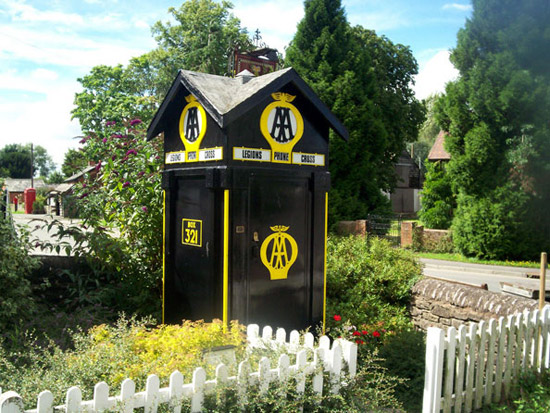
In their prime, AA call boxes were rectangular black kiosks with bright yellow detailing. Each was numbered individually for easy location and identification. A stranded motorist had only to use the key, open the box, and pick up the one-button telephone inside. A simple 'I am at box 472' would be all that was needed to dispatch help immediately. All kiosks were equipped with fire extinguishers, pulley lamps, maps, and sometimes other supplies. They were large enough for adequate shelter from the weather. There were over 1000 call boxes throughout the UK. All were used frequently. Around the middle 50s, Enham industries was contracted to design and manufacture the boxes. The company employed many ex-servicemen. One of them may well have designed the popular Mk IV style that soon became standard (4). Up to 1967, AA call boxes were all fitted with identical yellow "winged livery" logos, number plaques, and telephones (5). Popularity of AA Call Boxes Began To Fade
No new call boxes were produced after 1967. However, in that same year, all the boxes were re-fitted with the company's new square logo. This began the decline of the AA call boxes. There was a gradual phasing out of the boxes during the 1970s. Newer, smaller, and cheaper cabinets took the place of the full sized constructions. Later, these were reduced further to simple free-standing pedestal phones. By the mid 1980s, the final phones on posts were installed. The remaining call boxes, few of which were ever even visited, did receive a bit more attention in the 1990s. The square logo badges were re-branded - back to the original winged design. (5) Nothing was done to the box numbers. The AA call box was slowly becoming a piece of the past. Soon, new technology would make them even less important.
New Technology Made AA Call Boxes Obsolete
By 2001, over half of the AA call boxes had been taken over by government agencies. Those that were taken were relabelled and connected to local telephone networks (2). A phone call would now summon not the AA patrolman, but a uniformed official. Fewer and fewer people ever needed these phones. Mobile technology and cellular devices made them unnecessary. By 2002, the Automobile Association shut down its network, and began to provide for disposal and transport of the buildings. They were soon listed as historic landmarks, rather than functioning roadway items. A small group of gentlemen took interest in one particular sentry box, carefully restoring it to its former condition (1). Box 472, as it was called, survived its first winter, and became a mini-museum of AA call box history. Public appeals were made for others to join the respiration effort in other communities (4). At present, some boxes have been re-sited, others transported to museums, and some remain in need of attention. AA Box LocationsHere are the locations of the last remaining AA call boxes. Box 817 - Beadnell Box. On the B1340, Bamburgh - Alnwick, Beadnell, Northumberland, NE67. Box 753 - Glen Dye Box. B974, the Cairn on Mount road south of Banchory, Glen Dye, Strachan, Aberdeenshire. Box 751 - Inverary Box. Relocated to Glasgow Museum of Transport. Box 746 - Loch Allan. Looking south towards Grantown-on-Spey. At the junction of the A939 and A940 at Dava. Box 739 - Johnshaven Box. Relocated to Grampian Transport Museum, Alford. Box 723 - Cappercleuch Box. Yarrow. On the A708 Cappercleuch, St Marys Loch, , Dumfries and Galloway. Box 714 - Threapland Box. Threapland Wood, Urquhart. A96 Aberdeen to Inverness road at Threapland near Lhanbryde. Box 687 - Trinity Box. John's Rozel / Bouley Bay, St. Helier, Jersey, Channel Islands. Box 645 - Loughbrickland. Relocated to Ulster Folk and Transport Museum. Box 631 - Brachla Box. Brachla, Inverness and Bona. Box 580 - Boduan Box. Boduan, Llyn Peninsula, Gwynedd. Box 573 - Garrowby Box. Garrowby Hill, Bishop Wilton. Box 553 - Newby Box. Relocated to Lakeland Motor Museum, Backbarrow, South Lakeland. Box 535 - Carterway Heads. Relocated to Beamish Open Air Museum, County Durham. Box 530 - Brancaster Box. A149 Brancaster Staithe, North Norfolk,. Box 504 - Ardgay Box. Edderton, Sutherland on the old A9 between Tain and Ardgay. Box 487 - Dunmail Raise. A591 North of Grasmere, Lake District, Cumbria LA22 9RS. Box 472 - Cambus O'May Box. Cambus O' May, Nr Ballater, Royal Deeside, Cairngorms National Park, Aberdeenshire AB35 5SE. Box 456 - Halfway House. A3052 towards the junction with the B3180 road. It's postcode is AylesBeare, East Devon, EX5 2JP. Box 442 - Aysgarth Box. A684 south, just over a mile east of the turn to Aysgarth Falls. Burton-cum-Walden, Richmondshire, North Yorkshire. Box 374 - Maerdy Box. Relocated to Coventry Motor Museum. Box 372 - Mere Box. A556/A50, Mere Corner, Mere, East Cheshire. Box 342 - Bearley Cross Roads. Relocated to Wythall Transport Museum. Box 321 - Legions Cross. Outside The Cross Inn, Eardisland, Herefordshire. Box 289 - Devils Bridge. Junction of the B4574 and A4120 at Devil's Bridge, Ceredigion. Box 242 - Andoversford Box. Relocated to the GWSR Steam railway at Toddington, Gloucestershire, GL54 5TD. Box 189 - Bosley Cross Roads. Bakewell, Derbyshire (Leek - Macclesfield A523 / 80yds. South of Buxton - Congleton A54). Box 175 - Crosshall. Relocated to Glasgow's Museum of Transport. Box 162 - Highnam. Relocated to the Avoncroft Museum of Historic Buildings, Stoke Heath, Bromsgrove, Worcestershire, B60 4JR Box 161 - NantyFfin Box. Junction of the A479 with the A40, close to the Nant-y-ffin Cider Mill Inn, which is to the West of Crickhowell. Box 137 - Porlock Box. Porlock Hill, Somerset. Box 121 - Dotterel Box. Relocated to the AA Headquarters at Basingstoke. Box 73 - Wish Tower. Eastbourne (Sea front) Sussex. Box 59 - Trefnant Box. Relocated to the Cotswold Motor Museum. Box 44 - Offington Corner. Relocated to Amberley Working Museum. Box 45 - Derry Hill. Relocated to the Avoncroft Museum of Historic Buildings, Stoke Heath, Bromsgrove, Worcestershire, B60 4JR.
Complete list of AA boxes up to 1962 - Most do not exist today
AA Call Boxes Have Become a Part of HistoryThe AA call box is a uniquely UK phenomenon, a long-standing piece of history. It calls to mind the days when a young woman out motoring could count on assistance for a sprained ankle. She fell while driving, and so summoned a passing AA patrolman. He relayed the message to every single AA sentry box on the road to Southampton. The girl's parent were flagged down and informed of their child's injury (2). This kind of personal connection with strangers seems nearly impossible today. Perhaps it is not only the AA call box that has become a part of history. Perhaps something that is less tangible has also faded into the past.
Box 321 - Legions Cross. Outside The Cross Inn, Eardisland, Herefordshire
Box 242 - After restoration
Box 242 - Before restoration
A very modern AA call centre at Fanum House. Picture circa early 1960's
Sources:
|
|||||||
Last revised:FM2 |