The Phonopore
by Bob Estreich
This unusual phone was designed by Mr C Langdon-Davies of
London in the mid 1880s. He drew on earlier work by Francois van
Rysselberghe (1846-1893), who devised the principles used by the Phonopore.
Van Rysselberghe was a Professor of Physics at the Industrial School of the
Ostend School of Navigation. He was still in his teens during his early
career, and established a reputation for brilliance. He designed a
remote-reading weather station while attached to the Belgian Royal
Observatory, and it was probably this that led him into the idea of
superimposing a telephone signal across a telegraph line. He may have
followed on original work done by David Hughes in Britain, published in
1879. Hughes proposed the use of a choke coil to reduce interference between
telegraph circuits. Van Rysselberghe patented his system in 1882, and
provided details of a number of circuits to handle different configurations
of lines, both single-wire and full metallic (two wire). The system caught
on rapidly in Europe, where most long-distance telephone lines used his
system during the 1880s.
Van Rysselberghe set out to provide a long-distance
telephone using the existing telegraph networks owned by the various Post
Offices. To do this, he needed to filter out the Morse signals from the
voice, and the voice from the Morse. His timing was favourable. There were
now many telephones in operation and the subscribers wanted to make
longer-distance calls. The huge telegraph network was already in place. In
Europe the telegraph networks were owned by the same State-owned Post
Offices that owned the telephone trunk lines, so it was sensible that the
trunk service be enlarged using the existing infrastructure. In Britain, W H
Preece, the Post Office's Chief Electrician, held out on using the circuit
not because of any of its own deficiencies but because the the Wheatstone
high-speed telegraphy system used in Britain on the main telegraph lines may
have had problems with it. In spite of this, it was eventually introduced
anyway. It may have been the outcome of a visit by Preece to Paris in 1889,
where he saw the system in action and was allowed to make tests on it.
The following quotation is from Poole's The Practical
Telephone Handbook , 1912 edition., and it should be noted that the BPO
was still using Van Rysselberghe's circuits well into the 1930s.
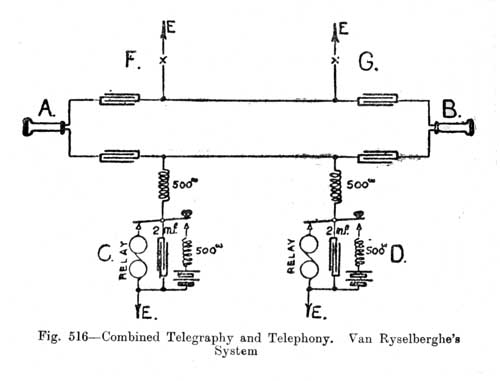
"By the inclusion in the battery and line circuit of
high inductance coils in a telegraph line, as shown in the lower part of
Fig. 516, the suddenness of the make-and-break telegraph currents can be so
reduced that a telephone connected in a branch circuit of a single wire line
would remain quite silent while telegraph messages were passing. As the
telephonic speaking current will not affect the telegraph instruments, it
was thus possible to work both telephone and telegraph on the same
single-wire line, at the same time, quite independently. This system has
been extensively used on the State telegraph lines in Belgium, and on a
number of railway lines in other countries , and for call-wire circuits for
trunk line working by the British Post Office.... By making the telephone
return through a second telegraph line fitted in a similar manner (at both
ends, of course) as shown in the upper part of Fig 516, it is easy to obtain
an inductionless metallic circuit for the telephone. if the lines are
properly balanced and twisted."
Van Rysselberghe went to the United States in 1885 to
test his system over longer lines, and was able to achieve a call from New
York to Chicago, a distance of about 1000 miles. Unfortunately in the United
States the situation was different to Europe. Western Union Telegraph and
Bell Telephones had settled their legal differences, and part of the
agreement was that they would stay out each others' business. This left Bell
with the need to build their own long distance network from scratch, an
expensive proposition. For this reason Van Rysselberghe's demonstration,
although highly successful, did not draw much further attention. Bell could
not provide a direct connection between the two cities until 1892. It was
not until Pupin's invention of the loading coil many years later that Bell
was able to provide true long-distance calls, and by then Van Rysselberghe's
work had been forgotten.
Van Rysselberghe set up business with Charles Mourlon in
Brussels to make the instruments for his system. They licensed their system
throughout the world, and its success was such that in 1889 they approached
the British and French governments about setting up a cross-Channel
telephone line. It would be paid for by the company, and repaid by a royalty
on the voice and telegraph calls made on it. The proposal was rejected by
both governments, as they were becoming concerned about the amount of
private ownership in the new and thriving telephone industry. Van
Rysselberghe died in 1893 at the age of forty six. Although recognised and
honoured in his own lifetime, his work seemed to be quickly forgotten -
except in one area.
The relationship between van Rysselberghe and
Langdon-Davies is unknown, but the operation of their two systems is
similar. Van Rysselberghe's name lapsed into obscurity, while Langdon-Davies
went on to put practical telephones into production in an area that Van
Rysselberghe appears to have ignored - the railways.
Langdon-Davies sold his Phonopores through his company,
the Phonopore Construction Co. Ltd., from a factory in Southall in Britain.
While Van Rysselberghe had designed a system to operate between telephone
exchanges or on phone-to-phone circuits, the Phonopore was designed
specifically to operate across the slow speed Morse telegraph lines owned by
the railways, and to meet their needs. To do this, it needed a filter to cut
out the low-frequency Morse pulses from the phone conversation, and to cut
out the frequencies of the voice call from the Morse, work that had already
been done by Van Rysselberghe. It also needed to signal a voice call without
interfering with the Morse. This ruled out magneto bells, as their pulses
were in the same range as the Morse. To overcome this, Langdon-Davies needed
a ringing frequency that was up in the voice ranges, not down around the
Morse frequencies. Oscillators were unknown then, so he devised a
"vibrator", a mechanical device that generated a ringing frequency by
opening and closing very fast. It worked at about 135 Hertz. This could use
a very efficient telephone receiver as a sort of bell substitute. Such a
receiver was available from the Collier-Marr company. This was a bulky
device and was not selling very well on their telephones, but it made an
ideal loudspeaker for the Phonopore. Its output was a harsh saw tooth
waveform, and the sound from the receiver was supposed to sound like the
squawking of a crow when driven by the vibrator.
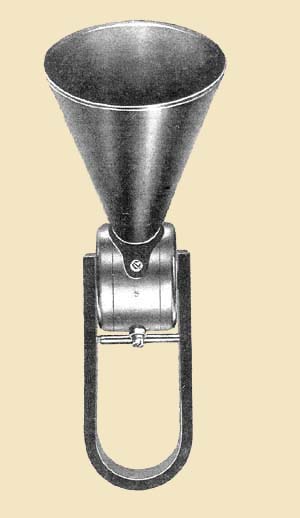 The
distinctive Collier-Marr receiver owed its high output to the double
diaphragm and massive coil assembly. An external horseshoe magnet is used to
polarize the iron core of the coil. A diaphragm is set at each end of the
iron core, between the core and the magnet's pole pieces. Although very
efficient, its size made it clumsy for use as a handheld receiver. It was
originally fitted with an earpiece, but Phonopore used a metal trumpet to
further amplify the sound. Most of the residual crosstalk between the
telephone and telegraph traffic was filtered out by placing a second
receiver in parallel with the first. These two features gave the Phonopore
telephones their distinctive appearance. The
distinctive Collier-Marr receiver owed its high output to the double
diaphragm and massive coil assembly. An external horseshoe magnet is used to
polarize the iron core of the coil. A diaphragm is set at each end of the
iron core, between the core and the magnet's pole pieces. Although very
efficient, its size made it clumsy for use as a handheld receiver. It was
originally fitted with an earpiece, but Phonopore used a metal trumpet to
further amplify the sound. Most of the residual crosstalk between the
telephone and telegraph traffic was filtered out by placing a second
receiver in parallel with the first. These two features gave the Phonopore
telephones their distinctive appearance.
The Phonopore proved efficient and reliable in use, was
almost free of induction noise and seemed immune to lightning strikes, in
spite of being based on a single-wire earth return system. Much of this was
due to the careful design of the filter coils fitted to each Phonopore and
telegraph instrument. The Compensating Coil filtered Phonopore signals from
the Morse instruments, and the Carrier Coil acted as a condenser and
filtered the Morse signals from Phonopore conversations. The company proudly
advertised "whereas condensers are continually failing through lightning,
no Carrier has ever been known to fail from this cause". The coils were
shunted to earth through efficient carbon lightning arrestors and must have
worked very well. The New Phonopore Company (the company was refinanced and
reorganized probably in the late 1890s to raise capital for expansion)
advertised that their phones could work across telegraph lines of up to 400
miles.
Langdon-Davies sourced the transmitter, receiver, and
many of the other parts from Kellogg in the United States. His company
resold Kellogg parts in Britain for some years. Some early Phonopores were
fitted with Phonopore-branded Kellogg transmitters. There is an example held
in the Powerhouse Museum in Sydney. Many surviving instruments have WE
receivers, but these were probably maintenance replacements.
The Phonopore quickly attracted attention among the
Railways, and sold well in Britain and overseas. It was reviewed in the U.S.
magazine "Manufacturer and Builder" in September 1885, the earliest known
record so far. An early British mention is in the "Pall Mall Gazette" of May
27, 1886, where the author was intrigued by the idea of two separate signals
being sent along a single wire. The company was also listed on the London
Stock Exchange by 1885.
As the phones went into wider use, Langdon-Davies found
it necessary to add two-line Phonopores, switchboards, linesmens' sets and
intercoms to the range. A desk Phonopore was also available. He even added
some standard CB and magneto telephones to the company's range, and
eventually marketed a 50-line step-by-step PAX for the railways'
administrative offices.
Mr Arthur Nicholson, the Chief Engineer of the New
Phonopore Company, devised a party line signalling system in 1914 that
allowed up to twelve connections. He did this by using relays sensitive to
particular levels of current. This did away with the need to use code rings
or other signalling arrangements, and greatly extended the use of the
Phonopore circuit. It required a two-wire circuit, but by this time these
were coming into wider use anyway. By adding a pole-changer (a device that
switched the current from + to - rapidly) magneto telephones could also be
used under some circumstances.
There were few other changes to the technology. The
vibrators eventually drifted out of adjustment and the Collier-Marr
receivers stopped working. The company designed the Resaphone, which was
simply a controlled feedback device. A signal was applied to a Kellogg-based
receiver module, and an attached pickup unit generated a feedback howl that
was fed down the line to the Collier-Marr units. It was simple and rugged
and needed no further adjustment. It probably sounded better, too, than the
squawk of the earlier models. In spite of this, Mr A Harrison designed a
simple screw adjustment mechanism for the old vibrators as late as 1919 to
allow them to be quickly brought back into adjustment by unskilled staff. A
self-adjusting unit was also produced.
Some of the telegraph noise could still feed into the
Phonopore receiver when the telephone and telegraph were operating
simultaneously on long lines with strong signals. Electrical engineer Mr
Mark Jacobs devised a number of ways of filtering out this crosstalk by
inserting a condenser or a redesigned Compensator Coil into the circuit. He
patented this in 1905. Mr Jacobs and Thorrowgood, another engineer, received
a patent in 1907 for a similar idea. By careful winding of a Compensating
coil into a receiver, a small capacitance could be built in that further cut
the noise. In practice few receivers were wound with the receiver coils, it
being simpler and cheaper to add the appropriate Compensator coil into the
circuit at some convenient point as per Jacobs' earlier design. The
Phonopore receiver winding is noted in the catalogue as only being available
in the Type RE, and it is also noted that this winding is "somewhat
delicate". The later Sterling Type A did away with the extra winding and
is noted in the catalogue as being "less liable to breakdown".
The simplicity and reliability of the Phonopore system
must have appealed to the railways, who had few technical repair people
available to them. Another attraction must have been the Phonopore's
simplicity of operation - push a button, wait for an answer, and speak. A
Morse telegraph required a trained and well-paid operator at each end, but a
Phonopore could be operated by anyone. Because the lower frequencies were
cut out by the filters, there were comments that the Phonopore sounded a bit
tinny, but that appeared to be its only fault until the railways began to
run telephone wires on the same poles. The Resaphone units generated rich
harmonics that induced into the parallel phone lines. Since the telephone
was steadily replacing the Phonopore anyway, this was rarely a problem.
The New Phonopore Company was not without competitors.
Phonopore-type phones are also known to have been supplied from Ericssons,
British Insulated and Helsby, Medhurst, Siemens and the Australian Post
Office.
The British Ericsson unit was more compact than the
Phonopore, and used an Ericsson receiver as the signalling unit. It was
their Model N1195. The use of a handset cut
down the size of the case required. They also produced a lineman's bag set.
The Model N1195 appears to have been used in Australia as its circuit is
shown in the 1914 Australian Post Office "Telephone Circuits" Handbook.
The Australian Post Office Phonopore, their
Tele 41, has been thoroughly described in the
Newsletter of the Australasian Telephone Collectors Society, January 1994
edition. It was a composite of parts assembled by the Post Office Workshops
in Melbourne. It also used an Ericsson receiver for the howler.
British Insulated and Helsby, a telephone and cable
producer, briefly made their Pantophone (Model
T707). It was a compact unit that also used an Ericsson receiver.
The Siemens & Halske phone was their Model 4126, but its
details are virtually unknown.
A Medhurst telephone is listed in the 1914 Australian
Post Office "Telephone Circuits" Handbook, and its circuit is shown, but
nothing else is known.
Around 1914 Mr Langdon-Davies sold the Phonopore business
to Sterling Telephone & Electric. They continued production with the phones
virtually unchanged. Production ceased in the early 1920s in the face of
competition from the growing public telephone networks. Many railways liked
their Phonopores, however, and the phones were often reconditioned in the
railways workshops. In New South Wales Phonopores were largely replaced by
telephones in the 1930s, but the last two were only finally taken out of
service in 1962.
References:-
Dargan, James "Morse to Micro" 1988
Bateman, Jim "History of the Telephone in NSW" 1980
Herbert & Proctor "Telephony Vol 1" 1932
Poole J "The Practical Telephone Handbook" 1912
"The Manufacturer and Builder" Volume 17, Issue 9Sept 1885 from
Cornell University Library website http://cdl.library.cornell.edu/
U.K. Patent Office
Siemens & Halske catalog, 1912 The New Phonopore Telephone Co. Ltd , "Railway
Telephones" catalogue 1910 (courtesy Linley Wilson)
For the information on Van Rysselberghe I have drawn
extensively on the detailed article "Francois van Rysselberghe: Pioneer
of Long-Distance Telephony" by D. Gordon Tucker, published in
Technology and Culture, Vol 19, No. 4 (Oct 1978). Professor Tucker's
article gives a well deserved insight into this brilliant but largely
forgotten man.
|