|
The BT Tower is a grade II listed
communications tower located in Fitzrovia, London, owned by BT Group. It has
been previously known as the GPO Tower, the Museum Tower, the Post Office
Tower and the British Telecom Tower. In 2024 an agreement to sell the
building to MCR Hotels was signed. Click here for
more information.
The main structure is 177 metres
(581 ft) high, with a further section of aerial rigging bringing the total
height to 189 metres (620 ft). The towers Post Office code for
the radio station (Microwave) and Repeater Station (Trunk) was YTOW.
The main contractor was Peter Lind & Co Ltd. Construction cost was
£1,250,000.
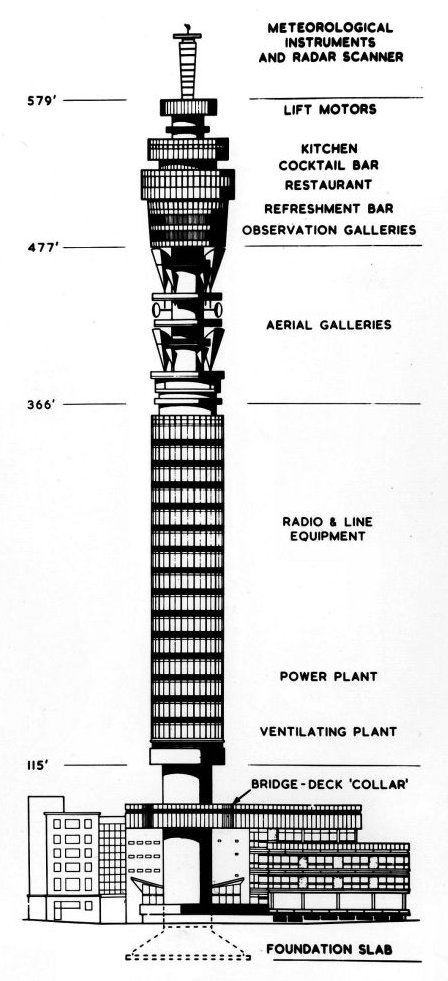 The
tower was originally designed to be just 111m (364ft) high, but it is in
fact 177m (581ft) high as a building and 191m (627ft) high with the aerial
rigging. The foundations are sunk down through 53 metres (174ft) of London
clay, and are formed of a concrete raft 27 metres (89ft) square, 1 metre
(3ft) thick, reinforced with six layers of cables, on top of which sits a
reinforced concrete pyramid. The
tower was originally designed to be just 111m (364ft) high, but it is in
fact 177m (581ft) high as a building and 191m (627ft) high with the aerial
rigging. The foundations are sunk down through 53 metres (174ft) of London
clay, and are formed of a concrete raft 27 metres (89ft) square, 1 metre
(3ft) thick, reinforced with six layers of cables, on top of which sits a
reinforced concrete pyramid.
The area adjacent to the Museum Telephone Exchange site
was chosen and the new tower was joined to the existing building via a
bridging section. The Museum exchange already had an earlier microwave
dishes on the roof, which were removed when the tower came on line.
The Tower was a hub for
Microwave transmission. It was constructed to overcome the issue of
tall buildings, that were planned for construction in London, and that would
interfere with the original microwave dish on top the Museum Telephone
Exchange building. Microwave was used as it was more cost effective
over long distances than cables. Height was necessary to see over the
horizon as microwave signals travel line-of-sight.
Upon completion in 1964, it overtook the Millbank Tower
to become the tallest building in both London and the United Kingdom, a title
that it held until 1980, when it in turn was overtaken by the NatWest Tower.
The GPO Tower was celebrated
for its revolving restaurant (run by holiday-camp giant ‘Butlins’
no less!) on floor 34, which made one complete revolution every 22 minutes
(it is the floor that revolves and not the top of the tower).
This was this was called The Top of the Tower.
Due to security concerns, the restaurant was closed in 1980 and the public
have been refused access to the landmark ever since (with the exception of
the annual ‘Open
House Weekend‘, when those wishing to visit must provide
security details before entering a lottery-draw to win one of the coveted
tickets).
In its first year the Tower hosted just under one million
visitors and over 100,000 diners ate in the restaurant.
Even Batman visited the tower in June 1967.
Click here
As well as the communications equipment and office space,
there were three public viewing galleries and a souvenir shop.
Opening
and use
The tower was topped out on 15 July 1964 and
officially opened by the then Prime Minister Harold Wilson on 8 October
1965.
The tower was officially
opened to the public on 19 May 1966, by Tony Benn (then known as Anthony
Wedgwood Benn) and Billy Butlin, with HM the Queen visiting on 17 May 1966.
In its first year the Tower hosted just under one million
visitors and over 100,000 diners ate in the restaurant.
In 2011 BT were allowed to remove the microwave horns as
they had deteriorated to a dangerous condition. These were once used to
transmit data across a nationwide network of similar towers.
Right up until the 1980s, the microwave network was responsible for
transmitting television signals and other data – some of it military.
The arrangement comprised of a link of transmitters, stretched across the
United Kingdom from north to south; with towers similar to the London GPO
erected in Birmingham (at Snow Hill) and Manchester (in Heaton Park).
Another microwave network
using towers was built for UK Government and in many instances used the GPO network. This was a secure network known by the codename, ‘Backbone’
and, in the event of a nuclear attack, this resilient network would have
provided vital communications for the government.
Quite how this would have
worked no one is sure when you consider the searing heat and 500mph blast
wave unleashed by a nuclear weapon, it is doubtful that any buildings (or
indeed people) would have been left standing. The rationale was that
after the nuclear strikes in Japan, during the 2nd World War, round towers
were still left standing.
But, it looks like Backbone was the start of the GPO
microwave network, because the GPO trunk network hubs were not connected by
Backbone. The GPO therefore decided to link the main telecom centres
by Microwave as a cost effective solution to installing co-axial cables and
also had links to Backbone..
It was reported
that one member had eye sight issues after working in these areas for a
period of time, so any work on the Microwave galleries only took place when
the horns in the area to be worked were switched off.
There were three viewing galleries, the lowest was
totally open to the elements with wire mesh windows, the middle gallery was
glazed and the upper gallery was a refreshment area.
The floors below the aerial gallery were used for equipment bays,
control rooms, ventilation rooms etc.
Until 1993, the Museum Tower was
classed as an official state secret!
This status meant that it was not allowed to appear on any map. Taking
photographs was also a no-no and its address on
Maple Street in
Fitzrovia, was classified.
Kate Howie MP, speaking in The UK Parliament on 19th February
1993 spilt the beans by announcing to the public:
"Hon. Members have given examples of seemingly trivial information
that remains officially secret. An example that has not been mentioned,
but which is so trivial that it is worth mentioning, is the absence of
the British Telecom tower from Ordnance Survey maps. I hope that I am
covered by parliamentary privilege when I reveal that the British
Telecom tower does exist and that its address is 60 Cleveland Street,
London (Hansard col.632)"
Although prohibited, the Tower has appeared in BBC’s
Doctor Who the 'War Machines' which curiously does have a “D” Notice slapped
on it as the YouTube clip has now been withdrawn by the BBC. The tower
has been a popular backdrop to science fiction films among others V for
Vendetta, The Fog, The New Avengers episode 'Sleeper;, The Day of the Triffids and even Harry Potter flies over it in a Ford Anglia. But an
all time favourite in which the tower is featured is the classic scene in The
Goodies, comedy TV show, when the Tower is toppled over by Twinkle the giant
kitten in the episode
'Kitten Kong'.
With the installation of the UK fibre network the Tower
was effectively made obsolete with the last of the microwave horns being
removed in 2011, due to their bad state of repair.
But the tower is still in use, and is still the site of a
major UK communications hub. Microwave links have been replaced by
subterranean fibre optic links for most mainstream purposes, but the former
are still in use at the tower. The second floor of the base of the tower
contains the TV Network Switching Centre which carries broadcasting traffic
and relays signals between television broadcasters (including the BBC),
production companies, advertisers, international satellite services and
uplink companies. The outside broadcast control is located above the former
revolving restaurant, with the kitchens on floor 35.
But with the sale of the site to a Hotel Company, the
communications and TV equipment will be scaled down and finally removed.
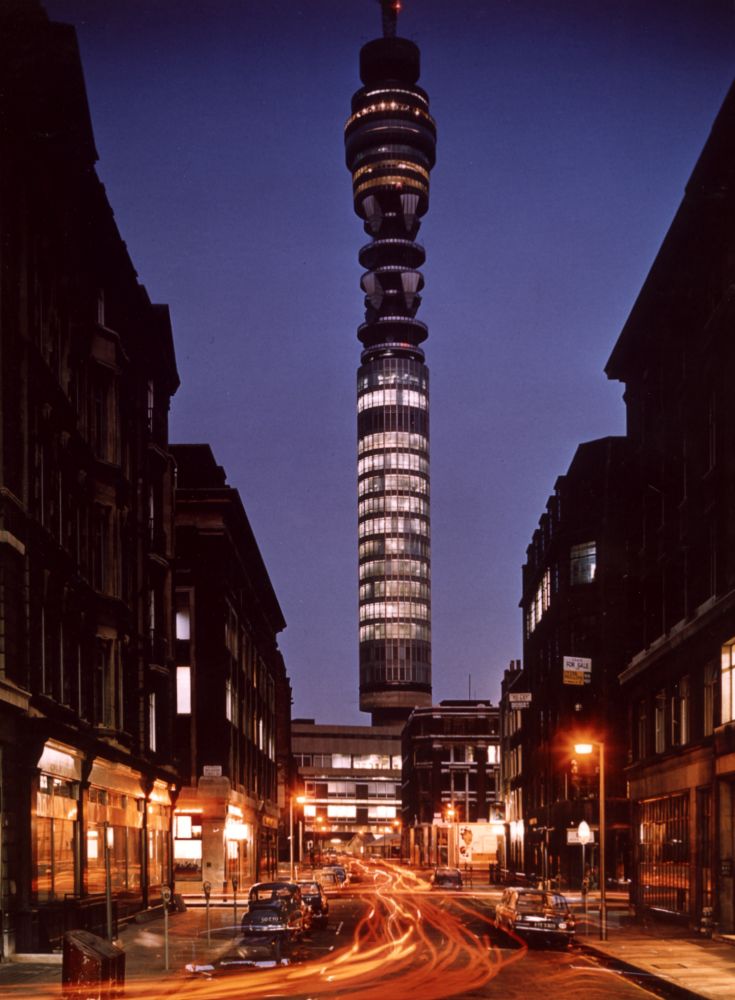
A renovation in the early 2000's introduced a 360° coloured lighting display
at the top of the tower. Seven colours were programmed to vary constantly at
night and intended to appear as a rotating globe to reflect BT’s “connected
world” corporate styling. The coloured lights give the tower a distinctive
appearance on the London skyline at night. In October 2009, a 360°
full-colour LED-based display system was installed at the top of the tower,
to replace the previous colour projection system. The new display, referred
to by BT as the “Information Band”, is wrapped around the 36th and 37th
floors of the tower, 167m (548ft) up. The display comprises some 529,750
LEDs arranged in 177 vertical strips, spaced around the tower. The display
is the largest in the world of its type, occupying an area of 280 m2
(3,000sq ft) and with a circumference of 59m (194ft). On 31 October 2009 the
screen began displaying a countdown of the number of days until the start of
the London Olympics in 2012.
In October 2009, The Times reported that the rotating restaurant would be
reopened in time for the 2012 London Olympics. However, in December 2010, it
was further announced that the plans to reopen had now been ‘quietly
dropped’ with no explanation as to the decision. For the tower’s 50th
anniversary, the 34th floor was opened for three days from October 3-5, 2015
to 2400 winners of a lottery.
The BT Tower was given Grade II listed building status in 2003. Several of
the defunct antennas located on the building could not be removed unless the
appropriate listed building consent was granted, as they were protected by
this listing.
In 2011 permission for the removal of the defunct antennas was
approved on safety grounds as they were in a bad state of repair and the
fixings were rotting and no longer secure. In December 2011 the last of the antennas was
removed leaving the core of the tower visible.
Entry to the building is provided by two high-speed lifts which travel at 7
metres per second (16 mph), reaching the top of the building in under 30
seconds. An Act of Parliament was passed to vary fire regulations, allowing
the building to be evacuated by using the lifts – unlike other buildings of
the time.
The tower is being used in a study to help monitor air quality in the
capital. The aim is to measure pollutant levels above ground level to
determine their source. One area of investigation is the long-range
transport of fine particles from outside the city.
1971 bombing
A bomb exploded in the roof of
the men's toilets at the Top of the Tower restaurant at 04:30 on 31st
October 1971, the blast damaged buildings and cars up to 400 yards away.
Responsibility for the bomb was claimed by members of the Angry Brigade and
a call was also made by a person claiming to be the Kilburn Battalion of the
IRA. This resulted in the tower being largely closed to the general
public.
The restaurant was closed to the public for security
reasons a matter of months after the bombing in 1971. Butlins' lease expired
in 1980 and in 1981 public access to the building ceased.
The tower is sometimes used for corporate events, such as
a children's Christmas party in December, Children in Need, and other
special events; even though it is closed, the tower retains its revolving
floor, providing a full panorama over London and the surrounding area.
Comment
Mr L.R.N. Mills former head of PO Inland Radio Planning, writing for
Connected Earth.
The birth of the BT London Tower sums up the position in
the early sixties. The GPO had a number of disjointed radio links
connected together by cable with no apparent plan for a national radio
network. Then came Backbone, a system planned to provide secure
communications between strategic Government locations avoiding cables which,
by the very nature of the network, passed through important towns and
cities. The Backbone network deliberately avoided built-up areas and
thus did not provide any basis for a national city to city radio network.
Top management in the Radio Branch were somewhat
irritated by this. Then came, BBC2, 625-line colour television and
plans were at last laid for a national city to city microwave radio network.
The next question is - if a national radio network were established for TV,
would adding telephony channels to radio links be cheaper than laying more
cables - the answer was Yes.
The conclusion from all this is that we have mainly to
thank the coming of 625-line colour television for the existence of BT's
microwave radio network and the London Tower.

|