|
As usual, with most GPO, Post Office or BT equipment, there are
markings on them which help identify the component.
Identification normally consists of the
type number, date and manufacturer.
Covers markings can be found on a plate embedded in the concrete face,
but many of the earlier covers are marked underneath, on the casting.
Drawing CN13687 (dated 1981) describes the embedded plate used
on later Footway and Driveway covers.
Originally the covers were either for the footway or carriageway
and called Cover, Joint Box or Covers, Manhole.
This then changed to Covers, Footway and Covers, Carriageway
with a new designation called Covers, Driveway introduced later.
Circa the year 2000 the plates changed show the British Standard numbers (group
and class) on them instead of the Footway or Carriageway designation. See
table below for further details.
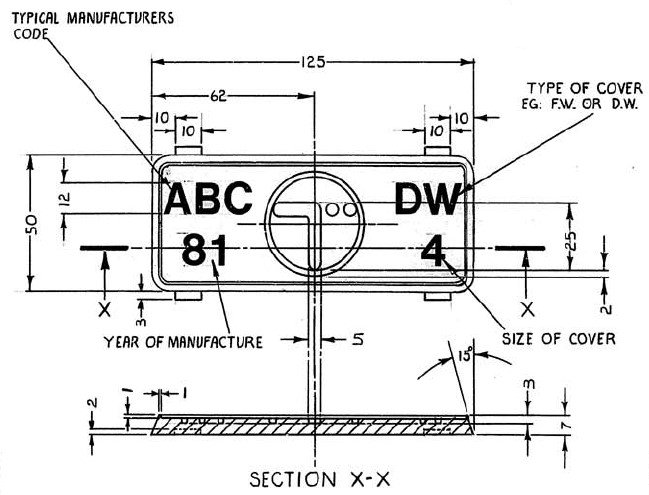
Extract from CN13687
Confusingly, the "Size of Cover" should probably read "Size/Cover
Number"
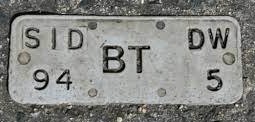
Typical Cover label
Made by SID in 1994
Driveway Cover No. 5
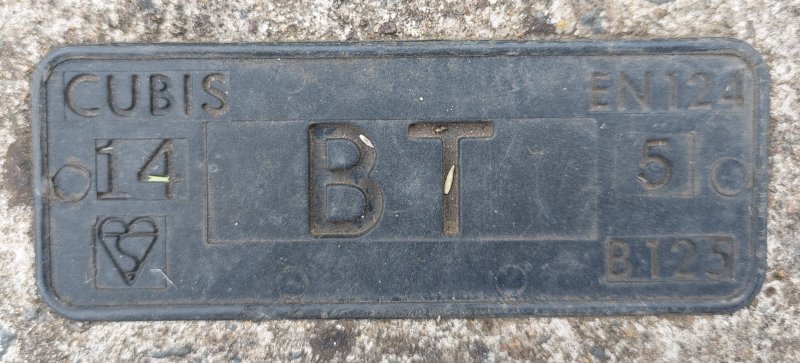
This is a Cover No. 5 with British Standard group and class
It is group EN128 and class B125
It is a Footway cover
An explanation of the
British Standard EN124
BS EN 124 history & definitions
BS EN 124 (Gully Tops and Manhole Tops for Vehicular and Pedestrian Areas)
superseded BS 497:1976 Specification for Manhole Covers, Road Gully Gratings
and Frames for Drainage Purposes in 1994, and was updated to become BS EN
124:2015. It is the British adoption of the European standard for covers and
gratings that separates products into a number of classes based on a static load
test, and also groups the locations where each class should be installed (and
the minimum class that should be used in each). It was produced and is published
by the
BSI Group.
The standard is split into one general part and five material-specific parts,
and brings products made of different materials into the scope of BS EN 124.
-
BS EN 124-1:2015 — Definitions, classification, general principles of
design, performance requirements and test methods:
- BS EN 124-2:2015 — Gully tops and manhole tops made of cast
iron.
- BS EN 124-3:2015 — Gully tops and manhole tops made of steel
or aluminium alloys.
- BS EN 124-4:2015 — Gully tops and manhole tops made of steel
reinforced concrete.
- BS EN 124-5:2015 — Gully tops and manhole tops made of
composite materials.
- BS EN 124-6:2015 — Gully tops and manhole tops made of
polypropylene (PP), polyethylene (PE) or un-plasticized polyvinyl
chloride (PVC-U).
BS EN 124 groups & classes
Let’s start by looking at the groups that BS EN 124 use to categorise the
areas in which covers may be used. These range from Group 1, representing the
least demanding environments, to Group 6 that represents the most demanding
environments.
- Group 1 — areas where only pedestrians have access.
- Group 2 — car parks and pedestrian areas where only
occasional vehicular access is likely (incl. driveways).
- Group 3 — car parks, forecourts, industrial sites and
areas with slow moving traffic. Also in highway locations up to 500mm from
the kerb and up to 200mm into the verge, excluding motorways.
- Group 4 — areas where cars and lorries have access,
including carriageways, hard shoulders and pedestrian areas.
- Group 5 — areas where high wheel loads are imposed,
such as loading areas, docks or aircraft pavements.
- Group 6 — areas where particularly high wheel loads are
imposed such as aircraft pavements.
Next up the classes that BS EN 124 to rate a cover's static load
capabilities, ranging from A15 to F900.
- Class A15 — covers and gratings capable of withstanding
a 15kN test load.
- Class B125 — covers and gratings capable of
withstanding a 125kN test load.
- Class C250 — covers and gratings capable of
withstanding a 250kN test load.
- Class D400 — covers and gratings capable of
withstanding a 400kN test load.
- Class E600 — covers and gratings capable of
withstanding a 600kN test load.
- Class F900 — covers and gratings capable of
withstanding a 900kN test load.
Classes are matched to their appropriate group to give the recommended
minimum rating for each group.
| Loading Group |
Installation
Area |
BS EN 124 Class |
BS EN 124 Test Load |
(Superseded)
BS 497 Equivalent |
| Group 1 |
For use in pedestrian areas where vehicles
have no access |
A15 |
15kN (1.5 tonnes) |
Grade C |
| Group 2 |
For use in car parks & pedestrian areas
where infrequent vehicle access is likely (incl. driveways) |
B125 |
125kN (12.5 tonnes) |
Grade B |
| Group 3 |
For access covers & gully gratings in
areas of slow moving, heavy traffic; also for gully gratings in
certain carriageway areas (see full definition above) |
C250 |
250kN (25 tonnes) |
Grade A |
| Group 4 |
For use in carriageways of roads, hard
shoulders and parking areas |
D400 |
400kN (40 tonnes) |
Grade A |
| Group 5 |
For use in areas where high wheel loads
are present |
E600 |
600kN (60 tonnes) |
- |
| Group 6 |
For use in areas where extremely high
wheel loads are present |
F900 |
900kN (90 tonnes) |
- |
Installation areas and BS 497 comparisons for guidance
only.
|