|
Various Types and their use -
Lines, Underground D1001
Duct laying - General Instructions -
Lines, Underground D3101
Cabling in ducts - A2D3010
Self-Aligning Ducts (Single and Multiple way), Salt-glazed
earthenware.
The class of conduit most frequently used is the earthenware duct, fitted with
spigot and socket ends and lined with Stanford's composition. The ducts are
"self-aligning," i.e., when the spigot of one duct is placed in the socket of
another and pressed home, the inside walls coincide and there is no need for
further adjustment. The ducts are issued in single and multiple "ways." The
single-way types are 3in. and 4in. internal diameter respectively, whilst the
multiple types are made up in 2, 3, 4, 5, 6 and 9 way sizes, each having an
internal duct diameter of 3.25in and are 2' 6" long. Joints are made with
hot tar or pitch.
A Duct, Terminating No. 11 was also available and this would
be the last duct used as it entered the manhole. This duct is 4" in
diameter and enabled a joint sleeve to be slipped up the pipe where space for
cable jointing was restricted.
For more information see
Lines, Underground, D1002
Duct Laying - Lines, Underground,
D3150
Duct No. 15 - Lines, Underground
D1006
Laying Duct No. 15 - Lines,
Underground D3156
Click here for a POEEJ article - 1964
Octagonal Ducts
These are used where more then 19 ways are required or where congestion
would render the use of Self Aligning Ducts uneconomical. These ducts are
laid on a concrete bed and jointed with Ozokerit tape. The ducts are then
covered with a mortar bed. These are 18in. length and have a bore of
3.25in. or 3.5in.
For more information see
Lines, Underground D1003
Duct Laying - Lines, Underground,
D3170
Asbestos Cement Ducts
These are used as an alternative to to self aligning ducts. They weight less and
have greater flexibility of formation than other duct types.
For more information see
Lines, Underground D1170
Pitched Fibre
Pitched Fibre Ducts were used in concrete for lead-ins to all types of exchanges
and other buildings.
Cheaper than Cast Iron these ducts are produced from wood pulp which is
impregnated with Bitumen and a preservative. Made in 5 foot lengths and
very light to handle. They are reduced at one end and fitted into each and
sealed with a compound. Ducts No. 80 and 81.
For more information see
Lines, Underground, D3175
Steel Ducts
Steel Pipes are used in
cases, such, for example, as bridge crossings, where conduits have to be laid
shallow and, because of lack of cover, earthenware ducts or cast iron pipes
would be liable to fracture. They are also used across bridges or canals, where
the pipes have to be slung. Lengths varying from 14ft. to 30ft., with spigot and
socket ends, are issued. The internal diameter is 3.25in. and the pipes are
covered with prepared jute, and coated inside and outside with preservative
compound. Ducts No. 70.
Mild Steel Pipes
In cases where a small dimension
conduit is required, mild steel pipe is used. It is issued in four sizes, with
internal diameters of 0.75in., 1in., 1.5in., and 2in. Each length is screwed at
both ends and one end of each length is fitted with a socket for screw jointing.
The smaller sizes are used for taking underground circuits direct into
subscribers' premises, under pavements, or enclosures, where the use of
troughing is unsuitable, also for attachment to walls or fences. The 1.5in. and
2in. sizes are used for the protection of cables which leave the underground
system and terminate at Distribution Poles. Mild Steel pipes are also used for
leading-in underground. cables to important business premises for Block
Distribution. Mild steel pipes can be bent locally as required. For the 0.75in.
size, a pipe vice is used, whilst Jim Crows are employed for bending the larger
sizes.
For more information on Steel Ducts see
Lines, Underground D1010
Duct Laying - Lines, Underground,
D3250
Ducts, Steel No. 70 - A2F0201
Cast Iron Ducts
Cast Iron Pipes have been extensively
used in the past, but self-aligning ducts superseded them. The use of cast
iron pipes was confined to congested thoroughfares, where frequent
disturbance of the ground is probable. Made from pig iron the pipes are dipped
in a solution of Dr. Angus Smiths composition, which acts as a rust
preventative. The pipes were made with spigot and socket
ends and were issued in three sizes, 3in., 3.25in. and 4in. All sizes are 9 ft.
long, exclusive of the socket. When joining pipes the spigot end has spun
yarn wrapped around it and the pipe is then inserted into the socket. The
yarn is then driven home with a caulking iron and the space left is filled with
molten lead. Without the yarn, the lead would flow into the pipe, thus
causing blockages.
For more information see
Lines, Underground D1015
Duct Laying - Lines, Underground,
D3301
Wrought Iron Ducts
Used for leading-in to subscribers premises under pavements and gardens.
For more information see
Lines, Underground D1020
Wood Troughing
Troughing, Wood Creosoted 1.5"
This is effectively a piece of 2.5" x 2.5" wood, with a 1.5" bore down the
centre and then split into two. The bottom sections are joined to each
other by nailed a bridging piece of wood between them. The top sections
are then wired to the bottom sections with binding wire. Supplied in 6'
and 20' lengths. Used for small cable schemes and laid at a shallow depth.
Duct Laying -
Lines, Underground, D3201
Polythene Duct
Duct No. 100 is polythene tubing for use as an alternative to Duct No. 62 where
the high mechanical strength provided by the latter is not essential, e.g. for
leading-in to subscribers' premises, under pavements, gardens or parks and in
certain circumstances for leading up to D.P.s.
Description
The duct has an internal diameter of 3/4in., a wall thickness of 1/8in., and is
supplied in 500 ft. coils.
Jointing
Normally the duct should be laid without joints, short ends being used for
suitable work. However, where costly relaying of existing Duct No. 100 can he
avoided by jointing on a new length a joint may be effectively made by using a
6in. length of 1in. internal diameter polythene tube as a sleeve. The duct ends
to be jointed should be cut square and pushed into the ends of the sleeve, so
that the two ends of the duct butt squarely against each other at the centre of
the sleeve. The joint shall then be lapped with Tape, Plastic, Adhesive, Grey,
the lapping extending 2in. beyond the ends of the sleeve. Since only small
amounts of 1in. internal diameter tube will he required for jointing, sufficient
quantities to meet requirements should be purchased locally.
Bends
The duct is flexible, but to avoid cabling difficulties bends should be avoided
as far as possible, except where the duct is brought up to ground level at the
wall of a building or at a D.P.
For more information see Lines,
Underground D1030
PVC Duct
PVC Duct No. 55 replaces Pitch Fibre duct in concrete for lead-ins to all types
of exchanges and other buildings and street duct tracks greater than 18 ways.
Duct No. 56 replaces Asbestos Cement Duct No. 21.
For more information see Lines,
Underground D1035

Duct No. 5, 6, 8, 9 and 10 (Self Aligning)
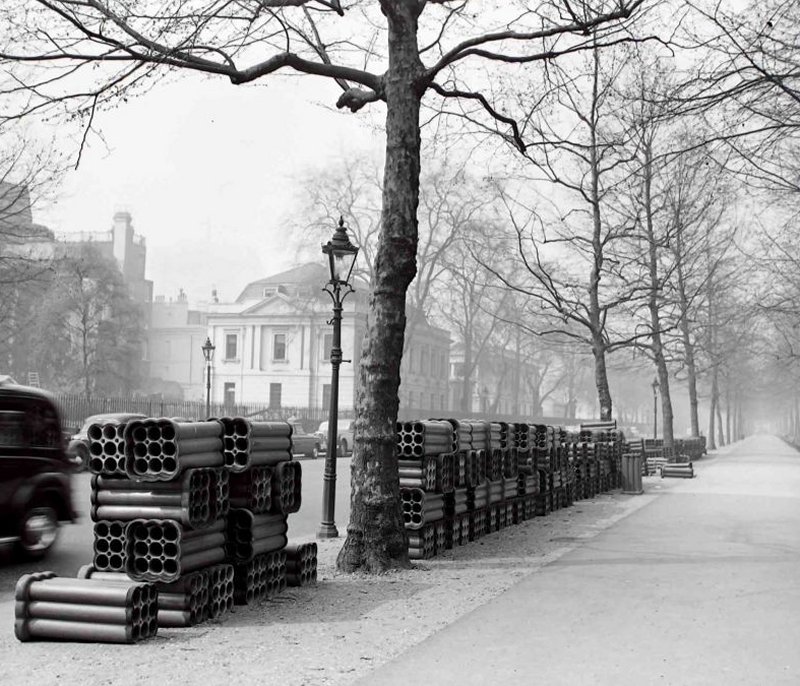
Duct No. 10 - Duct awaiting installation at Hyde Park, London in 1962

Steel and Octagonal ducts (Duct No. 80)

Steel and Octagonal ducts (Duct No. 80) - method of joining
|