| Make |
Karrier |
| Model |
Gamecock CK3 |
| Type |
2 ton General Utility Vehicle, Type 1
(Karrier) |
| Body Builder |
1947 - Yeading and 1948 - Spurling Motor
Bodies |
| Use |
Overhead construction |
| Registration Number |
JLE
625 (1947) and JXY 747 (1948) |
| Fleet Number Ranges |
U48046 (JLE 625) 1947 - Prototype
U56125 to U56334 (JXY 452 - 661) 1948
U56335 to U56434 (JXY 730 - 829) 1948
U57770 to U57775 (LUU 994 - 999) 1950
U57764 to U57847 (MLB 518 - 589) 1951
U57900 to U58041 (MLH 395 - 536) 1951 |
| Date of pictures |
September 1948 and 1950 |
Karrier
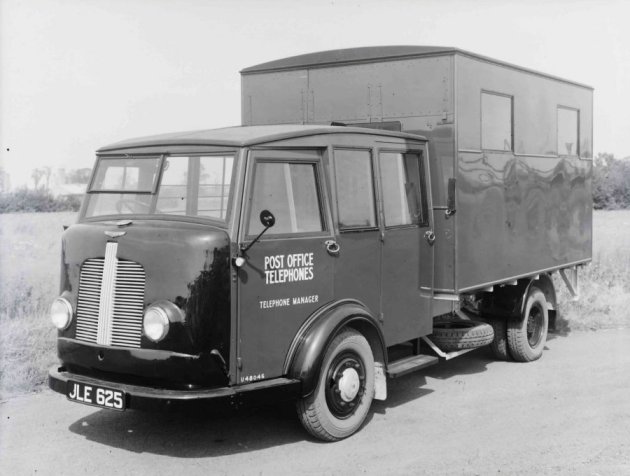
Gamecock, CK3 model, 2 ton, crew cabbed utility van. On this model the basic cab
was wooden framed with
aluminum cladding whereas the later Karrier QXM models
had a pressed steel cab.
This particular utility was probably the first postwar
2 ton utility to be delivered.
Click here for
an article on this vehicle
1947 Model


1948 Model


The Post Office Electrical
Engineers' Journal
VOL. 42 - April 1949
A New Utility Vehicle
G. H. SLATER
U.D.C. 629.113
A 2-ton general utility vehicle of an experimental type has
been designed by the Post Office and is now on trial in the field.
The advantages over earlier types include higher pay-load; low loading; more
floor and locker space; adequate pole and ladder-carrying capacity and an
improved standard of comfort for workmen.
Introduction
To introduce the subject, perhaps a reference to some of the utility
vehicles of the past will best serve to provide a suitable back ground
against which to display what it is hoped will be the advantages of the
future version of this type of vehicle.
One of the earliest, if not the earliest, "Utility" is shown in Fig.
1. Here some of the disadvantages of these vehicles of the earlier
days of motor transport in the Engineering Department are clearly presented;
the open cab, the open body, the unbalanced suspension of the ladders to
avoid obstructing entry to the cab, and the lack of pole-carrying
facilities.
At the time this vehicle was introduced (about 1925), it was no doubt the
acme of design, and although compared with present-day standards it presents
a somewhat severe and angular appearance, it was indeed a great step forward
from the alternative of trundling a heavy handcart in the execution of works
necessary to the provision and maintenance of an efficient telephone
service.
In 1927, the vehicle shown in Fig. 2 was brought into service, the
design of which incorporated a closed body with glazed panels, improved
ladder-carrying facilities, pole-carrying facilities,
wiring drums and an improved locker space.
The Utility as we know it to-day remains little changed from the vehicle
shown in Fig. 2, except for minor modifications such as sliding glazed
panels, improved locker doors and an attempt, in the form of hooks, clips
and a detailed stowing list, to provide a place for everything necessary.
These vehicles are of the 30-cwt. class and are officially described
as 30-cwt. Utility vehicles. They are most extensively used by
gangs employed on Advice Notes and Minor Works and are the standard vehicles
for four-man gangs.
Contemporary with the 30-cwt
Utility is the 30-cwt. Stores-carrying vehicle, which is sometimes
used as a Utility because of its superior pole carrying capacity and its
suitability for underground cabling works; during the war years it was used
because the standard utility vehicles were not available. The
stores-carrying vehicle, as its name implies, is primarily a vehicle for
carrying general stores, and when it is used as a Utility, it is usually
necessary to provide removable tool lockers. Recently, in an attempt
to alleviate the discomfort occasioned to workmen riding in the body of the
vehicle, a draught screen has been provided for fitting under the tilt of
the vehicle.

Fig. 1 - Utility Vehicle in 1925

Fig. 2 - Utility Vehicle in 1927
Necessity for a New Utility Vehicle
The present time, therefore, some 23 years after the introduction of the
first Utility, finds in regular
service two standard vehicles, one a utility vehicle
which does not meet entirely the present-day requirements, and the other a
stores-carrying vehicle which
is, at best, a makeshift affair when used as a Utility.
This also was the position in 1938, but the intervening
war years precluded any investigation of the possibilities of improvements
so clearly necessary to keep
abreast of the changing conditions and practices.
Further, during the immediate post-war years, with all
the attendant production difficulties of that period, it
was necessary to accept almost any vehicles which
could be obtained quickly, to meet the intensive
campaign against the arrears of telephone installation
works. Thus, the investigation was further delayed
until the immediate post-war demand was met and
the production position became more stable.
Eventually, an exhaustive investigation was made
towards the end of 1946 and it was found that the
30-cwt. Utility vehicle was being used for many
purposes for which it was not designed; overloading
was occurring more frequently than was desirable
and in many cases 50 per cent, of the locker space was
not used even when the vehicle was employed on
Advice Note works - for which it was originally intended. In practically
all cases, on whatever duty
the vehicle was employed, the floor space was
found to be occupied by items which could not be
stored in the lockers, such as earth plates, stayblocks,
bricks, sand, earth from excavations, joint box
frames, crowbars, sledge hammers, coils of rope, fire
pots, jointers tents, drums of cable, and motor pumps.
One vehicle was carrying ten men and hauling a motor
winch.
Gangs provided with 30-cwt
Utilities had little
criticism to offer when employed on overhead Advice
Note work and gangs provided with 30-cwt. stores-carrying vehicles
used as Utilities on similar duties,
were generally envious of gangs with 30-cwt. Utilities
and complained that the removable lockers were
unsuitable, that they occupied too much floor space
and afforded inadequate accommodation for tools and stores, and that
appreciable discomfort was occasioned
to members of the gang when riding in
the body of the vehicle.
Gangs employed on underground works, although not enthusiastic about the
stores-carrying vehicle used as a Utility, preferred it to the 30-cwt.
Utility, with the general complaint that the floor height of the vehicle was
too great.
Supervising officers generally agreed that the 30-cwt. Utility lacked
floor space in the body of the vehicle, and was of limited use and,
therefore, unsuitable for the mixed duties gangs are required to perform.
Design of New Vehicle
On analysing the information gleaned from the investigation, it became clear
that to meet the requirements of the mixed duties - anything from joint box
building and underground cabling works to Advice Notes - a vehicle was
required which combined as far as possible all the advantages of the 30-cwt.
Utility without introducing any of the disadvantages; in the main, a vehicle
which provided ample floor space and payload, adequate pole- and
ladder-carrying facilities, adequate comfort for the gang, a low floor
height and sufficient locker space.
Proposals for a new utility vehicle were therefore
formulated and the specification provided inter alia
for a minimum payload of 2 tons, cab accommodation
for five persons including the driver, lowest possible
floor height even if wheel arches within the body
could not be avoided, and, inside the vehicle, open
locker space confined to the offside and front end of
the body.
An experimental vehicle was decided upon, and
its construction was undertaken by the Post Office
in the workshops at Yeading, where, under the
direction of Motor Transport Branch officers, every
detail of the specification was incorporated in the
design of the new vehicle described in the following
paragraphs and illustrated in Fig. 3.
A 3-ton Karrier Low Loader chassis with small diameter twin rear wheels has
been used to provide for a payload of 2 tons, and to give a floor height of
approximately 3 ft. A step placed to the offside of the tailboard and
a conveniently placed grab handle (see Fig. 4) should prove of considerable
advantage to the users and reduce to a minimum the exertions necessary to
get in and out of the vehicle; quite an appreciable saving of effort when
one considers the number of times a workman may get up into and down from
the vehicle during a normal day's work.

Fig. 3 - The New Experimental Vehicle
The cab of the vehicle as shown in Fig. 5 next calls
for comment. Built as an entirely separate unit from
the body, this spacious compartment will accommodate in comfort five persons
including the driver. A
locker beneath one of the seats provides accommodation for the foreman's
books and papers, and a
folding table, together with a conveniently placed
light for use when occasion demands, completes the
furnishing and provides adequate office facilities for
completing the records a foreman is called upon to
make. Mention must be made of the exceptionally
clear view afforded by the forward setting of the cab,
the adjustable driving seat, and the wide forward-hung doors. The
introduction of this cab as standard
should, in the author's opinion, remove once and for
all those complaints, many of which
were quite justified, of the discomfort
of riding in the Department's Utility
vehicles. Further, the degree of comfort provided for the gang while
travelling to and from a work will no doubt be reflected in an
enhanced efficiency
when on the job, and will repay for
the careful consideration expended in
devising the cab accommodation.
So far the emphasis has been on the
comfort of the workmen, and the
impression may have been gained that
this was the sole purpose in mind.
Important as this may be, however, it
is not the only factor to receive attention, and the remainder of the
description will show that a balance has been
struck in providing a vehicle which will
result in an improved overall efficiency
in the field.
Mention was made earlier of the
limited pole-carrying facilities of the
30-cwt. Utility, and the high loading height of the 30-cwt.
stores-carrying vehicles.
In the new vehicle both these disadvantages have
been overcome in that the bolster arrangement gives
a low loading height and provides for the carrying of
an adequate load of poles of maximum length 36 ft.
and to a total load of 30 cwt. when necessary. The
openings at the forward end of the body are fitted
with doors which, when opened, lie flat on the top of
the cab, and have been arranged in three sections so
that only the section required need be opened. The
opening of these doors is effected from inside the
vehicle.
The ladder rack has been formed on top of the
offside lockers inside the vehicle, and has the advantage that an easy lift
to the rack is possible, thus
avoiding the awkward and high lift to the hooks that
occurs with the 30-cwt. Utility. Attached to the
front edge of the rack, two straps, arranged to prevent
them being left under the ladders as they are placed
on the rack, provide a means of securing the ladders in
position. The rack is free from loose parts likely
to become lost.
The lockers, as previously mentioned, have been
arranged along the offside and front end of the body,
leaving a clear floor space of approximately 8 ft. 6 in. x 4 ft., when the seat along the nearside of the body
is folded back. Anchor rings for securing loads when
necessary have been fitted along each side of this clear
floor space. The lockers take the form of open bins
with a four-inch guard rail and loose partitions for
dividing the bins to the requirements of the work
whether it be Advice Notes, U.G. cabling or O.H. construction, and
within reasonable limits allow for individual preferences in the arrangement
of the locker space. The lower shelf of the offside lockers provides
accommodation for the long tools such as digging bars and spoons, and a
conveniently-placed door in the rear panel of the body gives access to this
space. The deep forward lockers will provide ample space for storing
coils of rope, wire and similar items.

Fig. 4 - Rear View
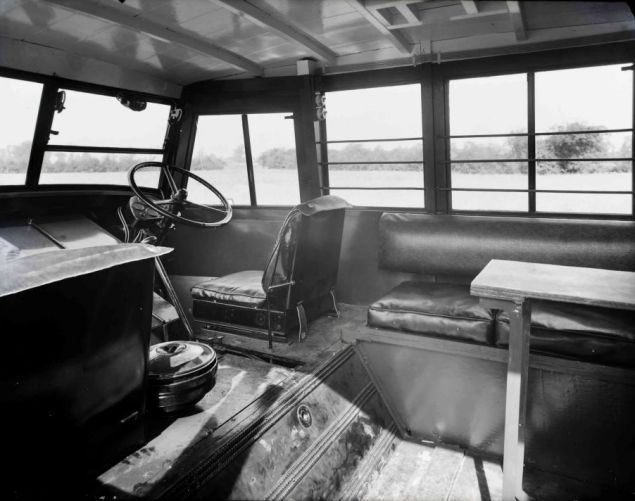
Fig. 5 - The Cab

Fig. 6 - Vehicle Closed and Locked
To facilitate the erection of open wires, arrangements have been made for
three spindles to be
provided as part of the vehicle equipment. These
spindles have been designed to fit into sockets in the
floor of the vehicle. Two of the spindles are suitable
for carrying wiring drums for 40-lb. bronze and
cadmium copper and one for the wiring drum of the
drum wheelbarrow so that the heavier gauge conductors may be handled without
the need for conveying the barrow. It is not proposed to provide
drums as standard equipment of the vehicle because
the utility of the vehicle permits of its use on many
works where drums are unnecessary, and the requirement can be met by drums
already in existence.
For cabling operations a bollard for attachment to
the spring-loaded draw bar provides a means of
attaching the rope for pulling in cables by means of
the vehicle.
The body of the vehicle is made
lockfast by means of a steel reinforced
canvas sheet (Fig. 6) which covers the
rear opening and which is secured in
position by a steel bar and padlocks.
A small door hinged at the top edge
and secured in position with a spring
bolt completes the lockfast arrangements at the rear end of the vehicle
when ladders are not being carried.
When ladders are in position, this door
is secured to the underside of the roof,
the ladders themselves providing
sufficient obstruction to prevent unauthorised access to the interior of the
vehicle.
Last, but not least, are the coat hooks
for the gang's clothing, the light for
illuminating the interior of the body
and the provision made for storing the
rear pole bolster and skid boards
beneath the floor of the vehicle when
these items are not in use - a considerable improvement over the old method
of stowing them on the floor of the vehicle where they were invariably in
the way and often inaccessible without moving part of the load.
Conclusion
In conclusion, it should be mentioned again that this is an experimental
vehicle which will be subjected to extensive field trials before its
introduction as a standard vehicle is considered. In the meantime,
therefore, the existing vehicles must remain the standard.
|