GPO VEHICLES & TRAILERS | ||||||||||||||||||
Trailer Handcarts and Pumps THE realization of the benefits to he obtained from the scientific utilization of motor transport has led in recent years to the adoption of trailers for economic haulage Not only can the motive power vehicle often be released for other work after towing the trailer to the scene of operations, but also the load which can be hauled is considerably greater than the rated carrying capacity of the lorry. For example, the haulage of a trailer of 10cwt. gross weight is equivalent to carrying only about 2cwt. load on the van body. A 20cwt. Morris vehicle (other than Utility type) can therefore carry a load of 18cwt. (men and stores) besides trailing a load of 10cwt. and the effective load transported is 28cwt., an increase of 40 per cent. Also the reduced overall dimensions of the trailer due to the
absence of the engine unit, with consequent greater ease of manoeuvring, are
extremely valuable in the case of the cable drum bogey or trailer. Conversely,
the additional length obtainable with a telescopic chassis pole trailer permits
longer poles to be carried than is possible on a standard lorry. Trailers of
these types have been in use for some time and have already been described in
detail in this Journal, but a few notes on a type of trailer which has recently
been introduced may be of interest.
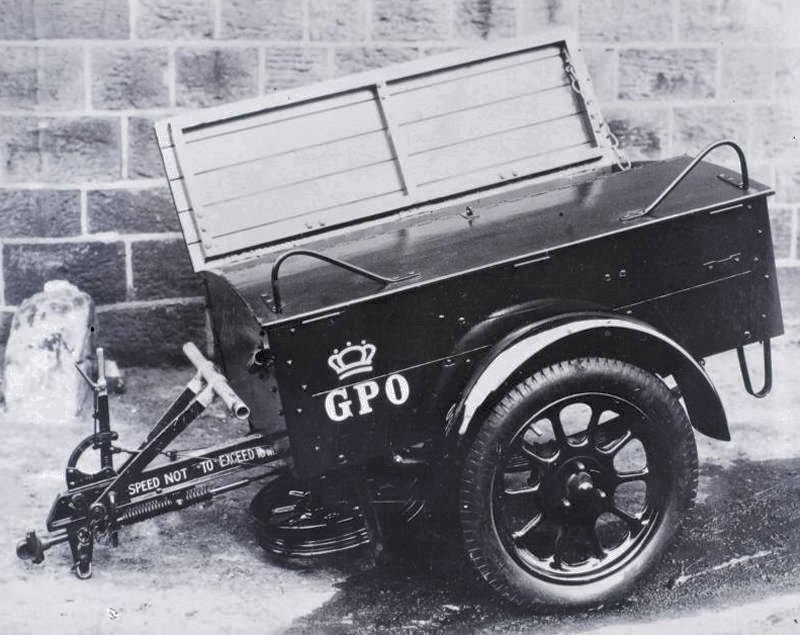
FIG. 1 - THE "GIBSON" TRAILER The "Gibson" trailer, Fig. 1, is an extremely light two-wheeled chassis built by Messrs. J. Brock-house & Co., Ltd., of West Bromwich. It weighs only 2.75cwt. complete with tyres and has a carrying capacity of 12cwt. The drawbar is built integral with the main frame of angle irons and is fitted with a self-locking ball hitch. The latter is spring-loaded and not only absorbs all starting shocks, but automatically operates internal expanding brakes on the trailer when the brakes are applied on the towing vehicle. The axle is, of nickel steel and is fitted with tapered roller bearings for the wheels which carry 27in. x 4.40in. low pressure tyres. An independent hand brake operated from the trailer is also fitted. This type of trailer has so far been introduced to carry handcarts and pumps.
FIG. 2 - TRAILER HANDCART Trailer Handcart (Fig. 2) Twenty of these trailers carrying handcart bodies have been built and are in use in various parts of the country. They are towed by vehicles of 20cwt. capacity and upwards, including both ordinary and Utility types except the 30cwt. Utility vehicle. The attachment of the towing hitch on the rear of the latter vehicle is somewhat difficult owing to the presence of other fixings, but special arrangements are being made so that this type of vehicle is not excluded from use with the trailer. An additional number plate is provided for every vehicle used to tow a trailer and the latter is provided with the necessary rear lamp and flexible extension and plug to connect it to the lighting system of the vehicle. They are a first attempt to provide for the gang working with ordinary handcart and motor transport facilities some of the advantages enjoyed by a gang using a Utility vehicle. Where previously it was necessary to haul the handcart up into a lorry for transport from job to job as required, with the trailer handcart it is the work of a moment to couple up the towing hitch to the rear of the lorry and the gang then has the advantage of the space previously occupied by the handcart. The facility for moving the trailer short distances is provided for by means of a folding handle which can be raised and locked out of the way when the trailer is on tow, and lowered into position for pushing when it is only a question of moving from one joint box to the next or some similar distance for which the presence of a vehicle standing by cannot he justified. Trailer Pump An attempt to satisfy these two conditions was made with the experimental introduction of a centrifugal pump, mounted on a light base, the whole being light enough to be lifted by two men. Centrifugal pumps have in the past been found unsatisfactory for sump and manhole drainage due to loss of priming, and entry of grit, but there is reason to believe that these troubles have been overcome in the particular pump of this type at present on trial. The latest attempt to meet the conditions has taken a
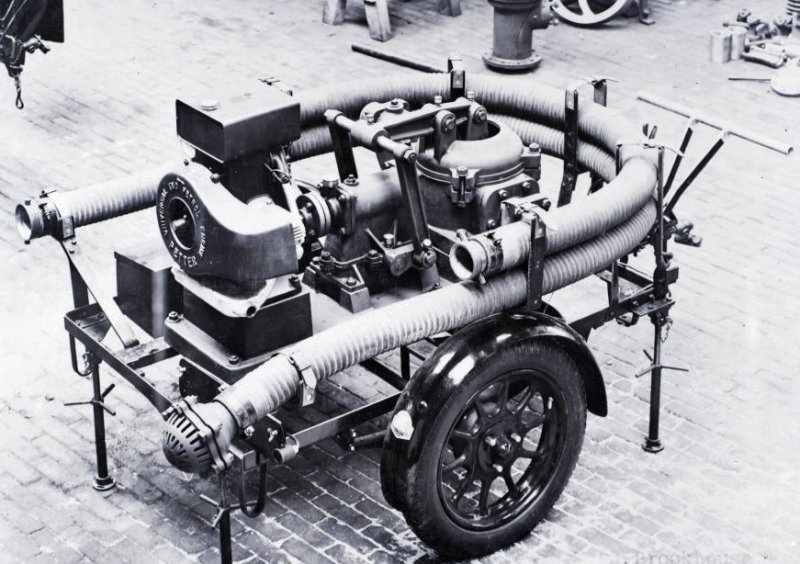
different form, and a 4" diaphragm pump driven by enclosed worm gear from a 2
H.P. Petter air-cooled petrol engine is employed. A diaphragm pump was selected
as it is simple and foolproof and is the most suitable type for dealing with
sump drainage without risk of stoppage by intrusion of grit. It is capable of
delivering 4,200 gallons, per hour at 20ft. suction head and 5,600 gallons per
hour at 15ft. head.
FIG. 3 - TRAILER PUMP
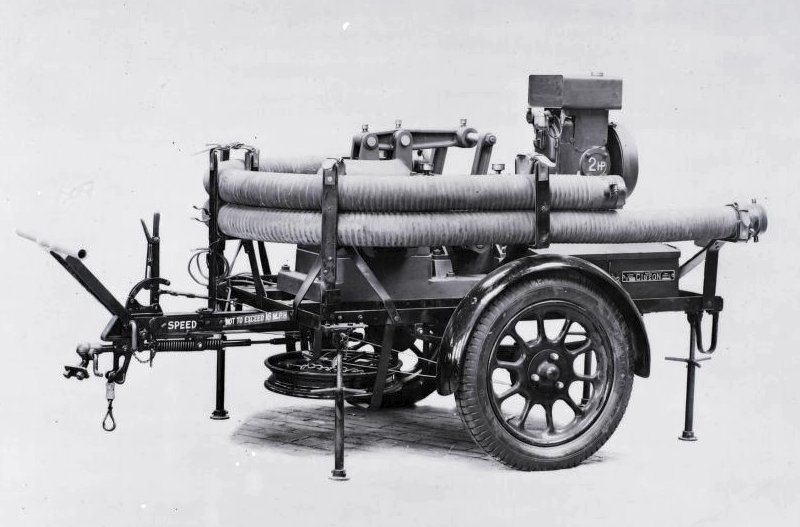
FIG. 4 - SIDE VIEW OF TRAILER PUMP The pump, gear, and engine are mounted on a common bedplate of substantial dimensions and this is bolted to longitudinal bearers on a "Gibson" trailer, Figs. 3 and 4. The trailer is of the type employed for mounting the handcarts, and is exact!)' as described above except that it is of standard dimensions (5' 6" x 3' 6") and has special leather-lined brackets to carry two lengths of suction hose (25ft. total), and one (10ft.) length of deliver)' hose. All hoses are 4" diameter and are of the wire-bound rubber type, the longer length of suction hose being fitted with foot valve and strainer. With the hail and socket type of towing hitch employed, a small downward load on the ball portion is desirable, but this must be kept as small as possible to ensure easy handling when the trailer is being manoeuvred from the handle. As a compromise a downward load of 20lb. was agreed, and the position of the pump bedplate was adjusted to give this figure. The trailer chassis is equipped at each corner with a screw-type jack which can be swung back under the chassis members and locked in position for travelling. With the weight taken by these jacks, the set is extremely steady and needs no attention when the pump engine is running. As this equipment carries its own spanners, couplings, hoses, etc., and has a legal maximum trailing speed of 16m.p.h., it is an extremely handy mobile unit and is likely to prove of particular value for cable breakdowns. In such cases the first essential is to get a pump working as quickly as possible to clear manholes and as soon as the pump has been brought to the scene of operations it can be set to carry out this work whilst the vehicle is released to pick up stores and equipment of other members of the gang if necessary and possibly also to trail out the gang's handcart. There is therefore with these trailers the probability of
considerable increase in efficiency in the use of existing motor vehicles and
experience with them will show whether it is practicable and economical for
other mechanical aids, e.g., winches, desiccators, to be provided in trailer
form, or whether the self-mobile type of unit is more advantageous.
|
||||||||||||||||||
Last revised: August 30, 2023FM3 |