BAUDOT | ||||||||
|
The Baudot code is an early character encoding for telegraphy invented by Émile Baudot in the 1870s. Baudot's code became known as the International Telegraph Alphabet No. 1 (ITA1) and is no longer used. But it was the predecessor to the International Telegraph Alphabet No. 2 (ITA2), the most common teleprinter code in use before ASCII. Each character in the alphabet is represented by a series of five bits, sent over a communication channel such as a telegraph wire or a radio signal by asynchronous serial communication. The symbol rate measurement is known as baud, and is derived from the same name. Operators had to maintain a steady rhythm, and the usual speed of operation was 30 words per minute.
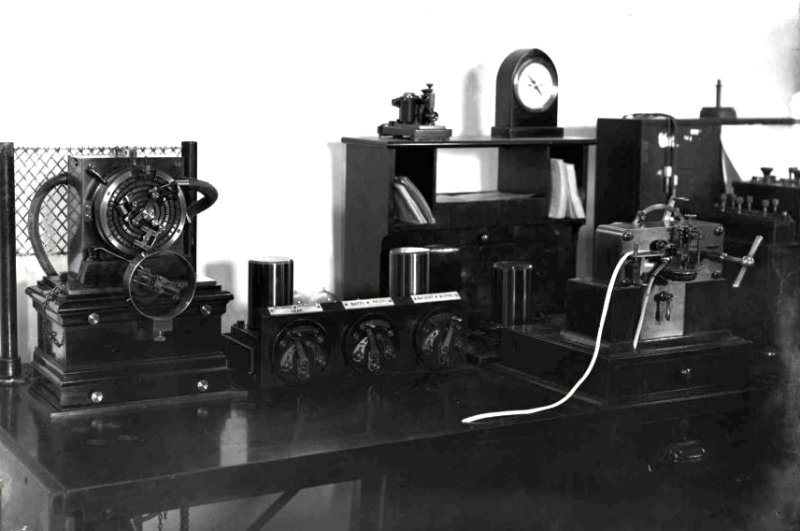
Baudot instruments in the CTO (Picture dated 1932)
Baudot operator in the CTO (Picture dated 1934)
Baudot Multiplex in the CTO (Picture dated 1912)
Baudot Distributor 1st Section (Picture dated 1918)
Baudot Keyboard Mark 4 (Picture dated 1927)
Baudot Keyboard Mark 5 (Picture dated 1927)
Baudot Keyboard Quad set (Picture dated 1915)
Baudot Receiver (Picture dated 1921)
Baudot Receiver No. 2 (Picture dated 1923)
Baudot Receiver No. 4 (Picture dated 1926)
Baudot Vibrator Multiplex (Picture dated 1932)
|
||||||||
Last revised: October 01, 2023FM2 | ||||||||