CENTRAL RADIO OFFICE | |||||||||||||
|
An extract from THE CENTRAL RADIO OFFICE
On the 26th January 1921 a duplex wireless service was opened between London and Berlin for a period of three hours daily. . . . . The following shows the traffic passed to and from London on the 25th February and is a fair example of the normal working:-
The above is an extract from the April, 1921, issue of this Journal and records what was really the beginning of the point-to-point radio services now controlled from the C.T.O. This service was carried on in a small room on the 4th Floor of G.P.O. West. The Stonehaven radio transmitter controlled by landline from this room was used as the transmitting station on the British side, while Germany utilised its station at Konigswursterhausen. In 1922 an additional service was opened between London and Rome, the Northolt arc transmitter being used for this purpose and controlled from the same room. This room was now being used to its fullest capacity and it became apparent that to develop these services and also to allow for future extensions additional accommodation would have to be provided. In September, 1922, therefore, these two services were transferred to a larger room which had been built on the roof of the same building. Here better accommodation was available for the existing services and provision made for additional apparatus. Improved leading-in facilities for the increasing number of aerials required was also provided. During the whole of this period the radio services had to be carried on under two very serious handicaps. In the first place the isolating of these services from cable services dealing with similar traffic, gave rise to difficulty in keeping both services supplied with traffic and, at the same time, equalising the delay. Secondly, and from the technical side more important, the receiving conditions leave very much to be desired. Owing to the proximity of the aerials and the radio receiving apparatus to the C.T.O. and other sources of electrical disturbance common to large towns, comparatively strong signals only can be received and high speed recording cannot be undertaken to the same extent would be possible under more ideal conditions of reception. In addition, owing to the location of the receiving
station in a crowded area, no advantage can be taken of any system of
directional reception, which experience has shown to be of considerable
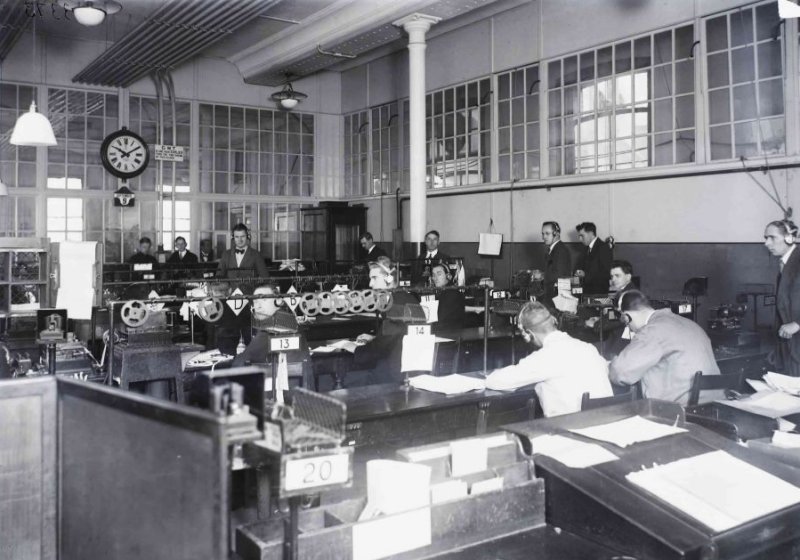
assistance in the elimination of unwanted and disturbing The Post Office, therefore, decided that the reception of radio signals should be transferred to a position free from the disturbing factors mentioned above and a Radio Relay Station (R.R.S.) is now in course of erection near St. Albans, Hertfordshire. As the name implies, this station will be used only for the reception and relaying of the radio signals into the C.T.O., all operating being performed at the latter office. In order to gain experience under relaying conditions, both from the technical and operating points of view, and also to provide space in the radio room on the roof for additional receivers, it was decided to proceed with the installation of a Central Radio Office in the C.T.O. itself, in close proximity to the Cable Room where similar traffic is dealt with. The Central Radio Office was opened in February, 1925, and it is the main object of this article to describe in detail the arrangement of this room. Since the opening of the C.R.O. all table space in the radio room on the roof, previously occupied by landline control apparatus used in connection with the transmitting stations, has been fitted with additional radio receivers. This room has now become pro tem the Radio Relay Station, which in the course of a few months will be transferred to St. Albans. This station contains ten receiving sets of various ranges and capable of reception on any wave-length between 20 and 20,000 metres. The Central Radio Office is situated on the second floor
of G.P.O. West (CTO) and occupies a floor space of approximately 1400 sq.
feet. In order to minimise to the fullest extent the noises in this room, it
bas been completely screened from other portions of the telegraph gallery.
For similar reasons all noisy apparatus, such as Gell perforators and Creed
type-printing machines, are fitted outside this room. TRANSMITTER CONTROL SETS As previously mentioned all operating, both as regards transmission and reception, is carried out in the C.R.O. In connection with the former, six control sets have been provided. These are ordinary D.C. Duplex sets which, in conjunction with the necessary landlines, directly control the radio transmitters situated in various parts of the country. Each set is fitted with a Wheatstone transmitter. It may here be explained that transmission is invariably carried out by Wheatstone transmitter, irrespective of the speed required. In this connection, the type of transmitter ordinarily used for high speed working on landline circuits, has been found unsuitable for radio working owing to its variation of speed when running on the lower limits. A type of motor-driven transmitter, specially adapted for speeds between 15 and 150 w.p.m., is now being tried and promises to be free from the disability possessed by the standard type of transmitter.
Fig. 1 - Central Radio Office, G.P.O. West CHECK SETS A small receiving aerial erected on the roof of the building is connected to three receiving sets fitted on the back table in the C.R.O. These sets are capable of being tuned to the various transmitting stations in use and supply loud speaker signals at the control positions. A complete check on transmission, both as regards the landline and the radio transmitting apparatus, is therefore provided. (See Fig. 4).
TELEPHONE RECEIVING POINTS There are 17 positions situated in various parts of the room to which aural signals, at hand speed, relayed from the R.R.S., can be led. These positions are fitted with three jacks joined in parallel, thus allowing for three pairs of headgear receivers being connected to the same line. Where traffic is heavy but strength of signal or atmospheric conditions will not permit high speed reception, transmission is often carried on at fast hand speed and without the usual pause between messages. In these circumstances two operators are employed, each operator receiving alternately. Under such adverse conditions the transmitter is thereby used to the best advantage.
Fig. 3 - Radio Relay Office, G.P.O. West (roof office) The third receiver connection enables the Officer-in-Charge
to examine the signals being received and thus deal with any complaints
which may arise. WHEATSTONE RECEIVING POINTS In spite of the adverse conditions before mentioned, improvements in the radio receiving and recording apparatus designed by the Post Office has enabled a considerable amount of high speed reception to be carried out. The actual recording of radio signals is done in the R.R.S. and relayed in the ordinary way over lines to the C.R.O. Four Wheatstone receiving sets adapted for Creed working are provided in the C.R.O. The aural signals being recorded are also led to this position. The operator can thus receive aurally any remark concerning the work which may occasionally be transmitted by hand. This combination also permits an operator who may be
receiving aural signals to refer to the slip, should confirmation of the
whole or part of a message be desired. LOCAL SPEAKER SETS Two local speaker (Sounder) sets are provided between the R.R.S. and the C.R.O. In the case of the latter room these sets are duplicated on each desk, thus providing ready access to a speaker for an operator in any part of the room. To avoid unnecessary noise from this source, each set is fitted with a switch for cutting such set out of circuit when not required.
Fig. 4 With the exception of the speaker sets, which are directly connected to their relative sets in the R .R .S., connections from all the above described sets are led to the switchboard in the room. To this switchboard are also connected all lines from the R.R.S., junctions to TS Provincial Test for extending to the C.R.O. the necessary land lines from transmitting stations, and also means for connecting the relays of the Wheatstone Receiver sets to the Creed printing apparatus outside the room. It can be seen therefore that this arrangement provides for complete interchangeability, and allows for the grouping of services where, as in the "fork" system, one transmitting point controls several reception services. Fig. 5 is a skeleton diagram showing the arrangement adopted for the relaying of the received signals from the R.R.S. to the C.R.O. Ten pairs of wires are led from the R.R.S. to the testing point in the basement of the G.P.O. West. They are led into this position instead of being taken direct to the C.R.O. in consideration of the temporary nature of the present R.R.S. arrangement; this arrangement allowing for the permanent connections between St. Albans and the C.R.O. being made with the minimum disturbance to the services.
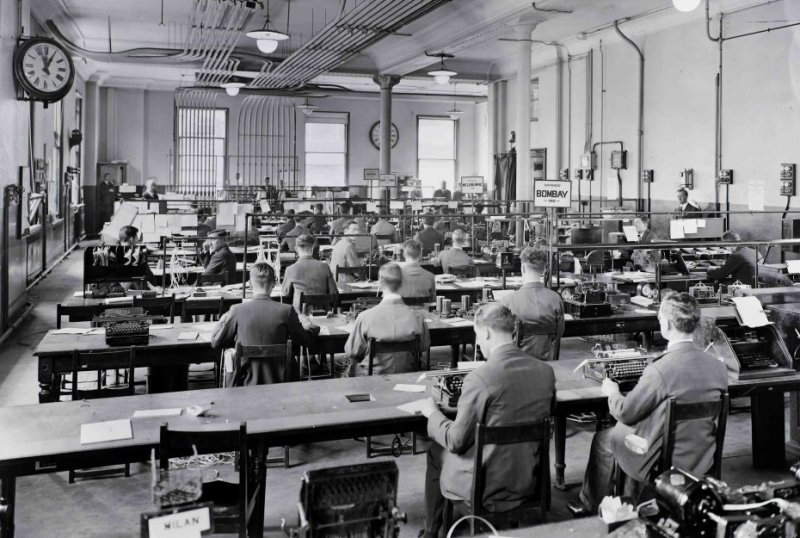
Fig. 5 From the testing point in the basement twenty pairs of wires are taken to the switchboard in the C.R.O. Ten of these pairs are joined to the ten pairs coming from the R.R.S. The remaining ten pairs are at present spare and can therefore be utilised during the transfer of the services to St. Albans without in any way interfering with the connections to the present Relay Station. When the lay-out of the C.R.O. was considered it was anticipated that adequate space had been provided to meet requirements for some time to come, but so rapid has been the development in this direction that with the opening of the Beam Stations now being erected for communicating with the Dominions a further considerable encroachment into the adjoining gallery of the C.T.O. will be necessary. Additional pictures of the C.R.O. offices
1925
1927
1933
|
|||||||||||||
Last revised: January 05, 2024FM2 | |||||||||||||