|
Telecom Instruction
B MARKETING
4 Commercial
J0032
Issue 1, August 1981
TELEPRINTER No. 73
Puma - Telex Terminal
1 INTRODUCTION
This instruction describes the Teleprinter No. 73 to be used on the
Telex network and also describes its mode of operation and the
facilities that are available.

2 GENERAL DESCRIPTION
The Teleprinter No. 73 is a fully electronic microprocessor controlled
machine with an internal non-volatile (by battery back-up) semi-conductor
memory.
2.1 Keyboard
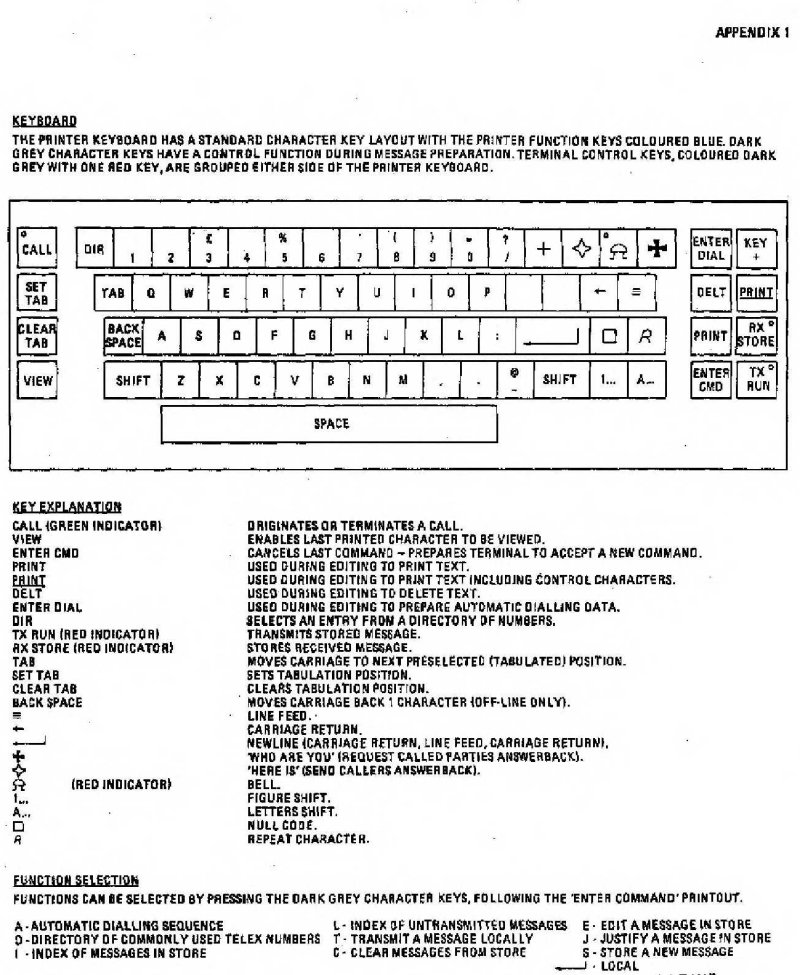
The keyboard is a solid state unit combining capacitor switches and a
single MOSYISI chip performing all functions of key-sensing and encoding. It
has a 4 row standard character keyboard similar in design to an electronic
typewriter. Its layout is shown in Appendix 1.
2.2 Printing Characters
These are printed in a 7 x 5 dot matrix by the impact of needles on a
Red/Black two coloured non abrasive nylon ribbon. Up to 69 characters or
spaces can be provided on each line of standard teleprinter paper. Paper can
be single-ply or multi-ply giving up to 3 under copies using carbon
inter-leaved paper.
3 FACILITIES
The Teleprinter No. 73 is a self contained unit requiring connexion only to
a suitable mains supply and to the telex line.
3.1 Design
Attractively styled and quiet in operation
the teleprinter is suitable for any office environment. It is housed in a
case moulded from structural foam plastic and covered with a paint which
produces a texture similar to suede. Modular in design the machine is easy
to maintain.
3.2 Fully Automatic Operation
The teleprinter has the capability to call one or more distant telex
numbers automatically when the machine is unattended. It will call, check
the received answerback, if correct, transmit a stored message and again
check the answerback before terminating the call. Should a called number be
unobtainable further attempts will be made at 2 minute intervals. The exact
number of repetitive attempts before the call is abandoned will depend on
the type of service signal returned.
3.3 Abbreviated Calling Codes
An internal directory of approximately 25 frequently used telex numbers
can be selected by the customer and stored in the memory of the machine.
Provision is made for staring the telex number(s), the called number(s)
answerback, followed by a short descriptive comment. These numbers can then
be accessed by a 2 character code. This facility reduces the risk of
making incorrect keyboard selections. Coupled with this facility is an index
which can provide a print out of the complete directory.
3.4 Operator Prompting
The machine provides a prompt and keeps the Operator informed of the
current operational mode. Should the Operator input an incorrect instruction
the machine will print out advice to this effect.
3.5 Editing
This function provides the Operator with the ability to insert, correct or
delete parts of messages in store. The memory can be searched to identify
the sequence for editing, and print the required passage up to the point to
be edited. It is then possible to edit the appropriate text and in
conjunction with the 'justification' function the text can be rearranged
ensuring that there are no split words at the end of a line.
To assist in the preparation of tables a tabulation
facility is provided.
A backspace facility is provided for correction but only
within the line being typed.
3.6 Non-Volatile Memory
There is a choice of an 8K or 16K character non-volatile (by battery
back-up) electronic memory which enables messages to be prepared and held in
store. Each message is automatically logged and allocated an identification
number. An in-built battery retains power to the memory for approximately 30
days after disconnexion of the terminal from the mains supply.
3.7 Message Index
This index provides a print out of all messages in the store, each message
is automatically allocated a number and status code. The status code
identifies whether a message has been transmitted, is still awaiting
transmission or has been received and held in store.
3.8 Paper Tape Attachment
The attachment can be used to input messages to the terminals electronic
store and to produce paper tape from messages already held in the terminal
store. Operationally, the attachment allows the terminal to be used in two
distinct roles.
As a clean tape preparation unit utilising the terminals
editing capabilities and subsequently punching out a tape of the edited
message. In this mode it can be used for tape preparation for feeding to
earlier types of automatic machine.
As an automatic calling terminal in which the terminals
automatic calling facilities are utilised. The messages being prepared off
line possibly on earlier types of machine or other devices. The automatic
calling information is appended and any editing carried out once the message
has been read into the store.
4 MARKETING POLICY
The teleprinter 73 is one of a range of new electronic teleprinters that
will be available for connexion to the telex network and which will bring
the benefits of modern technology to the customer. This new machine needs to
be marketed for its virtues of quietness, automatic calling and editing
capabilities. A non-volatile 8K or 16K memory store should reduce the number
of customers who will require a paper tape attachment. In fact customers
should be encouraged to adopt machines without paper tape attachments where
possible, although it is recognised that some customers may need them for
operational reasons. There will be no restriction on the supply of the
teleprinter 73 i.e. it will be available as new supply or can be provided on
a cease and new basis on existing lines.
4.1 Phased Introduction
The launch programme will commence initially in London Telephone Region on
an Area by Area basis in the Autumn of 1981. The date of availability of the
teleprinter in other Regions will depend upon the manufacturers ability to
produce the item, and BTs ability to implement the necessary training for
Area sales staff, telegraph service representatives and engineering
personnel. Each Region will be advised individually when the teleprinter
should be introduced.
5 SELLING BENEFITS
The main selling benefits of the new machine can be identified as follows:-
-
It is quieter in operation than previous machines
which makes it highly suitable for any office environment. Predominately
electronic in design and modular in construction make it reliable and
relatively easy to maintain.
-
A message or messages can be automatically
transmitted to single or multiple destinations. The machine will carry
out answerback validity checks at the start and end of message
transmission. If a called number is unobtainable further call attempts
will be made automatically.
-
A customer entered directory of abbreviated called
codes is provided. It will accommodate approximately 25 frequently
called telex numbers together with their answerbacks.
-
The Operator prompt facility provides significant
benefits in that untrained or casual users who may not be familiar with
the machine will be capable of handling telex communications. Editing,
justification and tabulation all assist the user in the rapid
preparation of messages.
-
A non-volatile 8K or 16K memory with battery back-up
enables messages to be stored with little risk of loss without recourse
to paper tape. Messages can be transmitted from or received into store
whilst the machine is unattended.
6 DIMENSIONS
TELEPRINTER
Height 151 mm
Width 481 mm
Depth 5I8 mm
Weight 18 Kilos
PAPER TAPE ATTACHMENT
Height 151 mm
Width 222 mm
Depth 419 mm
Weight 10 Kilos
PLINTH
Height 628 mm
Width (Max) 622 mm
Depth 481 mm
Weight 10 Kilos
|