WHEATSTONE A.B.C. TELEGRAPH | ||||||||
|
While developing apparatus which used artificial
alphabetical codes, inventors had not overlooked the possibility of a
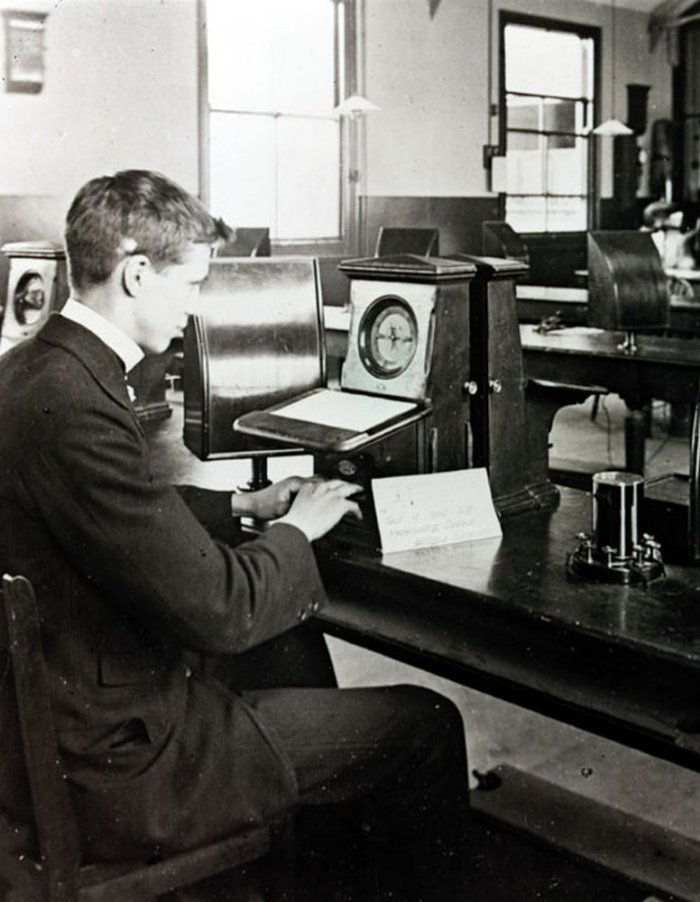
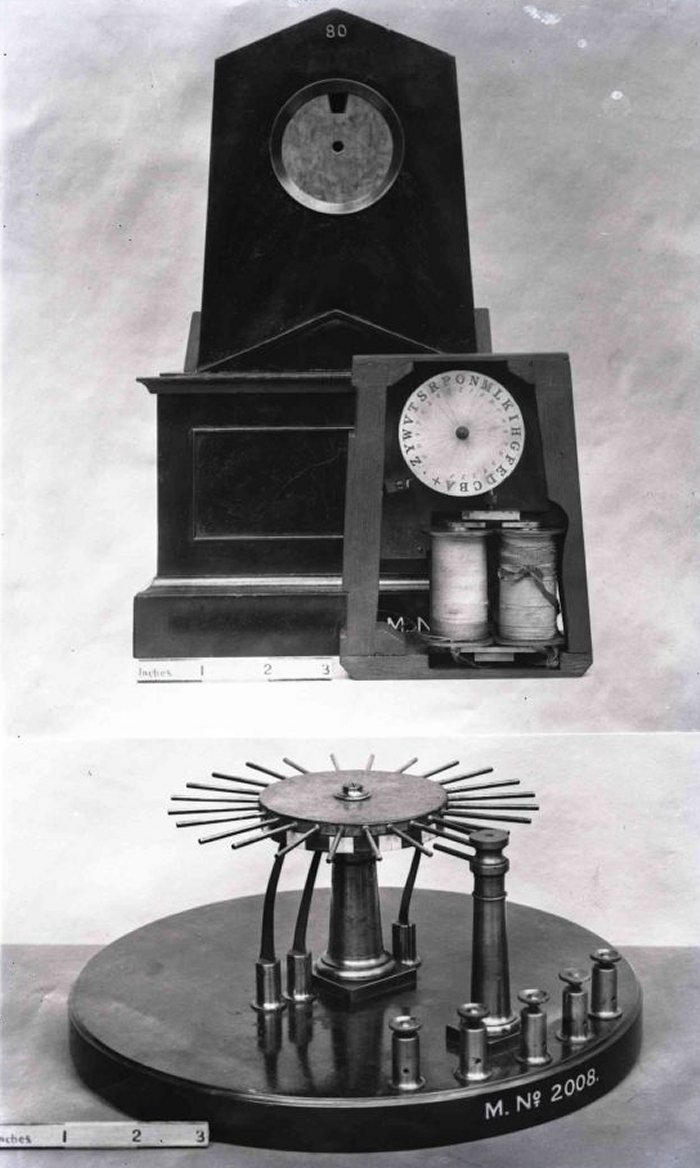
letter-indicating But it was Wheatstone who developed a practical alphabetical system in 1840 called the A.B.C. System, used mostly on private wires. This consisted of a "communicator" at the sending end and an "indicator" at the receiving end. The communicator consisted of a circular dial with a pointer and the 26 letters of the alphabet (and four punctuation marks) around its circumference. Against each letter was a key that could be pressed. A transmission would begin with the pointers on the dials at both ends set to the start position. The transmitting operator would then press down the key corresponding to the letter to be transmitted. In the base of the communicator was a magneto actuated by a handle on the front. This would be turned to apply an alternating voltage to the line. Each half cycle of the current would advance the pointers at both ends by one position. When the pointer reached the position of the depressed key, it would stop and the magneto would be disconnected from the line. The communicator's pointer was geared to the magneto mechanism. The indicator's pointer was moved by a polarised electromagnet whose armature was coupled to it through an escapement. Thus the alternating line voltage moved the indicator's pointer on to the position of the depressed key on the communicator. Pressing another key would then release the pointer and the previous key, and re-connect the magneto to the line. These machines were very robust and simple to operate, and they stayed in use in Britain until well into the 20th century.
A
magneto-powered
Wheatstone A. B. C. telegraph with the horizontal "communicator" dial, the
A.B.C. Single needle
Step-by-step
|
||||||||
Last revised: September 30, 2023FM2 | ||||||||