PRIVATE AUTOMATIC BRANCH EXCHANGES
10 + 50 PABX
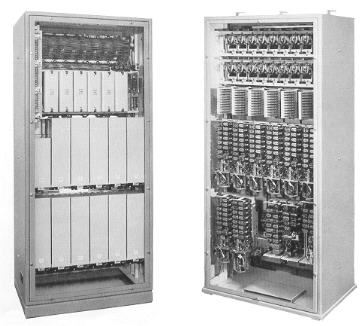 This is a single-unit equipment having
capacity for 10 exchange lines, 50 extension lines and 7 connecting circuits. A desk-type
cordless switchboard is supplied for dealing with incoming exchange calls, and assistance
calls. The stock unit, equipped for 4 exchange lines, 30 extension lines and 4 connecting
circuits, is fully wired to facilitate extension. Up to 5 tie lines to other private
installations can be provided. The total of exchange and tie lines must not exceed 10.
Both are normally arranged for auto or C.B. working. Maximum extension-line loop
resistance including the telephone is 800 ohms. Exchange and tie-line loop resistance may
be up to 1,000 ohms depending upon the limits imposed by the remote exchange equipment. This is a single-unit equipment having
capacity for 10 exchange lines, 50 extension lines and 7 connecting circuits. A desk-type
cordless switchboard is supplied for dealing with incoming exchange calls, and assistance
calls. The stock unit, equipped for 4 exchange lines, 30 extension lines and 4 connecting
circuits, is fully wired to facilitate extension. Up to 5 tie lines to other private
installations can be provided. The total of exchange and tie lines must not exceed 10.
Both are normally arranged for auto or C.B. working. Maximum extension-line loop
resistance including the telephone is 800 ohms. Exchange and tie-line loop resistance may
be up to 1,000 ohms depending upon the limits imposed by the remote exchange equipment.
Numbering and Facilities
Numbering Extensions are numbered 20 to 69. Single-digit dialling codes 7, 8, 9 and 0
are used for (a) exchange lines (b) tie lines or a second group of exchange lines (c)
assistance (d) night service answering.
Facilities
- Extension-to-Extension Calls are dialled direct.
- Outgoing Exchange Calls are made by dialling an access digit, then the exchange
subscriber's number (or instructing the distant operator if the exchange is manual).
Alternatively, calls may be set up by the PABX operator. The connecting circuits are used
only for the setting up of a call.
- Incoming Exchange Calls are received at the switchboard. Digit keys are used for
extending the calls 'Ring when free' facilities are provided.
- Barred Access. Extensions can be partially or completely barred exchange facilities.
- Enquiry Calls. An exchange call can be held by the PABX operator or an extension while
making an internal enquiry call. The internal conversation is secret from the exchange
subscriber.
- Call Transfer. Exchange calls can be repeatedly transferred, without operator
assistance, by extensions to other extensions permitted to receive such calls.
- Trunk Offering. The PABX operator can enter established connections; warning tone is
given.
- Right-of-way. Preference on local calls can be given to executives.
- Assistance. Extensions dial a single digit to call the PABX operator.
- Manual Extensions. Immediate calling of the PABX operator by lifting the handset can be
arranged for up to three of the extensions.
- Night Service. Incoming exchange calls are signalled by d.c. bells. Any extension not
full barred can answer by dialling 8. Alternatively, one or two extensions may be selected
to answer calls.
Optional Service Features
Message waiting; message registration; conference; trunk barring; extension busy'
lamps; direct access key calling and staff location.
Equipment
PABX Unit
This is a double-sided, pressed steel dustproof unit with lift-off steel-framed Perspex
doors at the front and rear. The exterior is enamelled opaline green; the interior
and apparatus covers are cream. The equipment has tropical finish. Connecting wires are
p.v.c. insulated.
Components are of standard BPO type and proven reliability. They include
N30000 (BPO 3000) and N45000 (BPO 600) relays, heavy- duty line-finder uniselectors
(BPO
No. 2) and 100-outlet 2-motion selectors N46600 (BPO 4000). If specially ordered,
selectors N43200 (BPO 2000) can be supplied. Excepting strip-mounted line and
miscellaneous relays, all circuits are on jack-in mountings to facilitate extension.
On
one side of the unit are line relays, exchange and tie-line relay sets and fuse panels; on
the other, the finder uniselectors, 2-motion selectors and connection strips. Connection
strips ('line' and 'exchange') are mounted under a cover at the side of the unit and serve
for the distribution of incoming lines, cross-connection being made by means of screw
terminated jumpers. Line protectors are provided complete with heat coils and fuses on a
separate wall mounting for 10 circuits when ordered.
The 25Hz and 400Hz ringing and tone
frequencies are generated by transistor-type oscillators powered from the 50v exchange
supply. These static devices require little maintenance and do not cause interference with
radio signals.
Cordless Switchboard
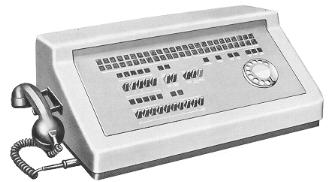 The design of the small two-tone grey switchboard accords with contemporary
taste and facilitates maintenance. The metal front panel and internal rear equipment frame
are both hinged to the metal base so that they can be opened, book fashion, when the ABS
copolymer plastic drop-on cover is removed. The design of the small two-tone grey switchboard accords with contemporary
taste and facilitates maintenance. The metal front panel and internal rear equipment frame
are both hinged to the metal base so that they can be opened, book fashion, when the ABS
copolymer plastic drop-on cover is removed.
Keys have wedge handles with tips of
contrasting colour to enable operated keys to be easily discerned. Fifty lamps, arranged
in two rows, are 'extension busy' lamps, fitted only when specified. The upper row
of double-throw keys and associated lamps are for exchange-line, tie-line, manual
extension, assistance and miscellaneous circuits. The lower row of keys, again of
double-throw type, serve as key-sender digit keys when operated downwards, and provide for
exchange and extension release, flash, test, speak, etc., facilities when operated
upwards.
Lamps can be removed without using an extractor. The dial has
standard numbering, 2:1 break/make pulse ratio, and a plastic fingerplate. A grey
plug-in handset with capsule receiver and grey braided extensible cord is provided, and
6Oft(18.29m) of p.v.c. insulated cable to connect the switchboard to the PABX unit.
Power Equipment
The working voltage is 45 to 55V (50V nominal). If a reliable a.c. mains supply is
available, a battery eliminator N22405D may be used. It is designed for inputs of 100 to
125V or 200 to 250V, 40 to 100 H z, has a 7.5A output and mounts on a wail. Alternatively,
a 3A charger and 20Ah battery may be used.
Telephones
Plesseyphones (catalogue sheet 7159)
or Etelphones (catalogue sheet 7145) are recommended for extension telephones. However,
any telephone suitable for 2-wire and earth or 3-wire working, may be used, provided it is
equipped with a non-locking press button and incorporates a dial with a 2:1 break/make
ratio and pulsing speed of 10 pps.
Weights (approx.)
| Equipment Item |
Net Weight lb (kg) |
| PABX equipped 4+30 |
750 (340.9) |
| PABX fully equipped 10+50 |
992 (450.9) |
| Battery eliminator N22405D |
57 (25.9) |
| Attendant's cabinet with busy lamps N24125A1T |
40 (18.2) |
| Attendant's cabinet without busy lamps N24125A2T |
38 (17.2) |
Click here for an
article from the Ericsson Bulletin
|
