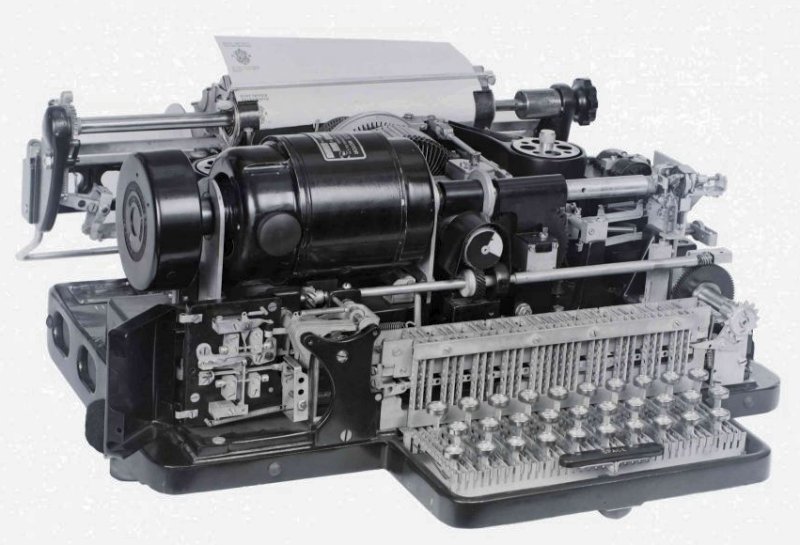
GPO TELEPRINTER No. 7


This is a Creed and Company manufactured start-stop combined receiving. and transmitting (Page or Tape) printing unit, with or without perforating keyboard.  Those items with perforating keyboards are distinguished by the addition of /PK to the title number.  They use the 5-unit International No. 2 signalling code.

Educational Pamphlet on the Teleprinter No. 7.


Teleprinter No. 7A
See E.I. Telegraphs, Teleprinter C1001.


Teleprinter No. 7B, Tape
Similar to the page machine with a printing attachment using paper tape.

See E.I. Telegraphs, Teleprinter C1010 and Telegraphs, Teleprinter C1050.

Diagrams - TG(L) 1101/0 and TG(L) 1101/1.


Teleprinter No. 7B/PKN3, Page
Similar to Teleprinter No. 7B, Page, but is fitted with a saw-tooth keyboard which includes a perforating unit which is controlled by key­board operation for production of  5-unit fully-perforated tape. The perforating unit may be  made inoperative by means of a throw-out lever.  RUN-OUT, HERE-IS and WRU keys are provided.  A/B off-normal contacts not provided.

See E.I. Telegraphs, Teleprinter C1061.

Diagram - TG(L) 1101/1.


Teleprinter No. 7B/RP, Page
Superseding Teleprinter No. 7B/PKN3, Page which it closely resembles.

The perforating unit is controlled from the combination  head so that the machine may be  used as a reperforator as well as  a keyboard  perforator. Mechanism is provided   to enable perforation of WRU,   Bell and A/B codes to be  suppressed.

See E.I. Telegraphs, Teleprinter C1062.

Diagram - TG(L) 1101/1.


Teleprinter No. 7D, Page

Used on automatic switching net-works. Differs from Teleprinter  No. 7B, Page in having a 33-way signalling cord, quick-start motor, timed answer-back off-normal contacts, motor on-speed contacts.

Motor auto-start-stop switch omitted.

See E.I. Telegraphs, Teleprinter C1070.

Diagrams - TG1259, TGW1259 and TGU1259.


Teleprinter No. 7D/RP, Page

Used on automatic switching net-works.  Differs from Teleprinter No. 7B/RP, Page, in having a 33-way signal cord, quick-start motor, timed answer-back off-normal contacts, motor on-speed contact.  Motor auto-start-stop switch omitted.

See E.I. Telegraphs, Teleprinter C1062.

Diagrams - TG1259, TGU1259 and TGW1259.


Teleprinter No. 7E, Page, 160/240V D.C. or 230/240V A.C.

Similar to Teleprinter No. 7D, Page, but is fitted with overlap-cam receiving mechanism to improve the receiving margin and allow the last character received to be printed without delay (follow-on printing).

See E.I. Telegraphs, Teleprinter C1070.

Diagrams - TG1259, TGW1259 and TGU1259.
 

Teleprinter No. 7E/RP, Page, 160/240V D.C. or 230/240V A.C.
Similar to Teleprinter No. 7D/RP, Page, but is fitted with  overlap-cam receiving mechanism with improved receiving margin.

See E.I. Telegraphs, Teleprinter C1062.

Diagrams - TG1259, TGU1259 and TGW1259.

.
Teleprinter No. 7.. Sprocket Feed
Similar to corresponding Teleprinter No. 7..., Page, but with carriage adapted for stationery with sprocket feed-holes.


Pictures

Teleprinter No. 7A (Picture dated 1932)


Teleprinter No. 7A (Picture dated 1932)


Teleprinter No. 7A (Picture dated 1932)


Teleprinter No. 7B


Teleprinter No. 7B/PKN3 (Picture dated 1939)


Teleprinter No. 7B/PKN3 (with Cover No. 40)


Teleprinter No. 7B/RP (Picture dated 1956)


Teleprinter No. 7D/RP (Picture dated 1965)


Teleprinter No. 7E


Teleprinter No. 7E (Picture dated 1958)


Teleprinter No. 7E (Picture dated 1958)


Teleprinter No. 7E/RP (Picture dated 1961)
With Unit, Telex No. 1


BACK Home page Telegraphy Main Page Search the Site Glossary of Telecom Terminology Quick Find All Telephone Systems

Last revised: February 21, 2026

FM2