DIAL FILE | ||||||||||||||||||||||||||||||
| Lettering on dials More information on later dials A selection of documents relating to dials.BPO standard dialsDetailed descriptions of the BPO’s standard dials can be found in Herbert & Procter’s Telephony and in Atkinson’s Telephony. Here is a summary:-
Certain other dial numbers were types used on test equipment, teleprinters and engineers’ phones.
Brighton Dial Early British dialsPrior to the introduction of the BPO No. 8 and 10 dials, each supplier had its own pattern and these were given numbers by the BPO as follows:
With the introduction of the No. 10, most suppliers adopted this for telephones supplied to all customers, not just the BPO. ATM, however, favoured the Type 24 dial designed by its parent company in Chicago (introduced 1926) and supplied this to Hull Corporation and other private customers well into the 1960's. A variant of this was the ‘dimple dial’, using the same mechanism but a plastic finger wheel having moulded dimples instead of proper finger holes. These ATM dials were never adopted by the BPO, although many type 24 dials, taken from Hull Corporation Teles. 162, were ‘brassed up’ in the 1970's and fitted to otherwise genuine BPO Teles. 150.
Dial No. 8 rear view
Parts for Dials No's 8 & 9 The Dial No 10 was drilled to take the finger stop in two positions. Normally the finger stop is further (clockwise) around the dial circumference, so as to allow the standard interdigital pause. Ron Kay in New
Zealand writes:- Click here for more information on the Dial No.10 Dial No 14 was available in three versions:-
The Dial No. 21 has a flush clear plastic label protector of the press-in type. To remove this you should use either a rubber suction cup or a 4” x 1/8” diameter screwdriver inserted radially between the finger plate and the number ring at a position �” below the digit hole for the numeral ‘1’. The screwdriver’s tip will enter a slot in the finger plate and by turning the screwdriver, the label holder will be ejected. Variants exist of Dial No. 21 too. GEC tried a design having a finger wheel with spokes rather than holes; later it also made a very cheap dial with many metal parts replaced by plastic. These were used on PAX telephones and were also supplied to the New Zealand Post Office. Click here for more information on the Dial No. 21 Other designations: AEI called the Dial No. 12 their Dial Switch 20. Ericsson named their Dial No. 10 their N.4381 and the Dial No. 21 their N.4394. GEC named the Dial No. 12 their DL 1100 series (standard), DL 1200 series (tropical finish). Export models: British manufacturers made versions of these dials for overseas use, including New Zealand numbering, Canadian letters and numbers, Egyptian numbers only, English and Egyptian numbers, also English and Chinese numbers. Pictures for identifying dials
Automatic Electric 'sunburst' dial, produced in Chicago before the 'Mercedes' pattern. These were not used by the British Post Office but may have appeared on private automatic systems imported to Britain before 1910.
This is the Automatic Electric dial that was fitted to the original telephones used at Epsom and the Official Switch in London in 1912; it appears that early supplies had Chicago-made dials. The UK-made ‘lookalike’ came soon afterwards, with the same ‘Mercedes Benz’ label clip and wording on the label. Some of the British-made dials were in an oxidised bronze finish, whereas the American one were nickel-plated. Similar dials were made in France as well and for repair purposes, all parts are interchangeable regardless of maker. Known to collectors as the 'Mercedes' pattern.
The same thing but in colour!
A Dial No. 1 offered on eBay during 2003 - front and rear
'Mercedes' pattern dial manufactured in France by Thomson-Houston.
Dial made by Northern Electric in Canada under
licence from Automatic Electric, similar to the
'Mercedes' pattern.
Dial No. 3, with Australian dial
markings, from the front....
...and from the rear.
Dial No. 3 - a British example.
Dial No. 8 - rear view
Dial No. 10 - Australian variant
Automatic Electric type 23 dial, used in North America. This replaced the Mercedes pattern. The similar-looking type 24C was made by Automatic Electric's British associate ATM Ltd as its model 24C.
ATM Dial No. 24 - front and rear
11-digit Automatic Electric dial used in the USA for special purposes.
Method of removing number ring on Automatic Electric dials when changing dial labels.
Dial fitted to many telephones used by KTAS, Denmark. It is in fact a BPO NO. 10, made by Siemens Brothers.
Hull Corporation Tele. 232, made by ATM Ltd and fitted with their Dial 24C. The shape of the finger stop distinguishes the dial from a BPO No. 10. Hull was the only place in Britain where this pattern of dial was used on a public network, although many railway PABX telephones had them as well. The design was never adopted by the BPO, however.
Close-up of Dial No. 24C fitted to
a Portuguese telephone.
The same thing produced in India
and applied to many modern reproduction telephones (repro pictured).
Number plate of a French type 24C dial made by Martens. It is, how you say in English, rather worn and faded.
An early production Dial No. 10. Some collectors assume all dials with small centre labels are No. 8 but this is not so. Dial No. 8 has four terminals on the back, the No. 10 has five.
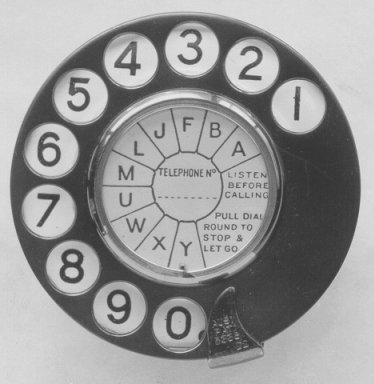
Siemens Brothers Dial No. 10 fitted to a 300-type telephone exported to Canada. Note the letter O on digit 6 and the instructions for using the telephone. This is on a magneto party line, with the option of 'simplex dialling' for making automatic calls. Similar calling arrangements were made in some British coal mines. Lettering on dials Many people will be surprised how many number and letter arrangements have been used on telephone dials and keypads in Britain. This section attempts to resolve them all. Number-only dials are the most common dials used in Britain; some dials had letters but by no means the majority. Normal dials have the digits 1 2 3 4 5 6 7 8 9 0, arranged anti-clockwise. An alternative arrangement 9 8 7 6 5 4 3 2 1 0 was used in New Zealand and because dials were made for that country in the same British factories as ‘British’ dials, it was inevitable that export dials would end up on British phones now and again (users were puzzled why all digits they dialled were wrong except 5 and 0). A large batch of telephones with New Zealand dials was delivered to British Rail by Pye-TMC in the 1970s and these phones also turned up on the Post Office from time to time. For lettered dials at least four schemes are noted. The first was that used in the USA and proposed for the Western Electric Panel exchange in London; the digit 6 carried letters MNO. In the event, it was never used here because the ATM Director system was selected in preference to Panel and the opportunity was taken to move the letter O to the zero digit. Both France and Britain believed the letter O and digit 0 were likely to be confused. Thus whilst the Americans stuck with MNO against the figure 6, we and the French moved the letter O to zero to reduce potential confusion. This scheme was maintained by the BPO right up until the time when international direct dialling was planned and it was also adopted for London Transport’s private telephone network, which also used letter codes. 1 2 3 4 5 6 7 8 9 0 ABC DEF GHI JKL MN PRS TUV WXY O The letter Q did not appear on this dial but it was used in France where an exchange in Paris went by the name ROQuette; the letter Q was located on the digit zero. To allow unrestricted international dialling this letter was adopted here as well and old dials were exchanged gradually for new dials with the letter Q. An entirely separate arrangement of letters was used in Germany before the war and this appeared on some telephones exported by the T & N company to their UK customer, the British Home & Office Telephone Company. The letters were not used here for dialling. 1 2 3 4 5 6 7 8 9 0 A B C D E F G H J K Yet another arrangement was found on dials (BPO No. 12) used to send up train descriptions in power signal boxes of British Railways (Western Region). These dials were not used for telephone calls but collectors may encounter these dials. 1 2 3 4 5 6 7 8 9 0 A B C F H J T V X Z One last arrangement is found on BPO No. 10 dials supplied by Siemens Bros. on telephones exported to the Manitoba Telephone System in Canada. These are the only dials carrying the letter Q in North America and it appears that codes employing Q were never introduced. 1 2 3 4 5 6 7 8 9 0 ABC DEF GHI JKL MNO PRS TUV WXY QZ Significant quantities of telephones equivalent to the Tele. 706 were exported to the USA (Telephone Rentals had a subsidiary in New York) and Canada and these too carried the North American letter arrangement (as above but with the letter Q omitted). Two locations in Britain had exchange names included on the dial, Guernsey and Brighton. Dials in Brighton were lettered thus:- 2 3 Hove 4 Portslade 5 Preston 6 Rottingdean 7 Southwick 0 Operator This is the scheme at Guernsey:- 2 Central 3 St Martin 4 St Sampson 5 Catel 6 St Peter To complete the story we must also consider letter arrangements used subsequently on push-button telephones in Britain. Letter dialling had been abolished in Britain when all-figure numbering replaced letter codes in the late 1960s (they persisted a little longer on London Transport’s system). In the 1980s a growing number of phones made for the American market trickled into Britain, bringing with them the US letter scheme (with MNO on digit 6). BT also supplied phones with these letters with its SL-X PABX. The American passion for toll-free numbers that spelled words was copied to an extent in France, where letters appeared on push button phones supplied by France T�l�com. These had the letters Q and Z on digit 0 and the same layout appeared on many mobile phones supplied by European manufacturers such as Nokia. 1 2 3 4 5 6 7 8 9 0 ABC DEF GHI JKL MN PRS TUV WXY QZ Just as pan-European standardisation looked imminent, the Americans moved the goalposts and added the letters Q and Z to different letters Q to 7 and Z to 9 and shifted letter O to digit 6. Subsequently this has become an international recommendation. 1 2 3 4 5 6 7 8 9 0 ABC DEF GHI JKL MNO PQRS TUV WXYZ
Repairing dials Many dials become sluggish after a while, usually through dust and/or over-lubrication in the past. If you are lucky they will respond to a quick squirt of WD40 or similar penetrating lubricant; if not, you will have to do a full disassembly job (tedious!) followed by washing in white spirit. Afterwards lubricate the re-assembled item with watch oil. Maplin and other electronics component shops sell a micro-spout oiler containing oil and Teflon particles for a very moderate price. If the problem is a broken spring, this advice from Steve Hilz will help. “You can rewind dial springs by carefully pushing the mainspring into the holder and working it into the centre as you go. You have to watch out that you don't let the spring release, but it will go back OK with some patience. Wear gloves so you don't cut yourself. If you have a broken spring near the end, you can anneal it in a flame and let it cool gradually. Then, make the bend that you want to be permanent. Then, reheat the portion of spring that you annealed, until it is red, then quench it in cold water to restore the temper.” Many thanks to Andy Emerson for the above. Other documents available here (in PDF format):
|
||||||||||||||||||||||||||||||
Last revised: July 26, 2025FM2 |




 .
.

