Automatic Telephones
INTERCOMMUNICATION WITH EXCHANGE FACILITIES
 |
|
 |
| N 1671 Type |
|
N 9001A |
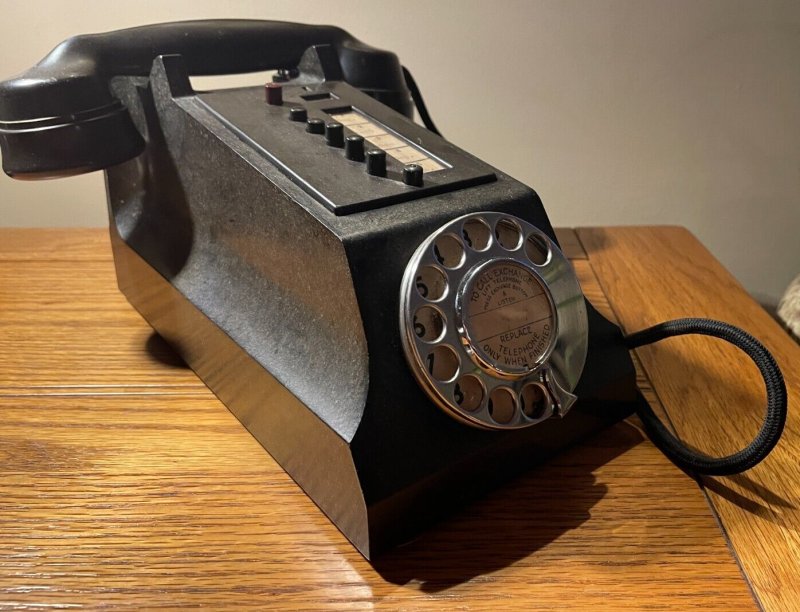
This distinctive and registered design combines all the facilities of a small
switchboard and an intercommunication system in one instrument. The case is of moulded
Bakelite and incorporates a much improved type of micro-telephone rest which has been
specially designed with a view to reducing the risk of breakage's. The interior mechanisms
and apparatus are arranged to give maximum accessibility to all parts and the buzzer is
mounted on the connecting plug so that it may be readily adjusted without interfering with
the instrument. Each set is connected up to a system on the plug-and-jack principle. If
required a directory tray can be fitted under the base.
In order that the instrument should not be unnecessarily complicated, certain
facilities were aimed at when designing, and the following have been achieved and
standardised.
1. There is only one design of instrument for C.B. and automatic public exchanges,
except that for the latter a dial is fitted.
2. Any instrument in an installation may be arranged as the master station.
3. Calls to or from the public exchange are secret. Local calls on the
intercommunication system are non-secret.
4. The engaged test is provided on "busy" exchange lines.
5. Exchange lines may be "held," if it is necessary to intervene with another
call.
6. Exchange calls can be transferred direct from one station to another.
7. Any selected stations can be arranged to supervise the exchange lines.
8. The master station controls trunk offering facilities.
9. Exchange calls may be barred to any station at the discretion of the master station.
10. The calling and clearing signals, at all types of public exchanges, are given
direct from any station.
11. Any number or arrangement of the local stations can be connected for conference
purposes.
12. An engaged test is given on stations engaged on exchange lines.
13. Simple external extensions working on two lines only can be connected (i.e., useful
for stations at considerable distances).
14. To operate from power supply over leads from the nearest exchanges.
15. Exchange lines connected through to a selected station for night service.
16. Exchange line buttons may be released without replacing the micro-telephone.
17. One size of case but two equipment's, i.e., 1 exchange line with 5 extensions and 2
exchange lines with 10 extensions.
The station selected in an installation to act as the master station for the care of
incoming exchange calls is fitted with an auxiliary or transfer unit, one of which is
illustrated.
| Code No. |
Description |
Dimensions |
Weight
|
G.P.O. No. |
| N1669 |
Auto Set for 1 exchange and 5 extensions |
6 x 12 x 9 |
10 |
|
| N1671F |
Auto Set for 2 exchange and 10 extensions |
6 x 12 x 9 |
11 |
|
| N9000A |
Transfer unit for 1 exchange line |
7.5 x 10 x 8 |
10 |
HES 1/2 |
| N9001A |
Transfer unit for 2 exchange lines |
7.5 x 10 x 8 |
12 |
HES 2/2 |
| N9004 |
External extension unit |
7.5 x 10 x 8 |
13 |
Unit Transfer 3 |
| N9005A |
Unit for 1 exchange and 1 external extension |
7.5 x 10 x 8 |
14 |
Unit Transfer 1A/2 |
| N3310 |
30-way junction box for cabling |
8 x 7.5 x 21 3.5 |
1 |
|
| N3311 |
48-way junction box for cabling |
12 x 8 x 24 |
5 |
Unit Transfer 2 |
The plugs are included in the weights but not in the dimensions.
Note - For working to magneto exchanges similar equipment's can be supplied.
These were made obsolete in 1971 and replaced by the PABX 2 + 7, Keymaster 2+5 or Keymaster 2+10
Taken from the Ericsson Telephone Catalogue issue no. 49
See also the article from the Ericsson
Bulletin No.11
N1669F1T - Tropicalised 1+5.
Pictures
N1669
|
