TELEPHONE No. 2 | ||||||||||||||||||||||||||||||||||||
CB Pedestal Telephone Golfball Candlestick The Golfball candlestick (named after the bulbous section in the middle of the stem) was made by the British Western Electric Company (probably at their BTMC factory) and based on the Western Electric No. 10 Candlestick, with OST (outside terminal) Receiver and a slightly extended pillar. The National Telephone Company first used this telephone, but the G.P.O. continued to use them after they purchased NTC and renamed the instrument as the Telephone No. 2. They were generally nickel plated. Early examples still have their transfers on them. Circuit diagrams and pictures have been found in Belgium documentation dated 1955. The Belgium diagram is DMT: 451-20 and refers to the telephone as the HA-BTM. This telephone also has a dial (which looks like a Western Electric dial), but still retains a very basic transmission circuit. This telephone can also be found in BTMC catalogues from 1910-1920, their Model No. 2589. The GPO originally called these telephones the "Telephone, Table, C.B., Transmitter Type, Types 20 and 2602". It could be speculated that the difference was the Transmitter, as BTMC produced a Transmitter No. 2602, called a Deville, that looks identical to those shown in the pictures on this page. The Golfball was first available in 1902 according to the publication "Western Electric - The 40th Milestone" which was a reprint from "Men of the day" (1923).
GPO Telephone No. 2 (Early version) Early documentation on the No. 2 is hard to find, but it appears that early versions of the No. 2 and No. 4 were available around 1904. It is thought that these early telephones were manufactured by BTMC, their Model No. 2600, and were based on the US Western Electric 20-S. The US WE 20-S is based on the US Western Electric No. 10 on which the Golfball was based. This early version of the No. 2 and No. 4 appear in the GPO Red Diagram book and probably did not last a long time due to the introduction of the 1909 model and the Golfballs that remained in stock.. This was a much simplified design compared to the Golfball, but it did have an adjustable transmitter. The base was covered in felt and was fixed to the stem by means of two screws through the base plate. A third screw, in the centre of the base plate, secured the terminal plate and transmitter assembly.
Pictures of this version are shown at the bottom of the page.
GPO Telephone No. 2
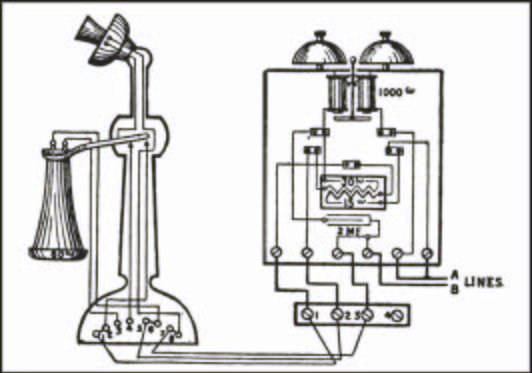
This telephone can also be connected to most of the standard GPO wooden wall telephones, which then allowed it share the wall telephones induction coil. Connections are the same as the Bellset No. 1. This telephone had all components finished in black. There were no transfers and all brass parts were painted. A hook could be fixed to the neck to support a Watch Receiver. The Transmitter No. 1 was replaced by the Transmitter No. 22 circa 1932. This gave superior transmission quality. The Rate Book of 1909 advises of a number of different variants:-
The later Mark 234 was superseded by the Mark 235 in 1911. The switch hook contact set consisted of three contacts that made contact with each other on operation and this was the newly introduced standard GPO switch hook that was insulated from the chassis. It was insulated from the chassis to prevent electric shock from power or tram cables touching the telephone wires in the street. The insulating bush inserted into the cable entry hole is made of Ebonite. Early table telephones were connected to the internal wiring with a Rosette or latter with a Strip, Flexible Cord Connection. Click here for more information. Many GPO Telephone No. 2's were converted, by the GPO factories division, to Telephone No. 150's after recovery from customers premises. This telephone was in the 1928 GPO Rate book but not available in the 1946 GPO Rate Book. The Telephone No. 2 superseded the Telephone No. 74 in 1914. The telephone has a rubber ring insert in the base plate to stop movement and damage to surfaces. These tend to decompose and break up, so a replacement is a 42mm length of 6mm of solid rubber tubing. Telephone included (1910, 1911, 1912, 1913, 1914, 1915 and 1928):- Superseded by Telephone No. 156LB in 1947. Supplied by British Ericsson, their Model No. CG1200. GPO Telephone No. 2A Telephone included (1946):- GPO Telephone No. 2B
Drawing - 62901 (Mark 235 dated 1911). Specification - D202. See also the Telephone Efficiency Committees Report on Common Battery Area telephones. Conversion to new style sockets Click here for pictures of a Candlestick before refurbishment Click here for Candlestick construction and how to dismantle the phone Candlestick Manufacturing (Messrs Keitmann) Collectors Information - what to look for Telephone mouthpiece sanitisers Telephone No. 2 (1909 onwards)
The exchange line is connected to Bellset Terminals L1 and L2. The "Golfball" Telephone
In 1901 there were two markets in the U.K. for the Golfball pedestal telephone, the General Post Office (GPO) and the National Telephone Company (NTC). How can you distinguish between the two types of Golfball? In the first version the GPO example had GPO engraved on the side of the open terminal receiver. The NTC example had a gold transfer of their name on the top of the black base.(3) On the side of the black base there was a second gold transfer Western Electric Co Ltd, Antwerp. Subscriber's Desk Set On 26th April 1882 the Bell Telephone Manufacturing Company (BTMC) was founded, and opened a factory in Antwerp in Belgium. Its ownership was shared between Bell and Western Electric. The BTMC factory quickly evolved a range of European phones to compete. In the earliest models, they used some parts brought in from other manufacturers until they could design their own versions. In other phones, they copied local styles. Most of these designs never made it back to the U.S., and are now uncommon. In particular, they developed their own desk sets long before the U.S.A. brought them into use. (1) BTMC produced various telephones. Around 1901 they mass produced a desk set and a wall set. These were to be the standard telephones used in the U.K. for many years to come. The Western Electric wall set has been covered previously in an article by Bob Estreich (2). The Western Electric Company Subscriber's Desk Set was given the nickname "Golfball". This was because of the bulbous section in the middle of the stem that housed the switching mechanism. From now this article will refer to the telephone as the Golfball. The first version of the Golfball had a switch hook arm that was open at the end. This design was the same as the switch hook arm, that appeared on U.S.A. telephones at that time. The Golfball manufactured in Antwerp, Belgium was only sold to the European market. The BTMC Golfball was in the BTMC Catalogue of 1912 and shows their Model 23589 which had a aluminium stem and a black enamelled base (13). In the factory photo (7) there could be as many as 1,000 Golfballs ready to go out for distribution. In the NTC brochure "The Universal Time Saver 1906", an article features the Golfball and Wall Set. (8) In another brochure Twentieth Century Telephone Service for Hotels and Residential Buildings 1907, (9) it states amongst others that the Golfball was supplied to the following hotels in London, such as The Russell, Hyde Park, Ritz, Savoy and Waldorf. In 1909 the NTC devised a coin-collecting box for use with the Golfball telephone. For use at large stores, to enable a counter pay service to be at the disposal of customers. The measurements of the box are 4" x 4" x 3". It is just sufficient to hold the pennies for one day's calls at a busy counter. The box has the NTC bell logo on the side. The brochure states that: "Between 400 and 500 have been fitted in London, and are serving their purpose admirably". (10)
In October 1909 the GPO supplied a telephone system to Harrods that gave them 214 extension circuits. Of these, 76 were Golfball counter telephones with special coin-collecting boxes that could be used by customers. (11) In the second version of the Golfball there had been a few minor changes. The GPO example no longer had GPO engraved on the side of the receiver, instead, it was engraved on the aluminium stem. For the NTC example the aluminium stem was painted black obliterating the GPO markings. NTC transfer was then added to the black base. The switch hook arm is now rounded at the end.
Golfball terminal block fitted inside base Golfball With Coin-Collecting Box The red GPO diagram book of 1909 (12) has diagrams for the Golfball No. 2 and the redesigned stem wired No. 2. It is thought that both designs were manufactured side by side for quite a few more years to come. The Golfball would have been in service for at least ten years if not even longer. During that period, many thousands of Golfballs would have been produced. The Post Office N-diagrams appeared in 1917. There was never an N diagram for a Golfball. Telephone engineers would have been issued with their new black book of N-diagrams but it is most likely that they still carried the red book of 1909 diagrams with them. It could be assumed that by 1917 the Golfball was being phased out.
References (1) The "European Bell and Western Electric Telephones", by Bob Estreich. (2) The "Western Electric Model 265" by Bob Estreich. (3) "National Telephone Company" Golfball, Wollaton Industrial Museum, Nottingham. (4) Practical Telephone Handbook, Poole 3rd edition, 1906 page 124. (5) "Western Electric Company" London, Catalogue, 1902 (front cover picture). (6) Practical Telephony, Bell & Wilson 4th edition, 1906 page 145. (7) Post Office Stores 1901, negative E266. B.T. Archives. (8) The Universal Time Saver, National Telephone Company, brochure, 1906 B.T. Archives. (9) Twentieth Century Telephone Service for Hotels and Residential Buildings, National Telephone Company, brochure, 1907, B.T Archives. (10) London and its organisation, National Telephone Company Journal, October 1909 page 137 and continued December 1909 page 179, B.T. Archives. (11) New telephone Installation at Harrods. I.P.O.E.E.J. 1910, Volume 3, page 137. (12) Connections of Telephonic Apparatus and Circuits. General Post Office, HMSO 1909. (13) BTMC Catalogue 1910. Minor additions have been made to the above article. Telephone No. 2
Telephone No. 2
GPO Model Number
GPO Year and Mark number
Additional Pictures
Western Electric advert showing Golfball
Golfball Advert 1905
GPO Holloway Factory, North London (Picture dated 1901)
GPO Golfball
Western Electric Candlestick
Golfball telephone at the Ritz Hotel in London
Golfball telephone at the Hotel Metropole in London
Golfball telephone at the Ritz Hotel in London
Golfball telephone at the Ritz Hotel in London
Golfball telephone at the GWR Hotel in London
|
||||||||||||||||||||||||||||||||||||
Last revised: June 29, 2026FM |
 When the
Post Office purchased the National Telephone Company (NTC) it continued to
use NTC telephones for a period of time. A few examples with G.P.O.
engraved on the upright stem of NTC pedestal telephones have been seen over the years,
the transfers having been removed. Many of
the early telephone books by Preece, Aitken and others show this type of
telephone as current subscribers apparatus and it is thought that these
Golfball candlesticks were generally just used in Europe.
When the
Post Office purchased the National Telephone Company (NTC) it continued to
use NTC telephones for a period of time. A few examples with G.P.O.
engraved on the upright stem of NTC pedestal telephones have been seen over the years,
the transfers having been removed. Many of
the early telephone books by Preece, Aitken and others show this type of
telephone as current subscribers apparatus and it is thought that these
Golfball candlesticks were generally just used in Europe.


 The Golfball was quite innovative. The solid back transmitter is hinged at
the top to a vertical rod, which can be pulled out about 1½ inches for
adjustment of height.(4) On some Golfballs there was a hook fitted directly
opposite the switch hook arm to take a watch receiver. This allowed a second
person to listen in on the telephone call. One of these appears on the cover of
the 1902 Western Electric London Company catalogue.(5) An image of how it is
wired is shown.(6) In the U.S.A. the Bell Telephone Company and Western Electric
Company decided that it would not be practical to export telephones and
switchboards to Europe. European manufacture was the solution.
The Golfball was quite innovative. The solid back transmitter is hinged at
the top to a vertical rod, which can be pulled out about 1½ inches for
adjustment of height.(4) On some Golfballs there was a hook fitted directly
opposite the switch hook arm to take a watch receiver. This allowed a second
person to listen in on the telephone call. One of these appears on the cover of
the 1902 Western Electric London Company catalogue.(5) An image of how it is
wired is shown.(6) In the U.S.A. the Bell Telephone Company and Western Electric
Company decided that it would not be practical to export telephones and
switchboards to Europe. European manufacture was the solution.